Thirteen sitting members of Parliament have taken sponsored trips to events hosted by organizations that are closely linked to an Iranian opposition group that was listed as a terrorist organization in Canada until 2012.
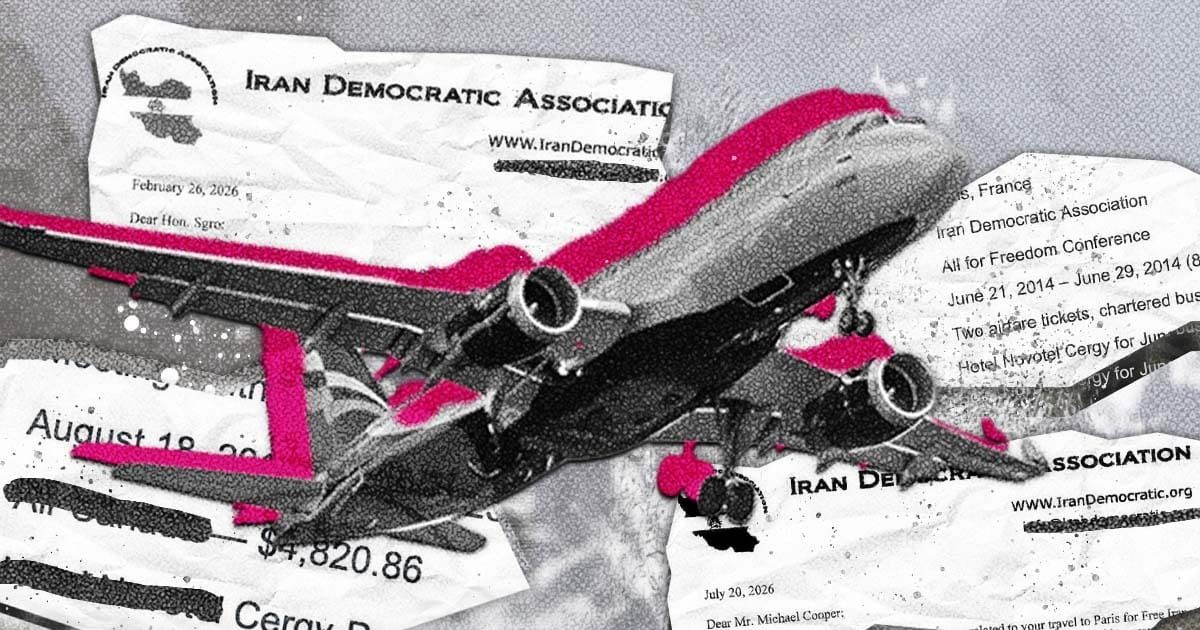
The trips, sponsored by the Iran Democratic Association (IDA) and in one case the National Council of Resistance of Iran (NCRI), took place between 2012 and 2026 and cost more than $86,000, according to publicly listed disclosures.
One of the trips, taken by Liberal MP Judy Sgro, took place six months before the Canadian government lifted the terrorist designation of the associated opposition group, the People’s Mojahedin Organization of Iran, more commonly known as MEK.
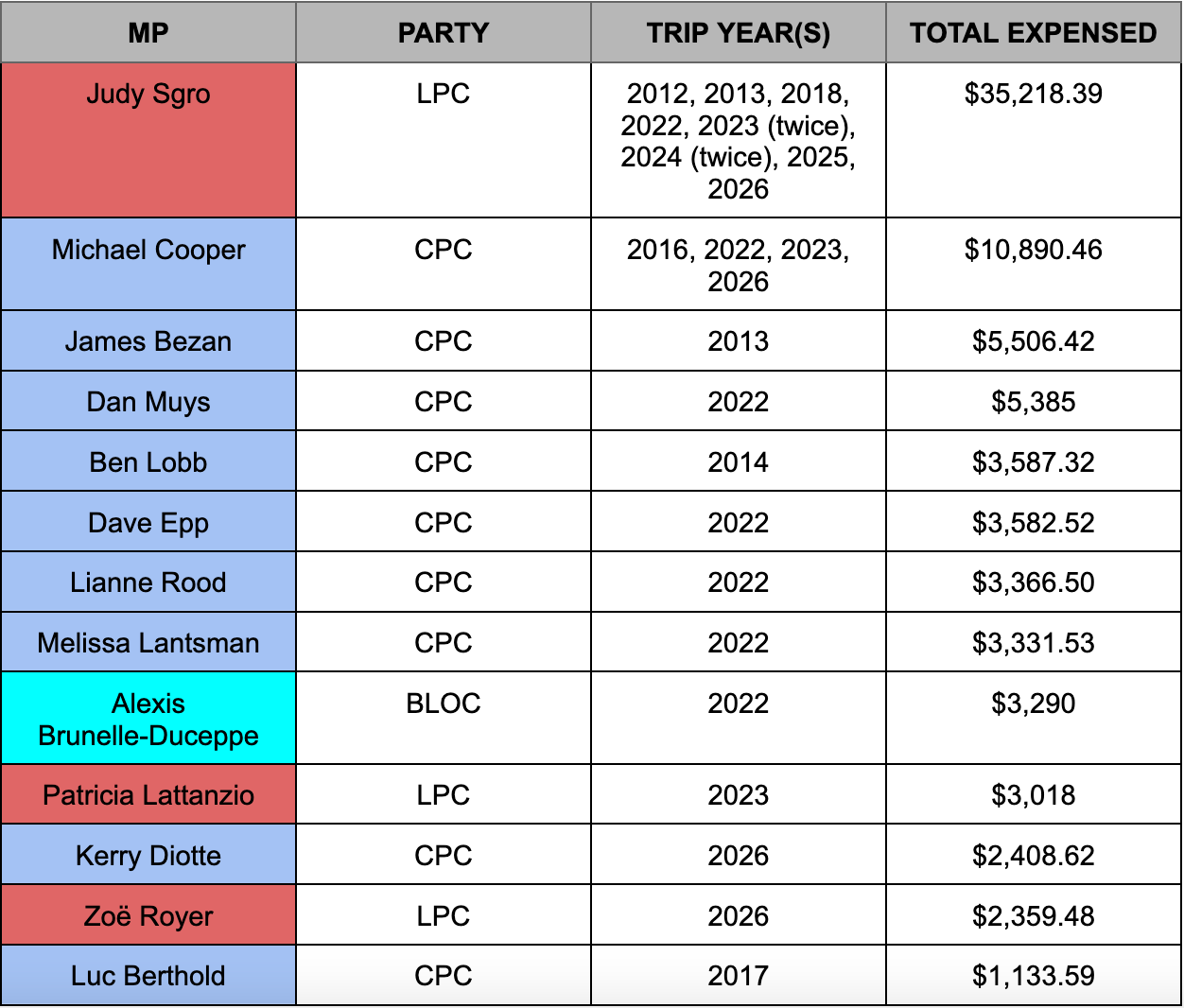
Nine Conservatives, three Liberals and one Bloc Québécois MP went on the sponsored trips. The most recent trips were taken by Conservative MPs Michael Cooper and Kerry Diotte, who both attended an IDA event in Paris in June.
The sitting MPs who have taken sponsored trips since 2012, listed in order of the total amount they expensed, are shown in the table below.
Most of the trips were taken to the annual “Free Iran Summit,” which attracts dozens of Western politicians as attendees and was recently described by the NCRI as “a powerful forum to validate the National Council of Resistance of Iran (NCRI) as the sole viable alternative to the current theocracy.”
Sgro and former Canadian foreign minister John Baird gave speeches at this year’s summit, which took place during the United States and Israel’s ongoing war on Iran.
The summit took place in June, but Sgro’s most recent IDA expense disclosure was filed for a women’s conference that she attended in February. In a video clip posted to X on March 1, Sgro delivered a speech in which she endorsed the NCRI’s political program.
There are currently no expense disclosures listed for Sgro’s attendance at the June summit.
Both the IDA and the NCRI are closely linked to MEK, and support the overthrow of the current Iranian government. Almost all of the trips were taken to France as well as Albania, where MEK is currently headquartered.
MEK is opposed by both the Iranian government, which categorizes it as a terrorist organization, and pro-Monarchist factions within the Iranian diaspora.
In 2023, self-described Iranian “crown prince” Reza Pahlavi said MEK have very little support inside Iran and are “very ill-perceived because of their terroristic past.”
The Iranian government, meanwhile, claims that MEK is responsible for the deaths of more than 17,000 Iranians over the decades of its existence.
Other critics have characterized MEK as a cult-like organization. A report published by the Rand Corporation in 2009 said: “An examination of MEK activities establishes its cultic practices and its deceptive recruitment and public relations strategies.”
During the 1970s and 1980s, MEK carried out attacks inside Iran, first against the Western-backed Shah of Iran and then against current government after it took power in 1979.
MEK also sided with Iraq during the Iran-Iraq War, which began in 1980. In 1992, dozens of MEK supporters stormed Iran’s embassy in Ottawa wielding sticks and hammers, according to reporting by The New York Times.
Canada’s announcement of its designation of MEK as a terrorist organization in 2005 noted the group was supported by Saddam Hussein’s government and is “even suspected of past collusion with the regime of the Taliban in Afghanistan.”
The Conservative opposition at the time criticized the Liberal government for “dithering” in its decision to list the group.
But the Stephen Harper government delisted MEK as a terrorist group in December 2012, following the lead of the U.S., which cited the group’s “public renunciation of violence, the absence of confirmed acts of terrorism by the MEK for more than a decade, and their cooperation in the peaceful closure of Camp Ashraf, their historic paramilitary base.”
In the U.S., MEK’s prominent supporters have included former Donald Trump advisor John Bolton and former New York City mayor Rudy Giuliani.
The Canadian government did not give any specific explanation for its decision to de-list MEK as a terrorist organization, but the measure was taken three months after Harper formally suspended all diplomatic relations with the Iranian government.
Bezan, a Conservative MP, told reporters in 2013 that he had been a “strong advocate for delisting the MEK as a terrorist entity” after visiting Iranian refugees in Iraq. He went on an IDA-sponsored trip to Paris seven months later.
All but one of the IDA-sponsored trips, taken by Sgro in June 2012, occurred after the Canadian government lifted MEK’s designation as a terrorist group. The Maple asked Sgro directly about this overlap of her IDA-sponsored trip and MEK’s terror designation, but did not receive any response.
The Maple contacted the other MPs mentioned in this story. Royer provided an emailed statement, which said:
“Canada does not endorse or support any particular Iranian group or political organization. The decision to place an entity on the terrorist listing is made based on the advice of our security and intelligence services, informed by evidence, intelligence, and thresholds outlined in the Criminal Code.”
The other MPs did not provide any responses.
On its website, the Ottawa-based IDA states that it supports “the 10-point platform of Iran’s opposition leader, Mrs. Maryam Rajavi,” a MEK co-leader.
Rajavi currently serves as “president-elect” of the NCRI, which was founded by MEK leaders and was described in a Politico article in March as “the U.S. branch of MEK’s political arm.”
In April, the NCRI published an article that included quotes from an NCRI official defending MEK, and has a page on its official website dedicated to describing MEK’s history and beliefs.
The Maple reached out to the IDA and NCRI for comment for this story, but did not receive any responses.