
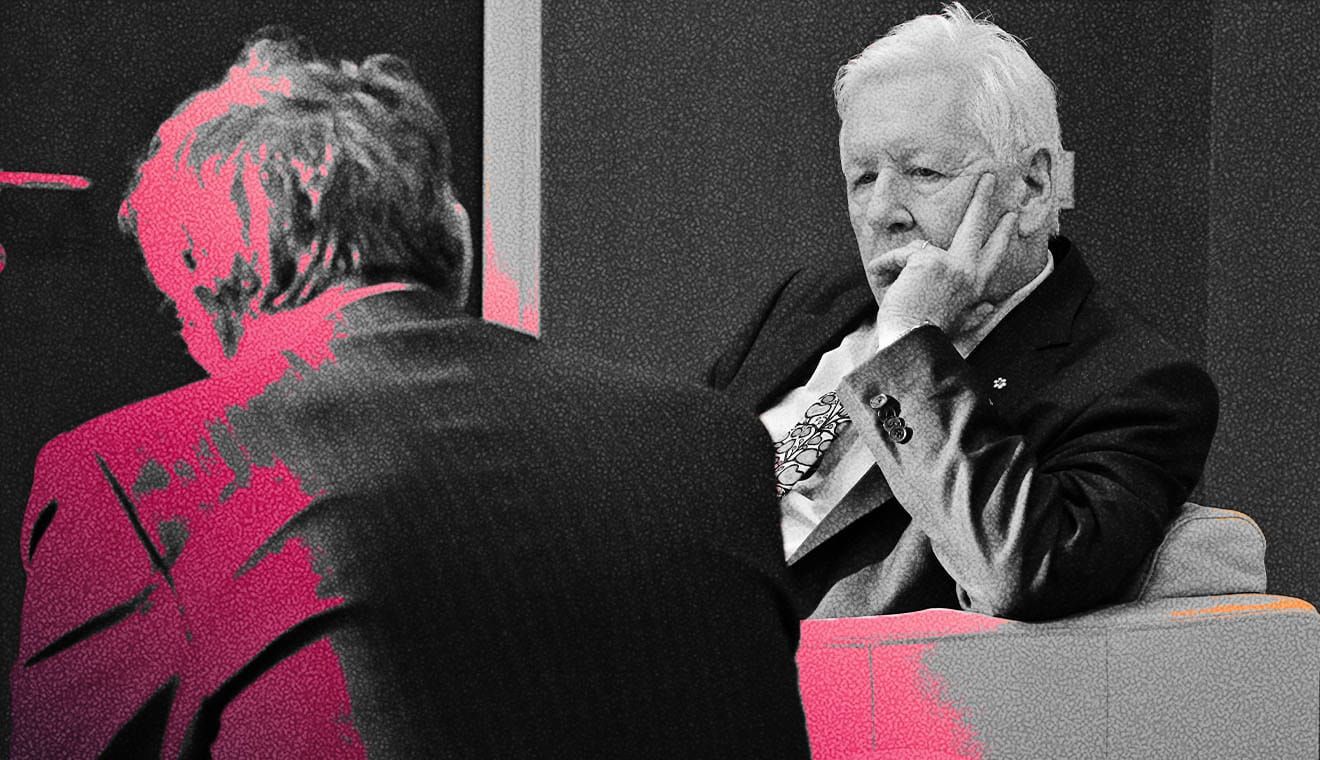
Former United Nations ambassador Bob Rae told a colleague he had his “wings clipped” for posting a tweet defending International Criminal Court (ICC) judges in the face of sanctions imposed by the United States earlier this year.
Records obtained by The Maple show that a Canadian diplomat based in Washington contacted Rae minutes after he posted the tweet.
On August 20, the administration of U.S. President Donald Trump announced it was sanctioning four ICC judges in order to “impose tangible and significant consequences on those directly engaged in the ICC’s transgressions against the United States and Israel.”
One of the four sanctioned judges, Kimberly Prost, is a Canadian. She was specifically targeted by the Trump administration for authorizing an ICC investigation into alleged crimes committed by American military personnel in Afghanistan.
Rae received news of this in direct messages obtained by The Maple through an access to information request. Rae wrote to Beatrice Maille, a legal advisor at Canada’s permanent mission to the UN, “I have tweeted. Enough is enough. We can’t pull our punches any longer.”
Rae had tweeted: “This attack on the International Criminal Court and its judges is disgraceful [...] Attacks on them by Russia, Israel and the US are intended to weaken and intimidate the international legal system.”
“They must not succeed,” he added.
But Rae quickly deleted the tweet. He wrote to Maille: “Getting my wings clipped.”
Other documents obtained by The Maple may provide some clues as to why.
Despite being almost entirely censored, documents released by Global Affairs Canada (GAC) show that Sara Cohen, deputy head of mission for foreign policy and national security at the Canadian Embassy in Washington, emailed Rae a few minutes after he tweeted.
Cohen was replying on an email thread that had the subject line “talking points/questions” and CC’d other Canadian diplomatic staff at the UN, the U.S., GAC’s Haiti division and the Organization of American States.
Over the course of approximately four hours, Rae and Cohen then privately exchanged several brief messages, nearly all of which were censored by GAC. The correspondence ended with Cohen writing: “Oh dear [redacted] Thank you for nudging.” Rae replied: “Count on me to nudge. And more.”
The Maple contacted the Canadian Embassy in Washington asking if its staff pressured Rae to delete the defence of the ICC over concerns it might upset the Trump administration. The embassy did not provide any response.
Because of GAC’s censorship of the records, it is not clear what the original email thread or Cohen’s messages with Rae said. The Maple specifically requested any communications regarding Rae’s tweet in defence of the ICC, and all of the documents were included in the release package.
The documents were censored under provisions in the Access to Information Act that allow federal departments to withhold information that concerns advice, consultations, or any disclosures which could “reasonably be expected to be injurious to the conduct of international affairs, the defence of Canada or any state allied or associated with Canada or the detection, prevention or suppression of subversive or hostile activities.”
Some of the records that were not censored show that not everyone was troubled by Rae’s defence of the ICC.
Later in the evening and on a separate email thread, Kristopher Yue wrote that an individual whose name was censored “was very happy to see Amb Rae’s tweet and is very thankful of the high level Canadian attention to this matter.”
Yue is a diplomat and legal advisor at the Canadian Embassy in the Hague in the Netherlands, where the ICC and Prost are based.
In September, Foreign Affairs Minister Anita Anand said she had “utmost confidence” in Prost, but made no comment about the U.S. sanctions. Prost told Al Jazeera earlier this month that the sanctions, which prohibit her from using credit cards and basic financial networks, were having a crippling affect on her life.
This week, Reuters reported that the Trump administration threatened new sanctions on the ICC unless the court promises not to investigate the president or his top officials, and drop investigations into Israeli leaders over their roles in the genocide in Gaza.
A Long History Of Attacks
The U.S. has been hostile to the ICC since the court’s founding in 2002. Under the presidency of George W. Bush, congress passed legislation called the American Service-Members’ Protection Act, otherwise known as “The Hague Invasion Act.”
The law allows the U.S. to use military force to extract any American or citizen of a U.S.-allied country — such as Israel — held by the court. The law was denounced by Human Rights Watch (HRW) at the time as “intended to intimidate countries that ratify the treaty” which founded the ICC.
The ICC is known as a “court of last resort” to pursue cases where national governments are unwilling or unable to investigate or prosecute crimes that take place under their jurisdiction.
Canada, unlike the U.S. and Israel, is a state party of the ICC.
In 2020, Prost, who has served as an ICC judge since 2018, was part of a unanimous decision to authorize the investigation of alleged war crimes committed in Afghanistan since May 2003, including by U.S. military personnel and members of the CIA.
The ICC’s chief prosecutor originally requested authorization to investigate in 2017, but was rejected in 2019 following threats and other intimidatory tactics against the court from the U.S.
The court’s rejection of the case prompted outrage from groups like Amnesty International, which said the decision abandoned the victims of the alleged crimes and weakened the court’s already questionable credibility. The 2020 decision overturned the rejection on appeal.
HRW has documented cases of ill-treatment and torture of detainees by American military and CIA personnel in Afghanistan since the U.S. occupied that country in 2001.
Canada joined the initial invasion of Afghanistan as part of Bush’s “global war on terror,” and formally withdrew in 2014. Canadian troops briefly returned to assist with evacuation efforts in August 2021, when Taliban forces seized power.
 Robert Hiltz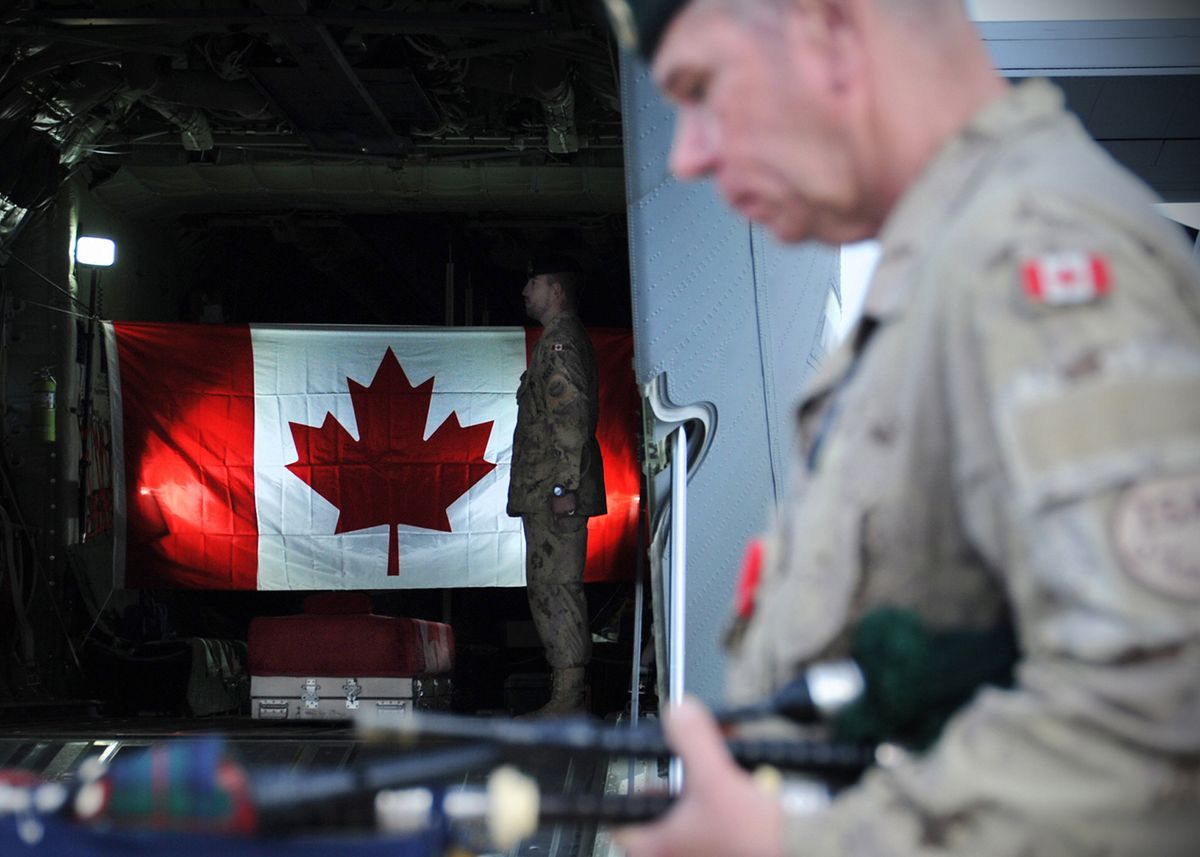
Despite not being named in the ICC case, Canadian forces are alleged to have been complicit in the torture and disappearance of Afghan detainees, and involved in killing unarmed civilians during Canada’s initial deployment.
When he was the Liberal Party’s foreign affairs critic, Rae gave an address calling for Canadian forces to extend their role in Afghanistan after their combat deployment ended in 2011.
Rae ended his tenure as Canada’s ambassador to the UN in November, having served since 2020. In an interview with CBC, he cited the Taliban takeover of Afghanistan, Russia’s invasion of Ukraine and Israel’s war on Gaza as memorable events that took place during his time in the role.
The interviewer noted that Israeli Prime Minister Benjamin Netanyahu, a fugitive war criminal with an ICC arrest warrant over his head, criticized countries, including Canada, for recognizing the State of Palestine in September. Dozens of diplomats walked out during Netanyahu’s speech, but Rae remained seated.
Rae told CBC: “I felt that it was important for Canada to be in the room, and I felt it was for us to listen to what he was saying. I disagreed strongly with much of what he said, but I thought that to simply join a walkout was not where Canada should be.”
Despite Rae’s disagreements with Netanyahu, it took Canada months to support a resolution at the UN General Assembly calling for a permanent ceasefire in Gaza. Canada had continued to authorize new military export permits to Israel during the first three months of the genocide.
Since leaving his role, Rae has written multiple articles contemplating current geopolitical uncertainties and his time as UN ambassador.
In Policy Magazine, he wrote that when he entered the role, “I’d been accustomed for years to speaking my mind, including to the media, and it would be an adjustment balancing that outspokenness with the demands of diplomacy.”
The Maple attempted to contact Rae for this story, but received no response.