Canada’s major media outlets have overrepresented proponents of a massive fighter jet deal between the federal government and American arms company Lockheed Martin, an analysis by The Maple has found.
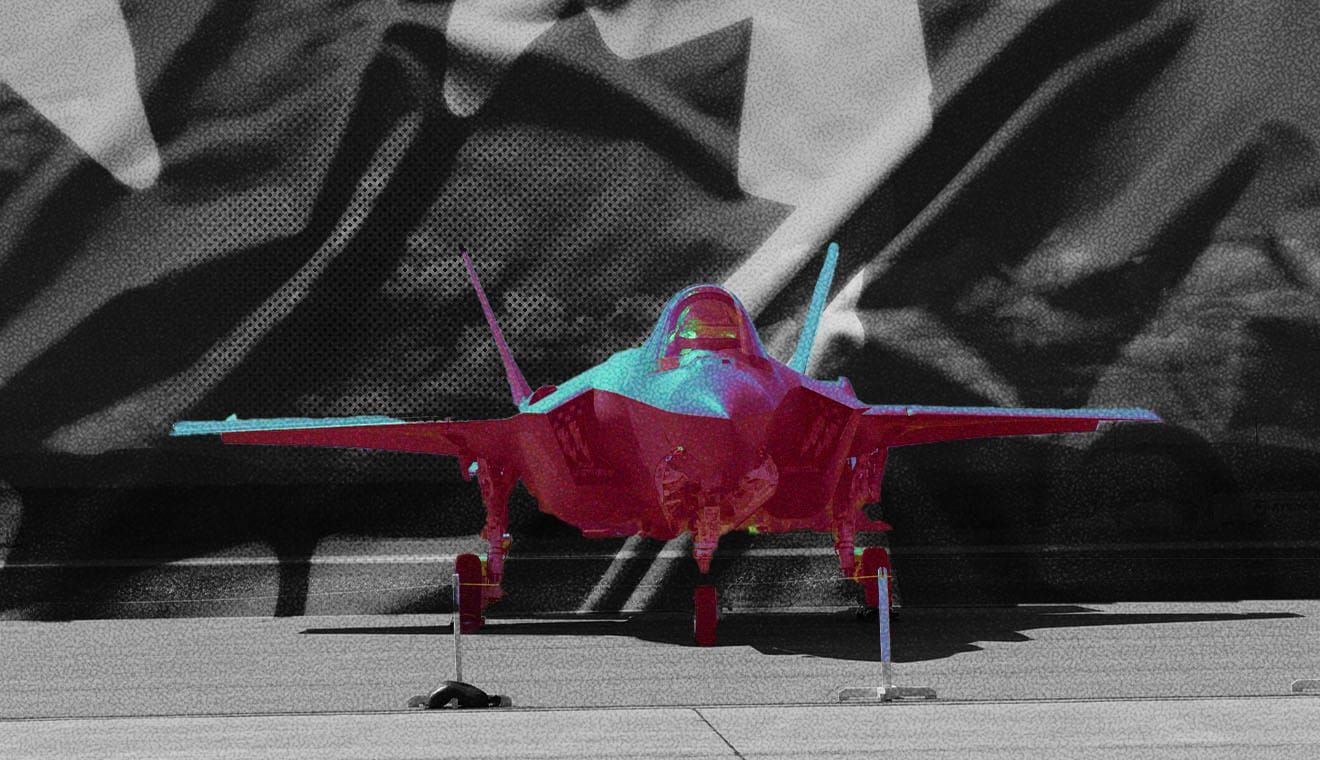
Under Justin Trudeau, the federal government announced the deal for 88 F-35 jets, which would carry an estimated lifetime cost of nearly $74 billion.
Prime Minister Mark Carney, however, threw the deal up in the air in March 2025, announcing that while Canada had already paid for 16 F-35s, the government would review whether the additional 72 jets were needed.
The decision to undertake the review came following U.S. President Donald Trump’s repeated threats to turn Canada into the “51st state” and his imposition of steep trade tariffs.
Now, it appears the Carney government is putting down funds to buy just 30 F-35s from Lockheed Martin.
The Maple analyzed 55 news articles and columns published by CBC News, the Toronto Star, The Globe and Mail and National Post about the F-35 purchase since Carney announced his government’s review of the deal.
Champions of the deal were quoted 41 per cent more often than critics.
Steven Staples, founder and vice-president of the board at the Rideau Institute, said he wasn’t surprised by The Maple’s findings.
“You just can’t underestimate the power of the defence lobby to mobilize experts, academic researchers that they fund, military leaders who hope to retire early and work for defence contractors at some point, or even just ideologically aligned people in government or in the national security establishment who really have a great allegiance to working closely with the United States,” he said.
The Maple only included articles that explicitly focused on Canada’s procurement of fighter jets. Articles that focused on the benefits that either Lockheed Martin or its main competitor, Saab, could bring to Canada were also included.
In the articles, 22 of the quoted individuals spoke 41 times in favour of Canada going through with the full order from Lockheed Martin.
Six of those quoted are current or former members of the military, six work for Lockheed Martin or one of its F-35 program suppliers, and four are associated with think-tanks that have received funding from Lockheed Martin.
One of the former military officials, former chief of defence staff Tom Lawson, previously consulted for Lockheed Martin a year after leaving the military, according to his LinkedIn page.
Sources who were categorized as against or critical of the deal included Saab’s CEO, who stands to benefit if Canada orders fighter jets from his company instead, and findings by the Auditor General, who is neutral but whose studies into the costs of the F-35 purchase were often cited in criticisms of the deal.
In an email to The Maple, a spokesperson for Lockheed Martin said the company does not expect think tanks to promote its interests, regardless of whether or not it provides them with funding.
“We maintain relationships with think tanks around the world, providing up-to-date information about Lockheed Martin’s programs to inform their in-depth research and reporting,” the spokesperson wrote.
The media’s tilt towards Lockheed Martin is out of step with the views of the broader public. In a poll conducted last March, 62 per cent said Canada should scrap the entire deal.
Carney’s review of the original order sparked a public relations push by the U.S. ambassador and the Canadian military, which has reportedly wanted F-35s from the very beginning.
A few weeks after Canadian company Bombardier said it was exploring the possibility of building fighter jets with Saab in Canada, a document was leaked from the Department of National Defence (DND) to CBC/Radio-Canada.
The document showed the F-35 beating Saab’s Gripen jet in categories like “upgradability” and “mission performance,” which, as an article in The Walrus pointed out, were never defined.
Around the same time, reports about a letter from a dozen of former Royal Canadian Air Force officials pushing Carney to choose the F-35 were also leaked to CBC/Radio Canada.
A Hefty Price Tag
Lockheed Martin’s F-35 is among the most expensive fighter jets ever made. Acquiring 88 of the planes would cost Canada $27.7 billion, plus another $5.5 billion for extras like upgrading essential infrastructure and advanced weapons, the Auditor General said in a report tabled in June.
Separately, the Parliamentary Budget Officer published a report in 2023 that found the total lifetime cost of the jets would be close to $74 billion. That estimate is much higher because it includes the costs of operating and sustaining the jets for decades to come.
The planes can fly at supersonic speeds, have stealth capabilities and can carry thousands of pounds of weapons.
“It’s a bomb truck. That’s what it is,” said Staples, who has written about the F-35 for the Canadian Centre for Policy Alternatives.
“It’s designed to go in over the beaches in the first or second wave of an attack on another country, to deliver bombs to its target.”
“I know some have argued that it has other support roles and things like that, but really that’s its main purpose, and it’s really not something that we need,” he said.
Lockheed Martin’s spokesperson said the jets were designed for “air-to-air combat” and “air-to-ground strikes,” as well as electronic warfare and reconnaissance.
“It defends coastal and Arctic frontiers by detecting, tracking and engaging threats while avoiding detection through inherent stealth features,” the spokesperson’s statement said.
“The F-35’s unprecedented ability to combine battlefield intelligence and technology and share it instantaneously across every domain—land, sea, air, space, cyber—gives it an overwhelming edge in capability over the alternatives.”
Vulnerable To U.S. Interference?
One of the deal’s major critics is Alan Williams, a former DND procurement official. He’s pointed out that F-35s rely on software from the United States — and updates may be withheld if Trump or a future U.S. president is angry at Canada.
“That’s been one of the problems with it, for sure, that they control the source code,” Williams told The Globe and Mail last year. “They have intellectual property rights, and it’s not shared. And if you want to upgrade, they’re the ones that do it.”
Lockheed Martin’s spokesperson said that as part of the company’s contracts with foreign governments that buy F-35s, all necessary data and infrastructure are delivered.
Another concern is that the purchase will further integrate the Canadian and U.S. militaries at a time when the U.S. president is threatening to annex Canada.
Trump has specifically said the U.S. may “tone down” the capabilities of future jet models it sells to allies by 10 per cent because, “someday, maybe they’re not our allies.”
Additionally, the spare parts for F-35s are owned by the U.S. until the moment they’re installed, meaning any spare parts in Canada could be seized by the U.S. Last year, the U.S. took spare parts from Denmark and transferred them to Israel.
Staples also pointed out that there have been problems with F-35s in cold temperatures.
An American pilot had to eject from an F-35 over Alaska in January 2025 because hydraulic lines in the jet’s nose and landing gears were clogged with ice. He spent 50 minutes on the phone with Lockheed Martin engineers, who couldn’t fix the problem, while he was still flying.
The pilot wasn’t seriously injured, but the $200-million USD plane crashed and exploded into a fireball. The temperature at the time was about -18 Celsius.
“I think it’s quite prophetic for Canada,” said Staples, “because one, it exposed how ill-suited it was to cold temperatures, and the fact that the pilot had actually called engineers at Lockheed Martin to try to get it fixed, and they couldn’t repair it.”
In response, Lockheed Martin said that the F-35 is regularly used for Arctic patrol missions by countries like Norway and Denmark.
“The F-35 has performed extremely well in all extreme weather testing conditions, including a variety of icy conditions like freezing rain, ice clouds and -40-degree temperatures,” the statement said.