
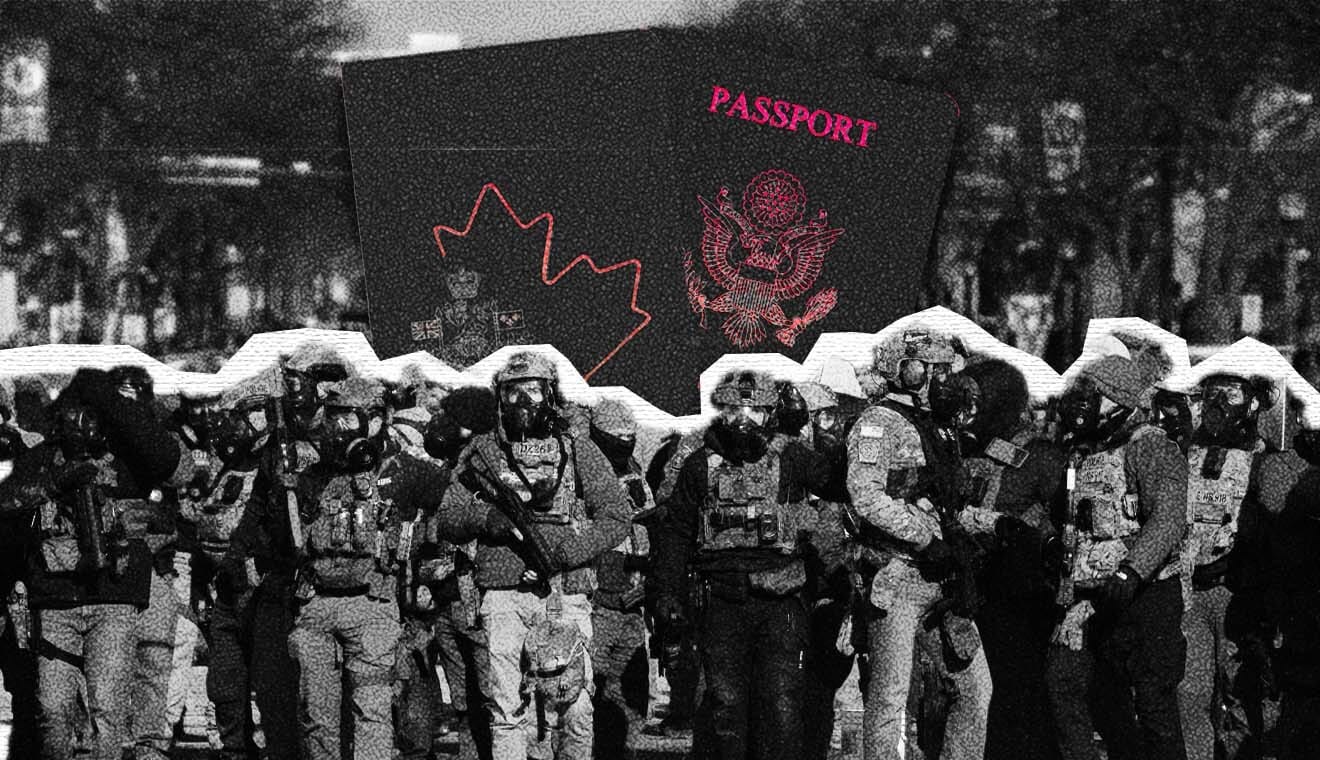
Neither the Canadian government nor the United States Immigration and Custom Enforcement (ICE) agency keeps track of how many Canadians might be employed as ICE agents, according to government statements.
An international human rights lawyer says that’s a problem, and is calling on the Canadian government to require citizens serving in any foreign military or law enforcement agency to first obtain permission to do so, and then be interrogated when they return to Canada.
Mark Kersten, an expert in international law and a professor at the University of Fraser Valley, told The Maple: “It’s in our interest to know what citizens are doing, but it’s also in our interest in terms of national security and public security.”
“If there are people engaged in a paramilitary branch of the United States, of the Trump administration, and potentially committing crimes or engaging in criminal conduct, it’s critically important that the Canadian government know about that.”
ICE, which serves as the vanguard of President Donald Trump’s brutal roundup of immigrants, has come under increasing scrutiny after federal agents recently shot and killed two American citizens in Minneapolis.
In the first incident, ICE agent Jonathan Ross shot Renee Nicole Good, a 37 year-old mother, three times as she attempted to turn her vehicle away from Ross.
More recently, federal agents shot Alex Jeffrey Pretti, a 37 year-old ICU nurse, at least 10 times after he attempted to help a bystander who had been thrown to the ground and pepper sprayed by another agent.
Before he was shot, Pretti was pinned to the ground by several agents, one of whom removed a holstered firearm that Pretti was legally permitted to carry, according to U.S. news reports.
The execution-style killings sparked outrage across the world, and renewed scrutiny on Canada’s relationship to ICE and the U.S. Department of Homeland Security (DHS).
In December, The Independent reported that ICE planned to spend $10 million on 20 armoured vehicles made by Roshel, a Brampton-based company. ICE later said the vehicles would be produced in the U.S. under “Buy American” provisions.
Vancouver-based tech company Hootsuite, meanwhile, has reportedly provided social media services to the DHS, of which ICE is a part.
This week, The Canadian Press reported that DHS wants to buy a warehouse in Richmond, Virginia from a real estate company owned by the British Columbia-based Jim Pattison Group to use as an ICE “processing facility.” ICE also operates dozens of international offices, including five in Canada.
What is not currently known, however, is how many Canadian citizens — if any — are currently employed as ICE agents.
ICE’s employment guidelines require that applicants be U.S. citizens and have lived in the U.S. for the past three years (unless serving in the military or a federal job overseas). But the agency does not explicitly prohibit employing individuals who are also citizens of other countries.
Approximately 800,000 Canadians currently live in the U.S., according to Global Affairs Canada (GAC). At least 200 Canadians, including children, spent time in ICE custody last year.
In response to an emailed question from The Maple, an ICE spokesperson said data about the dual citizenship of its agents was not readily available, and would require a freedom of information request for details about each employee’s file.
The Maple emailed the CBSA, GAC and Public Safety Canada (PSC) asking if the federal government keeps track of how many Canadians might be serving in ICE or other DHS agencies. The departments confirmed they do not track such information.
There are no laws that prohibit Canadians from working for an American law enforcement agency. The Foreign Enlistment Act, originally passed in 1937, prohibits Canadians from fighting in any military formation that is at war with a friendly state or involved in a conflict where Canada is officially neutral.
Kersten said service in both foreign militaries and law enforcement agencies should be tracked and investigated. This should apply, he added, regardless of whether or not Canada supports the foreign entity or agency that its citizens might be serving in.
“It should be universally applied that when they come home, when they return to Canada, that they go through a process of interviews where they articulate what they did, with whom, and also that they are asked about any evidence of wrongdoing that they may have witnessed, so human rights violations or war crimes or crimes against humanity, or just criminal activity in general.”
Kersten emphasized that it does not make sense to apply restrictions on Canadians serving in foreign militaries but not in law enforcement agencies.
“I can’t see what the logic would be to say that holds true if you’re a Canadian citizen going abroad to fight for a foreign military, and yet doesn’t hold true if you’re a Canadian citizen and you’re going to participate in the law enforcement of a different country’s criminal code or immigration rules, or whatever it is.”
“When you return, you should go through some process so that Canada understands what you have done, what you’ve been engaged in, and has a record of of that.”
In most cases, he said, this process wouldn’t cause any issues. It is unlikely that the federal government would find problems with most Canadians serving in a foreign legion in the Ukrainian Armed Forces, for example.
Kersten said the affect such restrictions might have on Canada’s relations with the U.S. are a valid consideration, but noted that the Trump administration has found reasons to pick fights with Canada regardless of what the Canadian government does or doesn’t do.
“[ICE] is a paramilitary wing of a fascist government, and it behooves Canada to take that fact as seriously as it possibly can,” said Kersten.