
Canada’s controversial Memorial to the Victims of Communism will not include the names of alleged victims of communism, per a statement from Canadian Heritage spokesperson Caroline Czajkowski.
Historians, journalists and other experts have warned since 2021 that a list of names submitted for commemoration on the monument included suspected war criminals, Nazi collaborators and members of wartime fascist groups.
“The Government of Canada has emphasized that all aspects of the Memorial to the Victims of Communism must align with Canadian values of democracy and human rights,” wrote Czajkowski in a statement. “The Wall of Remembrance will now solely feature thematic content that conveys the broader commemorative and educational intent of the Memorial.”
Czajkowski added that there is “no set timeline for the completion of the thematic content” and that the heritage department will continue to collaborate with project sponsor Tribute to Liberty “to ensure the Memorial remains a respectful and inclusive place of remembrance and reflection.”
Canadian Heritage did not provide any further details about what the thematic element will consist of.
Canadian Heritage’s statement was first reported by the Ottawa Citizen.
Tribute to Liberty was responsible for preparing the list of alleged victims, which were compiled as part of a fundraising effort over several years.
The Maple reached out to the organization’s board chair, Ludwik Klimkowski, for comment, but received no response.
According to Czajkowski, Tribute to Liberty is expected to independently develop an educational program related to the monument.
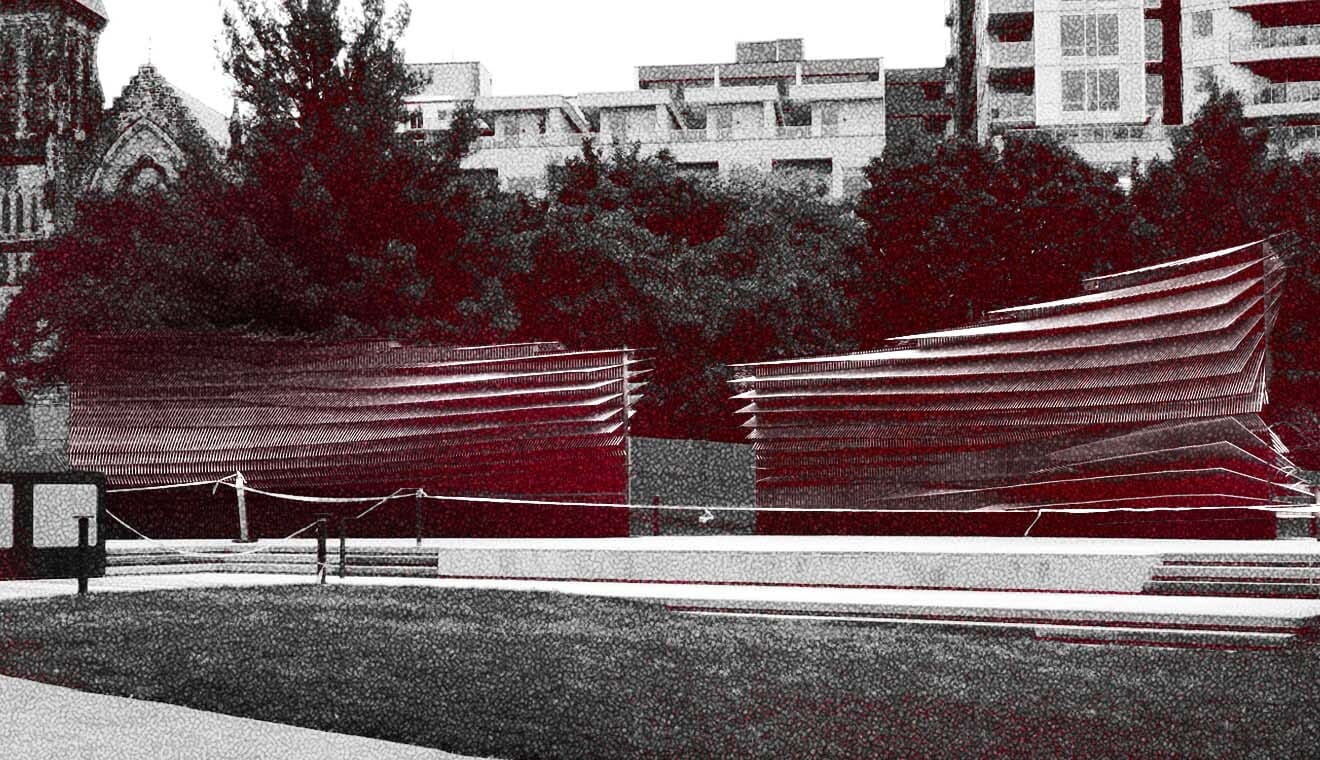
The monument was unveiled on Dec. 12, 2024 in a small private ceremony after a more than one year-long postponement.
The monument’s “Wall of Remembrance” was not complete at that time, with black panels covering the space where the names of alleged victims of communism were to be included.
Stephen Harper government cabinet ministers Jason Kenney and Chris Alexander announced funding for the monument on Black Ribbon Day in August 2013.
Canadian Heritage told The Maple that Kenney, but not Alexander, was invited to the unveiling ceremony. The department added that no members of Parliament were present.
During the ceremony, a protester shouted “No Nazis” after Klimkowski referenced the fact that no names had yet been unveiled on the Wall of Remembrance.
Also during the ceremony, Klimkowski indicated that the nameplates would be affixed to the Wall of Remembrance in 2025 and that there would be another public dedication once the monument was completed.
But a spokesperson for former heritage minister Pascale St-Onge said the government was still conducting its due diligence on the matter and had not committed to a timeline.
Parliament Scandal Caused Delay
As The Maple reported in October 2023, Canadian Heritage said the monument’s unveiling was postponed so that the department could conduct an additional review to ensure the monument was compatible with Canadian values.
In February 2024, Ottawa Citizen reporter David Pugliese obtained documents through an Access to Information request that showed the unveiling was actually postponed in part due to the fallout from the scandal surrounding Parliament’s standing ovations for Yaroslav Hunka, a Ukrainian Waffen-SS veteran.
In October 2024, the Ottawa Citizen reported that St-Onge’s office could not commit to ensuring no Nazis would be commemorated on the monument.
As reported in Ricochet, the name of at least one Nazi collaborator, Janis Niedra, had been engraved on a nameplate and affixed to the monument before the unveiling was postponed.
Sandra Richards, a Canadian Heritage project manager, noticed the name had been attached to the Wall of Remembrance during a site visit.
An email thread obtained by Ricochet through Access to Information revealed that Richards and several other Canadian Heritage officials were aware of Niedra’s name and that there was an agreement in principle that Niedra’s name would be excluded from the commemoration.
The nameplates had been engraved prior to Canadian Heritage completing its vetting of the names slated for commemoration.
Exactly how many Nazi collaborators and suspected war criminals were recommended for commemoration is not clear. Some problematic names continue to be found on Tribute to Liberty’s website.
Bradley Towle, a freelance journalist and public history graduate student at Empire State University, recently noticed “All Forest Brothers” were listed for commemoration.
The term applies to a broad collection of fighters across the Baltic states who resisted the Soviet Union in the immediate aftermath of the Second World War.
Although the exact composition of the fighters is difficult to determine, at least some of the members are known to have been drawn from the ranks of Nazi collaborators and some who participated in the Nazi Holocaust.
“One thing that stood out to me while researching the memorial is that the deeper you look, the more problematic it becomes,” wrote Towle in a statement to The Maple.
“Eastern Europe in the late 30s and early 40s was an absolute hellscape, and there were undoubtedly names of individuals from that region who would have been worthy of remembrance.”
Earlier Warnings
As previously reported by The Maple, an expert warned Canadian Heritage that the monument’s Wall of Remembrance could honour Nazi collaborators as early as January 2021.
The Maple also learned that Canadian Heritage had contacted University of Ottawa historian Jan Grabowski in April 2023 asking for help to review the commemorative list.
In an April 2024 interview, Grabowski told The Maple that he had heard criticisms and concerns “about the monument being a ‘countermeasure’ to the [National Holocaust Monument], about the need to ‘elevate’ the suffering of the victims of communism to the level of the Holocaust.”
Grabowski said scholars refer to this as “Holocaust envy.”
Emails recently obtained by The Maple through Access to Information show that Klimkowski compared the publicity efforts surrounding the unveiling of the Victims of Communism monument with the ceremony that accompanied the unveiling of the nearby National Holocaust Monument.
“I did not get any updates on the communication strategy nor on the location and time for our reception,” Klimkowski wrote to several Canadian Heritage employees in an email dated Nov. 29, 2024.
“I was one of your guests for the Holocaust Memorial unveiling. This one looks very, very different.”
The Maple asked Klimkowski about this message, but received no response.
In a statement to The Maple, Independent Jewish Voices (IJV) said that while they were relieved by Canadian Heritage’s decision to not include the names, the matter highlights a deeper problem.
“It’s time for Canadian Heritage, and the federal government more broadly, to seriously reflect on why it was even possible for individuals implicated in the persecution of Jews and other victims of fascism to have been considered for commemoration in the first place,” wrote Iso Setel, an IJV spokesperson.
“If Canada wants to be serious about fighting antisemitism, our government has to stop glossing over our own history of admitting Nazi collaborators after the war, and stop working with groups that try to whitewash that legacy by building memorials in their name.”
With far-right politics on the rise around the world, including in Canada, Setel wrote that now is the time for Canadians to think critically about the roles that commemorations play in shaping public memory and consciousness.
“We need to take a firm and consistent stand against initiatives that whitewash genocide or rehabilitate the memories of those who carried it out, be it past or present,” wrote Setel.
“We hope that this decision brings about a long-term commitment to ensuring that public commemorations are not used to valourize those responsible for atrocities.”
Per Anders Rudling, an associate professor of history at Lund University in Sweden, wonders whether the government’s retreat on adding names to the monument doesn’t make a strong case for greater transparency on Canada’s war criminals file.
A list of suspected Nazi war criminals was compiled in the mid-1980s by the Deschênes Commission.
The second part of the Deschênes Commission’s final report remains classified, despite renewed calls for it to be released in the wake of the standing ovations for Yaroslav Hunka in Parliament.
Canadian Heritage said its employees do not have access to the Deschênes Commission’s final report, and emphasized that it commissioned experts to review the proposed list of names to be featured on the monument.
“If there are names that are so compromised that they should not be on this monument, would it not be in the government’s interest to provide full and unfettered access to their files, 80 plus years after the Holocaust?,” wrote Rudling in a statement to The Maple.
“All these recurrent scandals – does it not occur to the government that perhaps because of all this secrecy candid research on these issues is so difficult?”
“Should they wait 100 or 120 years after the Holocaust, to make sure that all potential war criminals are very dead, so that they’d be on the safe side and they won’t, by mistake, stumble across any last perpetrators? It is so odd.”