
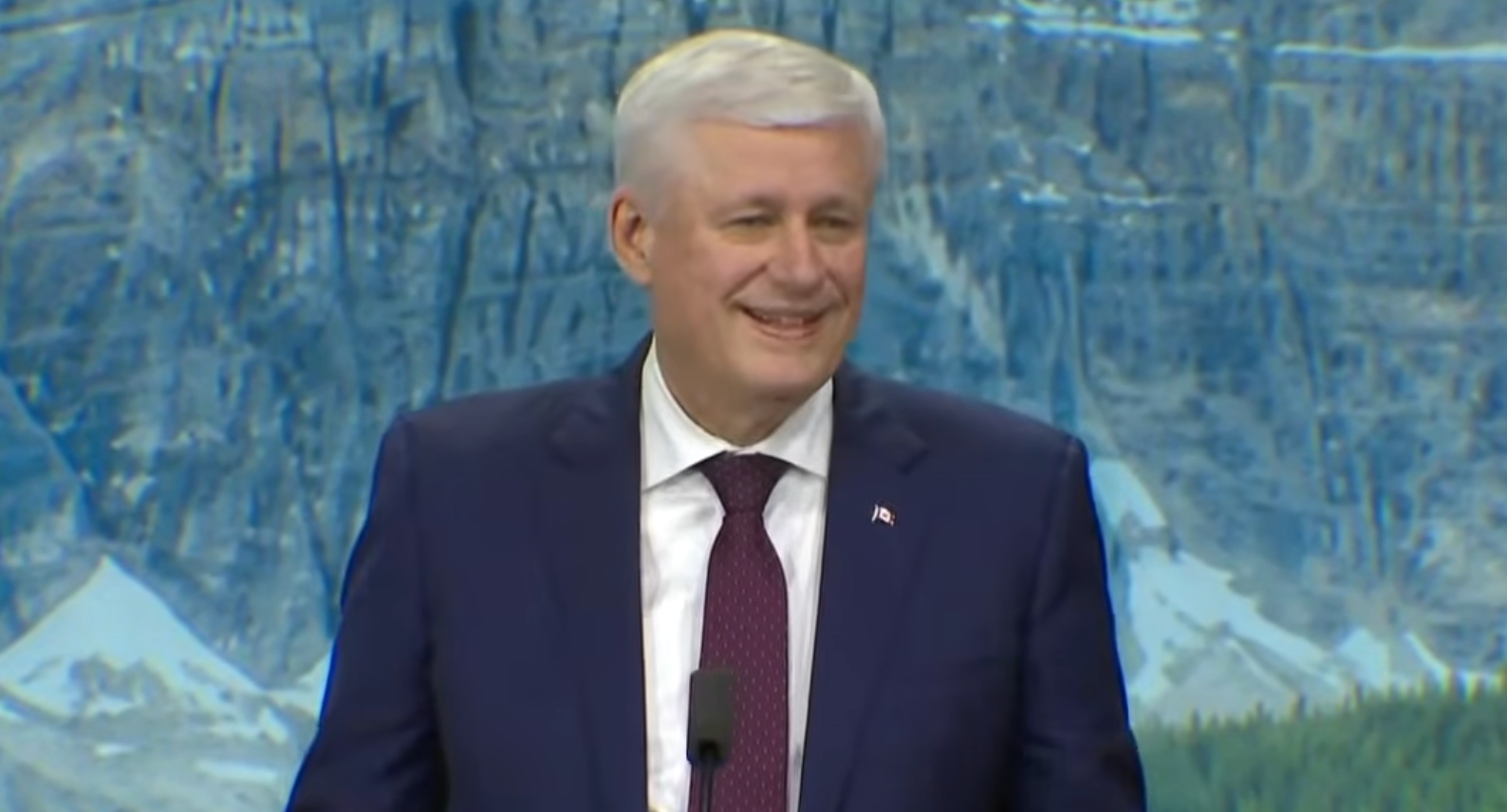
Former Conservative prime minister Stephen Harper was so impressed with Mark Carney’s Canada Investment Summit that he told attendees Tuesday he wishes he came up with the idea himself.
In a closing speech delivered to the summit in Toronto, Harper said: “I congratulate the federal government for holding this conference. I believe the first of its kind in Canada. It is such a great innovation that I wish I had thought of it.”
The former Conservative prime minister and current chair of the Alberta Investment Management Corporation said he believes Canada was poised to become an “energy superpower” in 2015, but that changed because of policies enacted under the Liberal government of Justin Trudeau.
However, he praised the Carney government during his speech.
“I do congratulate our current federal government on the measures it has taken to fast-track major project approvals, especially for projects in the oil sands. These changes are welcome and they are very important.”
He added: “More does need to be done. The burdens and restrictions that do not exist elsewhere simply must be removed in Canada.”
“I believe that Canada’s new government is committed to further reforms in these areas and committed to their urgency.”
During the summit, the Carney government said it is looking to bring a total of $1 trillion in new investments into the Canadian economy over the next five years.
During a press conference Tuesday, David Reevely from The Logic noted that some of the corporate leaders who attended this week’s summit control a significant portfolio of American capital.
The reporter asked Carney how American investment in Canadian infrastructure would help shore up Canadian sovereignty.
Carney said: “Just under 80 per cent of our trade with the United States is still tariff free. So there still are deep ties. There’s still aspects there.”
“American capital is welcome here to help build this economy.”
The prime minister emphasized that other investors would come from elsewhere as well as from within Canada. He added that “about half” of the total investment target would come from the private sector, alongside investments from federal and provincial governments.
This week’s summit resulted in “nearly $500 billion in new investment commitments to Canada,” according to a press release from the Prime Minister’s Office (PMO).
The Maple contacted the PMO for further comment on Carney’s stated investment targets, but did not receive any response by publication time.
Attendees at the investment summit reportedly included Larry Fink, chairman of the U.S.-based investment firm BlackRock Inc., and leaders from major Canadian corporations.
Also present were leaders from some of Canada’s largest pension funds, including the Canada Pension Plan and the Public Sector Pension Investment Board.
According to a summit prospectus obtained by CBC News earlier this week, investment opportunities that were presented to attendees included: 42 conventional and clean energy projects, 63 in mining and metals, 16 in port infrastructure, 11 in power and utilities, 10 in digital technology, 19 in manufacturing and six transport projects.
During the summit, Carney sought to entice new investment by announcing plans to sell off Canada’s four largest airports (Toronto-Pearson, Montreal-Trudeau, and Vancouver and Calgary international) and to introduce major tax breaks for investments in new projects.
Carney announced that his government would be slashing Canada’s marginal effective tax rate on new business investments from 13 per cent down to 6.4 per cent.
A coalition called “The Many vs. The Money Network” protested the summit, and released a statement Tuesday warning that Carney was advancing a “privatization fire sale for the super rich.”
“This is not nation-building; it is a corporate asset grab. The federal government is setting up a rigged system where the public absorbs all the financial, environmental, and operational risks while private capital extracts all the profit,” the coalition said.
Carney’s welcoming of new American capital comes amid a protracted trade war with the U.S. along with President Donald Trump’s repeated threats to turn Canada into the “51st” American state.