
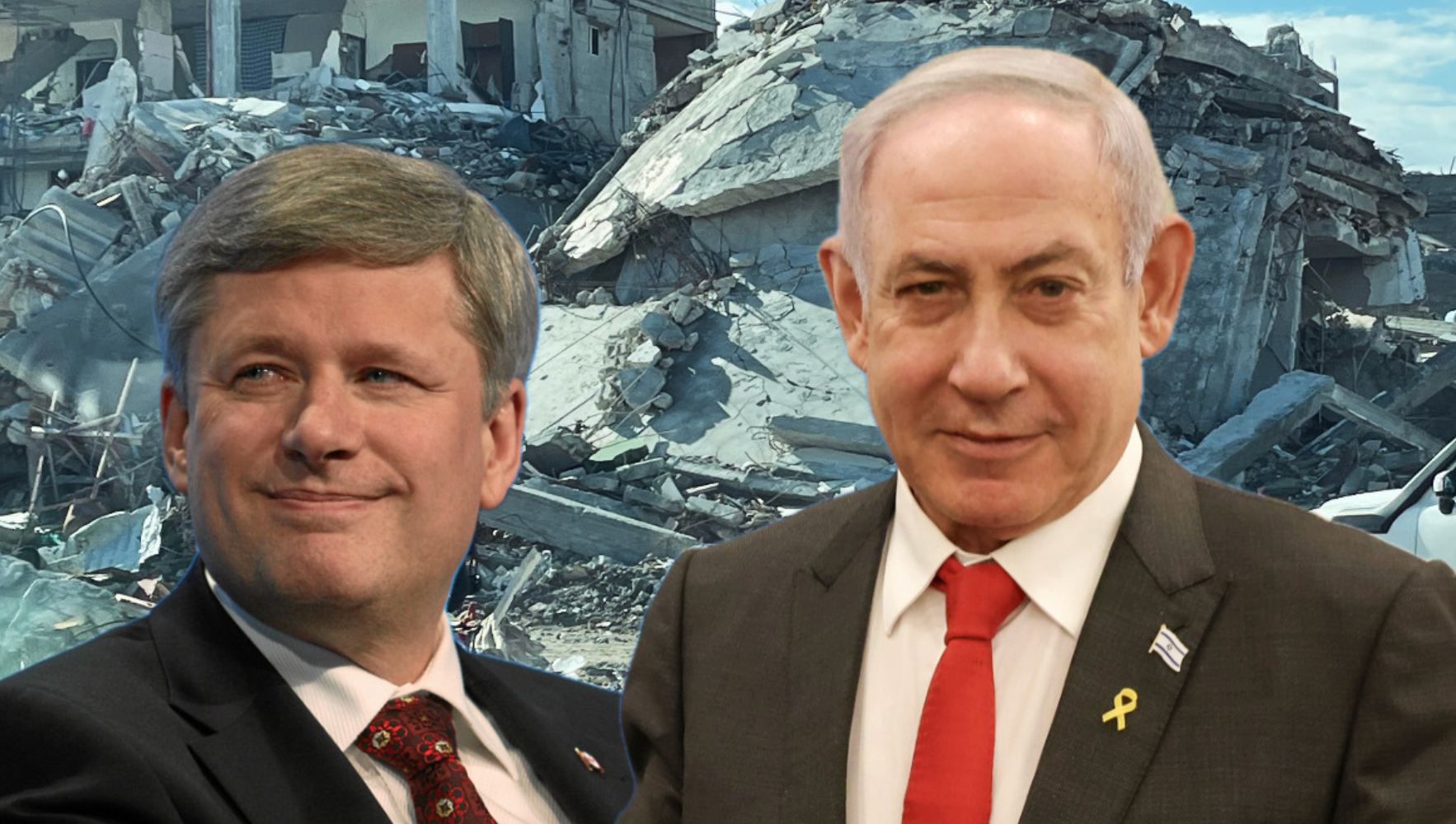
Former prime minister Stephen Harper lauds Israeli Prime Minister Benjamin Netanyahu as “probably the smartest, best-read, most-articulate foreign leader I have met” in his newly published memoir, Here for Canada.
Netanyahu, a wanted war criminal and leader of Israel’s genocide in Gaza, has long been a close ally of Harper. The two solidified closer ties between Canada and Israel when both leaders were in office from 2009 and 2015.
In his memoir, published this week by Penguin Random House, Harper writes: “Love him or hate him, my prediction is that no matter who is in power after Netanyahu, they will deviate little from the course Bibi has charted on a range of domestic and foreign affairs.”
Netanyahu, Israel’s longest serving prime minister, currently faces an uncertain political future as Israel’s recent legislative elections resulted in a deadlock between rivalling right-wing Zionist blocs.
Following the election, which saw a high turnout among Palestinian citizens of Israel, Netanyahu baselessly accused Palestinian-Israeli parties of engaging in electoral fraud and accepting foreign funds from Qatar.
The Israeli prime minister also pushed U.S. President Donald Trump to resume his attacks on Iran, which could help Netanyahu form an emergency government.
Another section of Harper’s new memoir directly contradicts one of his government’s own policies regarding the Middle East.
Under Harper, Canada maintained its official policy of not recognizing permanent Israeli control over the territories that Israel illegally occupied following the 1967 war, including Syria’s Golan Heights.
In his memoir, however, Harper writes: “For basic security, Israel must never relinquish control of that area.”
Harper also writes that “our Government was supportive of a two-state solution” and the creation of an independent Palestinian state.
But Netanyahu and almost every other major political leader in Israel explicitly oppose the creation of any Palestinian state.
The memoir also takes direct aim at the Palestine solidarity movement, calling anti-Zionism “unequivocally antisemitic” and falsely equating the “from the river to the sea, Palestine will be free” protest chant with “Nazi thinking.”
Harper is widely considered to be one of the most pro-Israel prime ministers in Canadian history, and he has maintained close ties with Israel since leaving office.
Harper is currently a partner with AWZ Ventures, which is invested in an Israeli company called Corsight, whose technology is used by the Israeli military to target and conduct mass surveillance of Palestinians in Gaza.
In September 2025, Amnesty International identified Corsight as one of several companies it accused of “contributing to Israel’s unlawful occupation, genocide or other crimes under international law.”
As of late 2023, AWZ had poured at least $350 million into Israel’s military technology sector, according to The Breach.
In his memoir, Harper says he is optimistic about the future of Israel, which is currently on trial for genocide at the International Court of Justice.
He writes: “I believe the strengths that have built Israel from almost nothing to one of the wealthiest, most-innovative, and freest nations in the world in just three generations will continue to drive it forward.”
Harper Defends Saudi Arms Deal
Elsewhere in the memoir, Harper defends his government’s decision to authorize the sale of $15 billion of light-armoured vehicles to Saudi Arabia 2014, which has since waged a brutal war against Yemen.
Harper writes: “I am not going to tell you Saudi Arabia is a Western liberal democracy. What I will say is that, even then, it was a valuable geopolitical partner in that part of the world in both the fight against [the Islamic State of Iraq and Syria] and the dangers posed by the Iranian regime.”
“From an economic point of view, cancelling the contract would have been just plain stupid. Even the Liberals recognized this reality, eventually ratifying the deal in early 2019.”
The Mark Carney government has further deepened Canada’s trade and diplomatic ties with Saudi Arabia.
In July, Carney travelled to Jeddah where he signed $1 billion of new commercial agreements and memorandums of understanding with the Saudi monarchy.