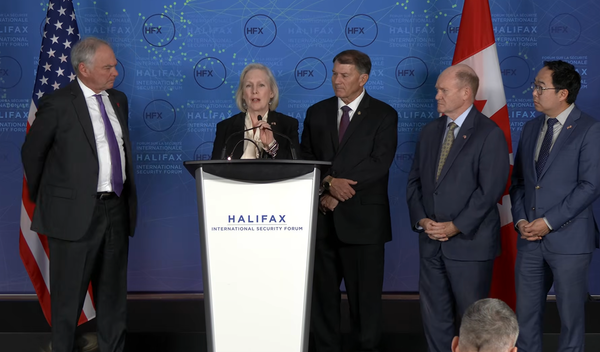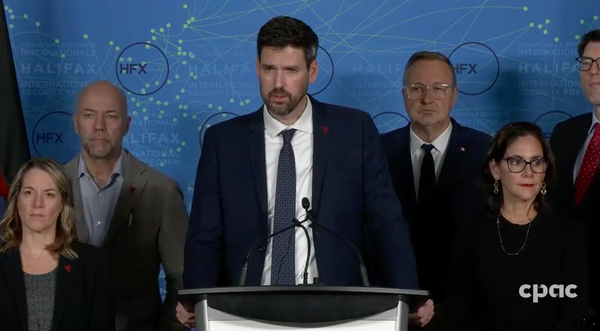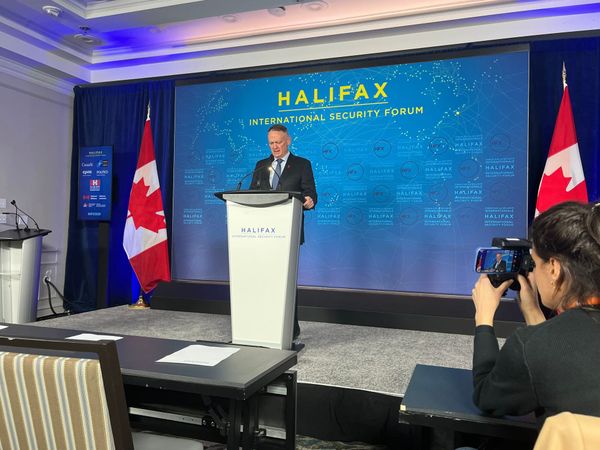
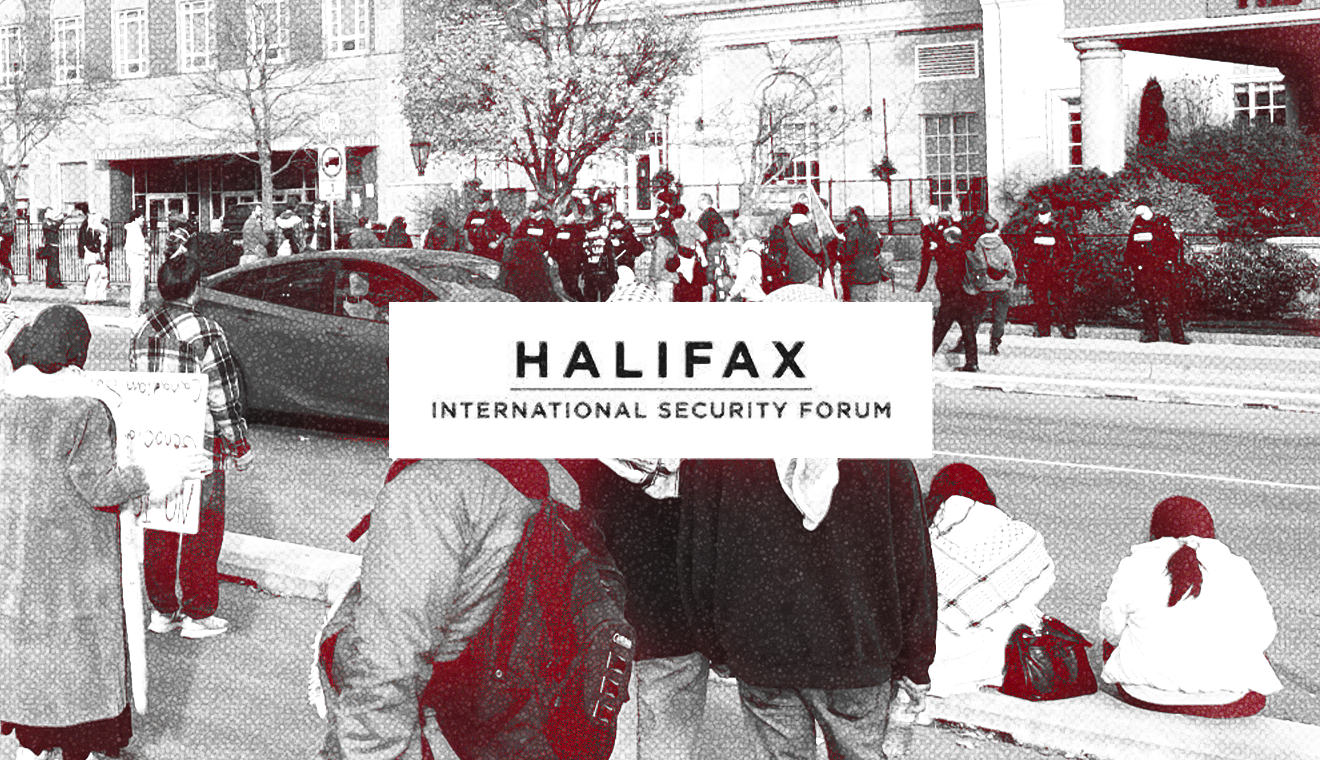
Approximately 150 people gathered outside the Westin Nova Scotian on Saturday to protest the Halifax International Security Forum, an annual event that draws politicians, military commanders and NGO leaders from states and organizations allied with the United States.
The main theme of this year’s forum focused on the growth of artificial intelligence, with several on-the-record panels discussing this topic.
The event also included a number of closed-door discussions that were held under the “Chatham House rule.” Some of these panels were hosted by Canadian journalists, including Toronto Star columnist Justin Ling and author Stephen Maher.
The forum’s funders and partners include Canada’s Department of National Defence, NATO and defence companies Saab, CAE, and Dominion Dynamics. Canadian AI company Cohere, which the federal government recently invested $1.6 billion into, was also listed as a partner at this year’s forum.
The demonstrators gathered outside the forum waved Palestinian flags and called attention to Israel’s use of AI technology in its ongoing genocide in Gaza.
Halifax is a key military city and serves as a port for shipping military goods. Kelly Bee, an independent artist who attended the protest, told The Maple that she does not want her city used as a launch pad for munitions that are used to slaughter civilians, including children.
“I think that a lot of us are threading the loop between the genocide in Gaza, the genocide in Congo, Sudan, and AI and defence broadly, and AI and defence as an industry enriching itself by committing these acts,” said Bee.
Many of the panel discussions at this year’s forum included titles riffing on the initials “AI,” such as “Agenda: Ideals” and “Antisemitism, Insidious.”
“They’re so silly, it feels like [they’re] mocking us is really what it comes down to,” said Bee.
Neil Balan, an academic affiliated with Labour for Palestine, told The Maple that he protested the forum because the event presents itself as “entirely and totally depoliticized.”
“We’re trying to re-politicize what happens in there, which is totally egregious and problematic because it’s the policy track for all the nasty things that we see happening in the world right now, particularly in relation to an American imperialism that is really not in rapid decline, but kind of in crisis,” he explained.
While protests against the forum take place every year, Balan said the number of attendees at this year’s event grew as a result of recent opposition to a proposed AI data centre in Point Tupper, N.S.
“It’s really brought more numbers out,” he said.
Asaf Rashid, with the Halifax Committee Against Imperialist War and Genocide, noted that although the forum takes place in Halifax, the non-profit organization that runs the event is based in Washington.
“It goes to show I think where the real leading edge is coming from as far as who’s really running the show,” Rashid told The Maple.
“The same way that you have Donald Trump in January 2025, demanding, pounding his fist on the table calling on all NATO countries to commit 5 per cent of their GDP towards NATO spending, and [Mark] Carney complied, and European NATO members complied.”
The Liberal government’s latest federal budget promises $451.3 billion in core military spending over the next five years, plus an additional $320 billion in “defence and security related funding.”
The budget projects that Canada’s total military spending will surpass 4 per cent of national GDP by 2028.
Many of the participants at the Halifax forum do not support Trump but, Rashid said, they still support the same drive towards increased militarization, albeit with more refined branding that focuses on ideals like “human rights” and “democracy.”
“The liberal veneer is really effective for them … They’re trying to sell everyone that it’s important that 5 per cent of GDP goes towards military spending, so it has to be palatable,” said Rashid.
“If you look overall at the agenda, you don’t get distracted by this or that session’s title. Then you see that the big picture is one of a world which is dominated by the U.S. and Europe, which seeks to continue to dominate and to beef up military presence in order to hold the world order in the way they want.”
That agenda comes with a specific set of geopolitical aims, Rashid explained.
“One of the focal points for NATO is not just to fight Russia but also to contain China in order to keep Western hegemony under the U.S. in play.”