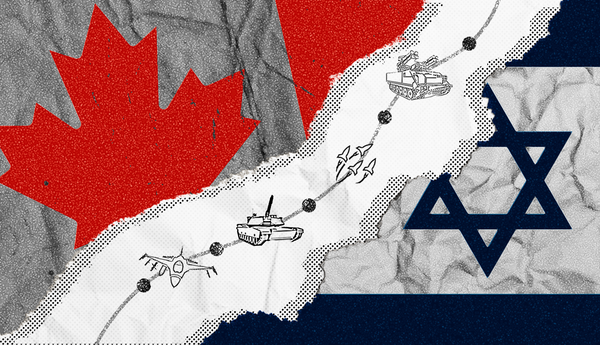
At least six companies in Canada are currently manufacturing, maintaining or producing components for the same types of weaponry and military assets that the U.S. has used in its war on Iran, an investigation by The Maple has found.
Five of the companies — Raytheon, Boeing, Standard Aero, Northrop Grumman and General Atomics — are subsidiaries or branches of American firms. One of the companies, M1 Composites Technology, has its headquarters in Canada.
These companies produce for the U.S. government components for Tomahawk missiles and MQ-9A Reaper drones, landing gear for fighter jets, nose radomes for bomber jets, and other components, artillery, and accessories for the types of weapons and aircraft being used in the current war.
The total value of the contracts analyzed by The Maple that implicate Canadian facilities is $5.2 billion U.S., or $7 billion Canadian. Most of the contracts stipulate that a majority of the work must be completed in the United States, with 2.5 per cent or less being completed in Canada.
In individual cases, as little as 0.01 per cent and as much as 99 per cent of the work is taking place in Canada.
Rachel Small, an organizer with World Beyond War, was disturbed by The Maple’s finding that Raytheon was contracted in September 2025 to make antennae hardware kits for Tomahawk missiles — the same type of munition that the U.S. used to bomb a girls’ school in Iran.
Raytheon will perform one per cent of the work for that contract in Ontario.
Small said it’s “deeply unsurprising” because Canada has refused to implement a full arms embargo on Israel over the last three years. “We’ve created a situation where we’re materially complicit in the worst war crimes on the planet,” she said.
 Alex Cosh
Canada’s participation in the American “war machine” is at odds with Prime Minister Mark Carney’s rhetoric about distancing Canada from its southern neighbour, Small added.
On Sunday, Carney said Canada’s ties to the U.S. are now “weaknesses.”
“Despite all of that talk about elbows, about separating from the U.S., about resisting big bullies, his actual agenda is about moving Canada closer and closer to the U.S. militarily,” said Small.
The Maple asked Carney’s office how Canada’s production of weaponry for the U.S. war squares with his other comments about sovereignty. A spokesperson for the prime minister referred the question to Global Affairs Canada, but that department did not respond by the deadline.
The Maple analyzed hundreds of contracts signed between January 2021 and March 2026 to determine how Canadian facilities may be contributing to U.S. President Donald Trump and Israeli Prime Minister Benjamin Netanyahu’s war on Iran.
The resulting data represents the only detailed breakdown by any media outlet showing how the weapons industry in Canada may be implicated in the violence in the Middle East.
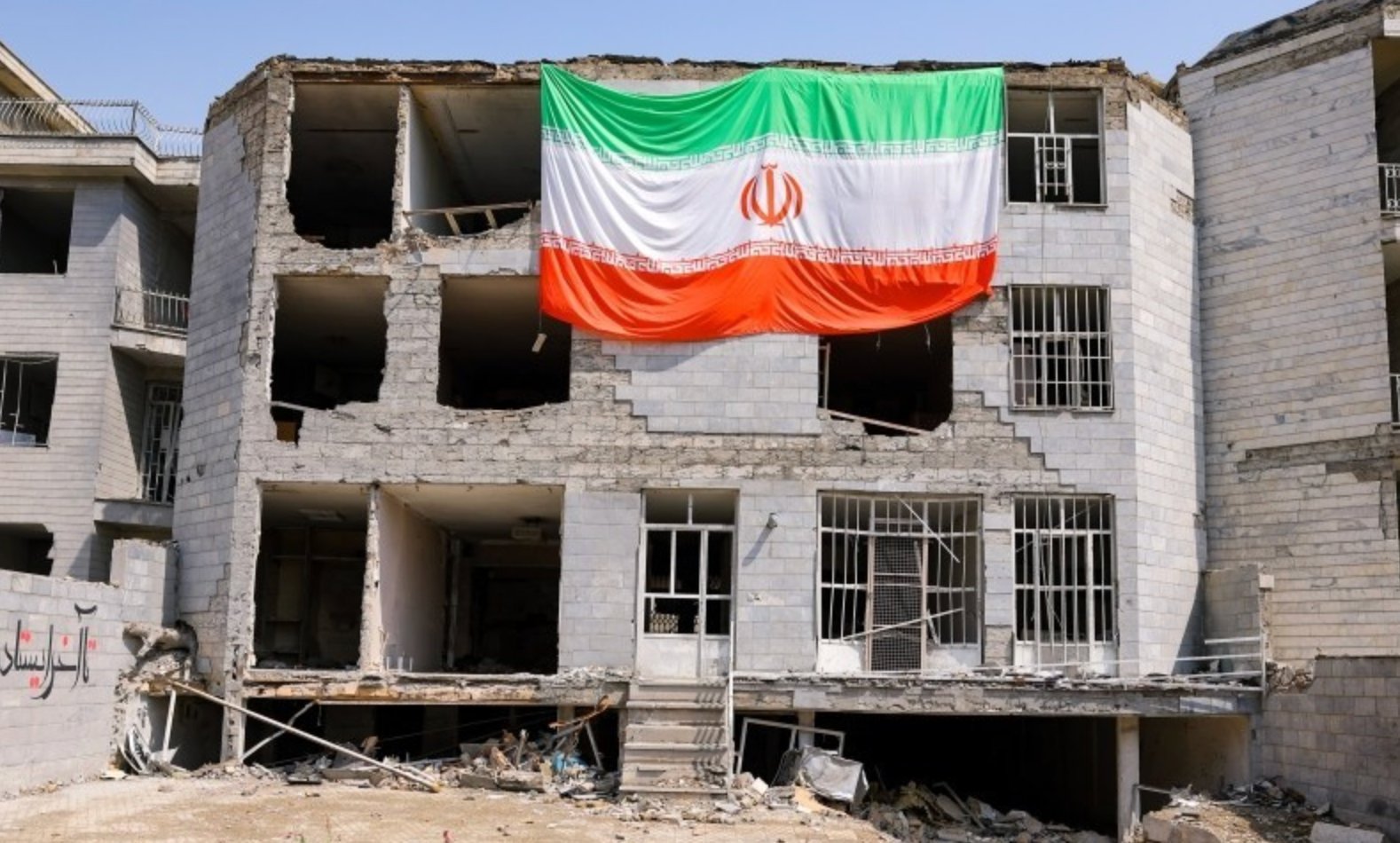
The U.S.-Israeli war on Iran has killed at least 3,636 people in Iran, including 1,701 civilians and 254 children since it began on February 28, according to Human Right Activists News Agency. Israel’s attacks on Lebanon have killed at least 1,830 and displaced more than 1 million.
Twenty-three Israelis and 13 American soldiers have also been killed.
The war is unpopular in both Canada and the U.S. Polls have found that between 49 per cent and 58 per cent of Canadians oppose the bombing of Iran.
In the U.S., 61 per cent of Americans disapprove of Trump’s handling of the war and 59 per cent believe it was wrong to use military force on Iran.
There is a ceasefire in place that has been extended indefinitely. Trump has indicated that talks between the parties aimed at ending the war, which previously collapsed, could begin again within days.
Raytheon
Raytheon is the maker of Tomahawk missiles, the same type of munition that hit a girls’ elementary school in Minab, Iran, on February 28, killing at least 175 people, mostly children.
Five active contracts announced by the U.S. Department of War state that Raytheon is doing work on Tomahawk missiles in Canada.
The contracts are for the production of Tomahawk missiles or safety subsystem kits, test kits, navigation and communications antenna, hardware kits, spares, replacement components, and “recertification and modernization.”
The contracts say that between 1 and 2.12 per cent of the work will be done in Midland, Ont. or simply in “Ontario, Canada.” The contracts for all the work, including the portions to be completed in the U.S., have a total ceiling value of $1.29 billion U.S.
Raytheon is also the maker of the AIM-9X Sidewinder missile. Contracts signed last year for the missiles and associated work list Midland, Ont. as a work location. Many American jets are armed with AIM-9s, according to Defense One, a publication that specializes in military affairs.
Raytheon is also the maker of the Evolved SeaSparrow Missile (ESSM), a medium-range projectile launched from ships. The missiles are compatible with a weapons system called AEGIS, which was identified by a defence industry publication as one of the costly American systems that has been depleted during the war on Iran.
Raytheon holds at least eight active contracts for ESSMs and associated work that list Mississauga, Ont. and Cambridge, Ont. as work locations. As much as 14 per cent of the work performed under these contracts, each worth between $8.1 million and $525 million USD, is being done in Canada.
Spokespeople for Raytheon did not respond to written questions from The Maple.
Boeing
Boeing manufactures F/A-18 Super Hornet fighter jets and KC-135 Stratotanker refueling aircraft. A video reviewed by The Aviationist showed an F/A-18 operating over Iran on March 25, and the KC-135 is the same model of aircraft that went down in Iraq on March 12, killing six American crew members.
Eight active contracts announced by the U.S. Department of War state that Boeing is working on these types of aircraft in Vancouver, B.C.; Longeuil, Que.; and Kanata, Ont. or simply in “Quebec,” “Ontario” or “Canada.”
Six of the contracts are for F/A-18 jets or associated landing gear, repairs, parts, operations and data. Two of the contracts are for work related to KC-135 parts and engineering support.
One of the contracts states that work on F/A-18 landing gear is being done in “Safran, Ontario, Canada.” But Safran is the name of an independent supplier to Boeing in Ajax, Ont., not a town.
The total value of the Boeing contracts that implicate Canadian facilities is $1.97 billion U.S. Large proportions of the work related to these contracts — up to 57 per cent — are being performed in Canada.
Spokespeople for Boeing did not respond to written questions from The Maple.
Standard Aero
Standard Aero is an aviation company that was founded in Winnipeg but now has its corporate headquarters in Scottsdale, Arizona. The company still has six locations in Canada.
Standard Aero provides repairs and maintenance for the U.S. Navy on its E-2D Advanced Hawkeye and P-8 Poseidon aircraft, both of which the U.S. said were deployed in Iran.
Ninety-nine per cent of Standard Aero’s work on the P-8 aircraft is being done in Winnipeg, the contract states. Twenty-five per cent of its work on the E-2D aircraft is being done in Winnipeg.
These two contracts represent a maximum of more than $1.2 billion U.S. worth of work, although Standard Aero split one of the contracts with another supplier and will bid on individual orders.
Representatives for Standard Aero did not respond to written questions from The Maple.
Northrop Grumman
Northrop Grumman is currently completing two orders under one single contract for upgrades to E-2D Advanced Hawkeye aircraft.
Only 0.01 per cent of the work is being performed in Laval, Que., with the rest taking place in the U.S., according to the order announcements. The total value of the orders is $466 million U.S.
Northrop Grumman also holds hundreds of millions of additional dollars worth of contracts for the U.S. Navy related to MQ-4C Triton drones. Part of this work is done in Longeuil, Que., the contract announcements state.
It was reported that one of these drones broadcast an emergency signal then disappeared over the Persian Gulf days before the U.S. and Israel launched their attacks on Iran.
Spokespeople for Northtrop Grumman did not respond to written questions from The Maple.
General Atomics
General Atomics makes MQ-9 Reaper drones, which are remotely piloted aircraft that can be used for reconnaissance or loaded with weapons to conduct air strikes.
More than a dozen of those drones have been destroyed during the war on Iran, U.S. government officials told ABC News in March.
General Atomics holds one active contract for $35.9 million U.S. to provide the U.S. Navy with spare parts for MQ-9 drones and other equipment. The contract states that 0.75 per cent of the work will be performed in Toronto.
Representatives for General Atomics did not respond to written questions from The Maple.
M1 Composites Technology
M1 Composites Technology is an aerospace company that was founded in Laval, Que. It offers manufacturing, engineering and repairs on aircraft.
Last year, the U.S. Department of War awarded the company a contract worth $34 million U.S. for nose radomes on B-1 bomber jets. Nose radomes are protective shells installed on the fronts of aircraft.
B-1 jets have been deployed in Iran, the U.S. Central Command said on X in March. The bombers are “the backbone of America’s long-range bomber force,” the U.S. Air Force says, and can carry payloads of weaponry weighing up to 75,000 pounds.
A spokesperson for M1 Composites responded to an email from The Maple after this story was published, and more than one week past the original deadline for a response.
“Our products are designed and provided for lawful uses in accordance with applicable laws and regulations,” said the email from Caroline Poirier. “We do not have visibility or control over how products are used once they are outside our direct distribution channels. We have no further comment at this time.”
Editor’s note, April 24, 2026: This story has been updated to include a statement from M1 Composites.