
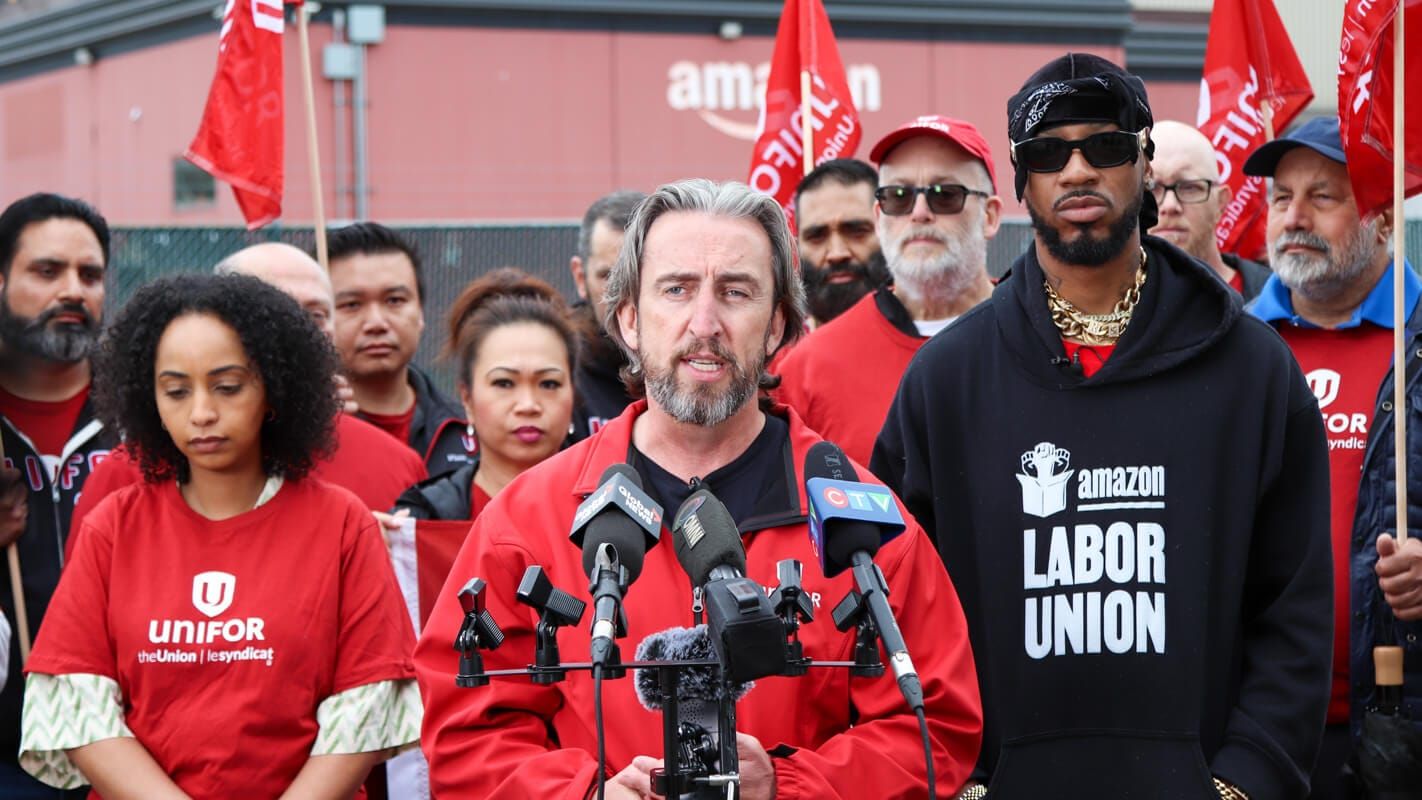

The British Columbia Labour Relations Board recently ruled that Amazon violated the provincial Labour Code by denying scheduled pay increases to workers who unionized.
Unifor Local 114, which certified a bargaining unit of about 800 workers at Amazon’s Delta, B.C., facility in July 2025, filed a complaint after the e-commerce giant granted pay increases to all Amazon workers in the region except union members.
“This decision confirms what Amazon workers have been saying all along—the company broke the law by singling out unionized workers for unfair treatment. [...] No worker should be punished for exercising their legal right to join a union, and today’s ruling sends a clear message that Amazon is not above the law,” said Unifor national president Lana Payne in a union press release.
According to the union, the Labour Board’s decision will likely result in more than $1 million in back wages for these Amazon workers.
The practice of companies withholding pay increases or other compensation and benefit enhancements from newly unionized workers is relatively common, if unlawful. For example, Starbucks previously took similar actions against unionized workers in B.C.
Employers typically argue that labour law prohibits changes to pay or working conditions until a collective agreement is settled, and this therefore prevents them from extending pay or benefit increases to new union members. While this is technically true, labour boards have generally considered increasing the pay of non-union workers while denying this to workers in the bargaining unit to be a form of retaliation.
Unifor charges that Amazon has breached several other provisions of B.C.’s Labour Code, but the Board has yet to consider these additional allegations.
Local 114 gave Amazon notice to bargain in October 2025, following the company’s continued efforts to resist the union and ultimately repeal its certification.
Shortly after, the union announced that surveys and conversations with workers at the facility indicated that “workload, speed-ups, and rampant favouritism” were among the most pressing issues. In late October, bargaining representatives elected by the workers “sat down across the table from Amazon representatives to negotiate a first collective agreement” for the first time.
Following an intense two-year organizing campaign, B.C.’s Labour Board granted a remedial certification last July, finding that Amazon went on a hiring spree to dilute union support in the workplace while also attempting to intimidate and coerce workers against organizing.
In September, Unifor engaged in a series of site visits at the facility to discuss issues with the workers. Amazon was forced to allow these meetings as part of the Labour Board’s decision that granted the union certification.
Undaunted, Amazon then tried and failed to overturn the Board’s decision and repeal the certification. The company has now also filed for a judicial review at the B.C. Supreme Court.
“Despite repeated rebukes from the B.C. Labour Relations Board for abusing and interfering in the unionization process, Amazon continues to wage a misinformation war against its own employees on the shop floor,” the union said in a press release from October.
Formal bargaining ultimately commenced in December, but according to the union, little progress has been made to date. Unifor now intends to seek mediation to expedite a first collective agreement for the Delta workers.
“Time and again, Amazon has used procedural delays and abused its incredible power to punish and discriminate against unionized workers at YVR2,” said Unifor western regional director Gavin McGarrigle. “That is exactly why we’re seeking to expedite negotiations toward a strong union contract. Workers deserve stability, dignity, and accountability from their employer.”
The B.C. Labour Relations Code permits unions to seek mediation and arbitration to secure a first collective agreement.
Though it remains relatively early in the bargaining process, Unifor’s decision to seek mediation indicates that securing a first contract at Amazon will be unlikely without outside assistance. A collective agreement ultimately imposed through arbitration may be the most likely option, though this could take some time.
The workers at YVR2, as the Delta facility is called, remain the only unionized Amazon employees in Canada, after the corporation shuttered its Quebec facilities in January 2025 in response to a successful union drive in that province. Roughly 300 workers at a warehouse located in Laval unionized in May 2024, but ultimately failed to secure a contract due to Amazon’s retaliatory departure from the province.
As in B.C., Quebec labour law allows for first contract arbitration. In fact, Quebec’s arbitration provision is stronger than the one found in B.C.’s Labour Code. A year ago, Amazon was facing the prospect of an imposed collective agreement in the province with the strongest labour movement in Canada. Rather than allow that to happen, the company opted to close up shop and outsource its Quebec operations to subcontractors.
It remains to be seen how the company will respond to Unifor’s attempt to use the mediation and arbitration processes in B.C. to move closer to a contract. One hopes that the Quebec experience is not a preclude.
The challenges ahead therefore remain immense. Amazon’s relentless anti-unionism will continue, and overcoming its enormous wealth and power to secure a first contract will necessitate a multi-pronged strategy. A first collective agreement at YVR2 could then be the key to expanding unionization to other Amazon facilities in B.C. and across the country.
Waging this fight first in a jurisdiction with relatively favourable labour laws provides Unifor with some added leverage. Card-check unionization helped to sign up new members and secure support, while a remedial labour board decision ultimately certified the bargaining unit. First contract mediation and arbitration may prove crucial to securing a collective agreement.
However, leaning too heavily on labour law and the provincial Labour Board also presents its own set of risks. Winning against Amazon will require deep organizing and super-majority participation among workers themselves. Although supportive laws are important, they are no substitute for mass organizing and worker power.
If Unifor and the Delta workers can win at Amazon in B.C., the labour movement may finally gain the foothold it needs to bring Amazon to heel across Canada.
It’s long been said that organizing Amazon is an existential question for organized labour. Let’s hope that YVR2 is just the beginning.
Recent Class Struggle Issues
- February 23 | Liberals To Blame For CUPE’s Subpar Air Canada Settlement
- February 17 | The Time Has Come For Sectoral Bargaining
- February 9 | Top-Paid CEOs Made More In 33 Hours Than Workers Will In 2026
- February 2 | Carney’s Job Cuts Undermine Canada’s Position Against Trump