

On March 29, NDP members elected Avi Lewis as their new federal leader at the party’s convention in Winnipeg.
Lewis won the election on the first ballot, securing 39,734 votes (56 per cent). The second place candidate, Edmonton Strathcona MP Heather McPherson, secured 20,899 votes (29 per cent).
The NDP uses a ranked voting system, but with Lewis’s first ballot victory, no subsequent round of vote counting was necessary.
Lewis emerged victorious after a seven-month campaign that mobilized an impressive number of young activists and volunteers, centred progressive policy proposals, and took unapologetic stands on key issues, such as the genocide in Gaza. Heading into the convention, Lewis had raised more money than all other candidates combined, while relying on more small dollar donations than his opponents.
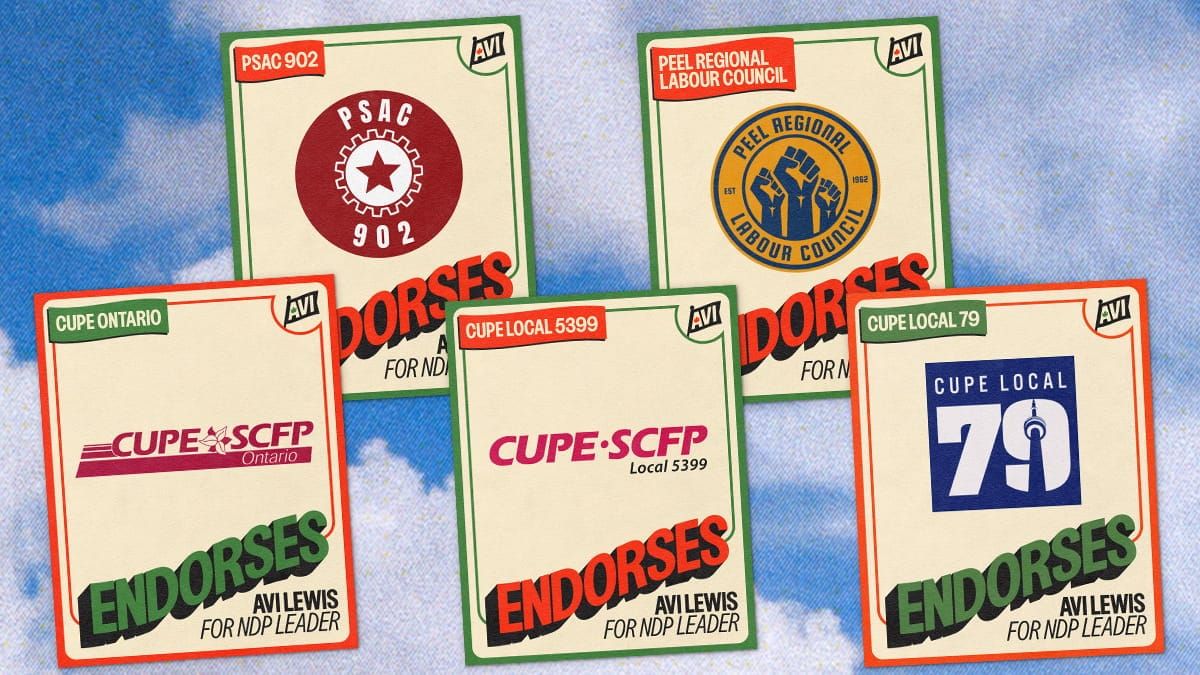
Yet, despite Lewis’s bold workers’ rights platform, he secured fewer endorsements from unions, central labour bodies and union leaders than Rob Ashton, the president of the International Longshore and Warehouse Union (ILWU) Canada.
Unions endorsing Ashton included the Canadian Union of Public Employees (CUPE) British Columbia, CUPE Saskatchewan, the United Food and Commercial Workers (UFCW) Canada, the Service Employees International Union (SEIU) Local 2, as well as many local labour councils. Several prominent labour leaders also backed Ashton, including the president of the Canadian Labour Congress (CLC), Bea Bruske, and Marty Warren, the national director of the United Steelworkers (USW) Canada.
This level of official labour support was somewhat predictable given Ashton’s prominent and respected place in the Canadian labour movement, particularly in British Columbia. Yet when the votes were tallied, Ashton finished fourth, pulling in only 4,193 votes (5.9 per cent).
As Brock University Labour Studies professor Larry Savage pointed out, unions endorsing Ashton collectively represent 659,200 workers. This means that fewer than 0.6 per cent of members from these endorsing unions joined the NDP and voted for Ashton.
As Savage continued, “The result is a striking reminder that endorsements don’t always translate into votes. Given that organizing and mobilizing are the lifeblood of the union movement, this result is a disaster and tells us a lot about the institutional weakness of unions inside the NDP.”
The result also suggests, however, that many unions did not recognize the growing appetite for change among their own members.
It wasn’t only Ashton’s defeat that revealed labour’s disconnect from NDP members. The Party’s executive, including incumbent treasurer Susanne Skidmore, the sitting president of the B.C. Federation of Labour, was also voted out in favour of the Lewis-aligned “Change, together” slate of candidates.
This raises the question: Could the grassroots mobilization that helped secure both Lewis’s election as leader and a new party executive find similar expression within the labour movement itself?
Lewis will no doubt inspire new, younger and more left-leaning candidates to run in federal and provincial elections, but can a change of direction inside the federal NDP inspire rank-and-file workers to run for leadership positions in their unions and throughout the labour movement?
Workers who participated in the Lewis campaign, particularly young ones, may see an opportunity to form opposition caucuses and slates and run for union leadership positions at the local level and beyond. Short of running for elected union positions, workers could also mobilize around contract fights with large employers, labour convention resolutions and public policy campaigns that complement NDP objectives.
Activating workers inside the labour movement could also be mutually beneficial for Lewis and the new NDP leadership team. To combat the opposition that Lewis is already facing — and will continue to face — from some party insiders and more centrist party members in the provinces, the party will need a highly mobilized base of active supporters.
As York University political science professor Dennis Pilon recently put it, “The precise details of the NDP’s policy mix are much less important than the party’s approach to mobilizing an electorate [that] can act as an anchor for the progressive policies the party is trying to introduce.”
The challenge, according to Pilon, is that working-class electoral and political participation has been trending downward for a long time. Consequently, rebuilding the political capacity of the left requires new mechanisms for mobilizing and activating workers. Historically, the mechanism for doing this has been the labour movement. If a Lewis-led NDP is to be effective, even as an opposition force in Parliament, it’s going to need an activated base on the outside, primarily in the labour movement.
Although the NDP was formed with the support of the Canadian Labour Congress and has often been viewed as the party of labour, it has never enjoyed majority support from the Canadian working class nor the strong union linkages typical of many social democratic parties in Europe.
Labour’s influence within the NDP is even less pronounced now, as many unions have embraced strategic voting and political non-alignment and as the party itself has lost support among blue-collar workers and, like social democratic parties the world over, replaced them with university-educated, higher-income professionals. Ashton’s fourth place finish in the NDP leadership contest is but one manifestation of this broader de-linking of labour and the electoral left.
One of the many challenges facing the Lewis-led federal NDP will thus be rebuilding the party’s connection with the broad spectrum of working-class voters. This is a necessary, albeit difficult, task.
As former CUPE president Paul Moist aptly summed it up recently, “A formal labour alliance with a social democratic party is by no means a guarantee of success for workers. But non-alliance Gompersism is a prescription for labour isolation and decline.”
In other words, rebuilding a stronger connection between labour and the party will prevent the kinds of transactional politics that have become typical of many unions that embrace strategic voting, and was characteristic of the American labour leader Samuel Gompers, who stressed that unions should avoid lasting political allegations.
Mobilized rank-and-file workers, acting within and through their unions, may thus be part of the strategy for reinvigorating the NDP. This would mean not only maintaining the base of support necessary to buttress the Lewis-led NDP policy aims, but also reconnecting the organized labour movement with the ostensible party of labour.
Moreover, there will also be issues on which the NDP and particular unions have strong overlapping interests. The massive cuts the Carney government is currently imposing on the federal public service, for example, are an issue around which the Lewis-led NDP and federal public sector unions could converge.
There’s no question that the NDP under Lewis has a lot of work ahead of it. With only six seats remaining in Parliament, the NDP is without official party status and faces a Liberal Party and prime minister still enjoying significant public support.
At the same time, with a new party executive and a transition team ready to implement his vision, there is room to manoeuvre. What’s needed is an activated base that remains engaged, inside and outside the official party.
While Lewis wants the NDP under his leadership to be more connected to social movements, to effect change the Party will also need the institutional strength of labour. This is all the more reason for workers supportive of the NDP’s new direction to think seriously about how their unions are orienting themselves politically.
There’s never been a better time to get involved and revitalize the labour movement.
Recent Class Struggle Issues
- March 30 | Union Members View Migration More Positively Than Other Workers
- March 23 | Canada’s Unions Should Mobilize Against The Iran War
- March 16 | Canada’s Richest 86 Families As Wealthy As Poorest 6.2 Million
- March 10 | Government Denies Unpaid Work Exists In Canadian Airlines