
Canadian government officials sought approval from their American counterparts before releasing parts of a damning report about how the CIA resettled alleged Nazi war criminals in Canada, documents show.
The Americans seemingly did not approve, and Canada subsequently gave the U.S. a heads up when the Federal Court ordered that some previously secret parts of the report be released anyway.
“The review of these records included working with Global Affairs and the United States to assess the sensitivity of this information,” wrote Philippe Guertin with Library and Archives Canada’s Military and Intelligence ATIP Branch in an email sent to The Maple.
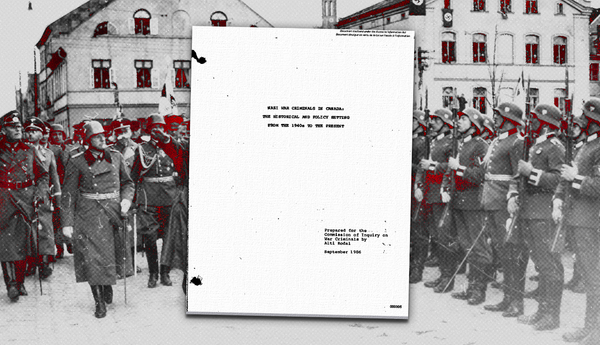
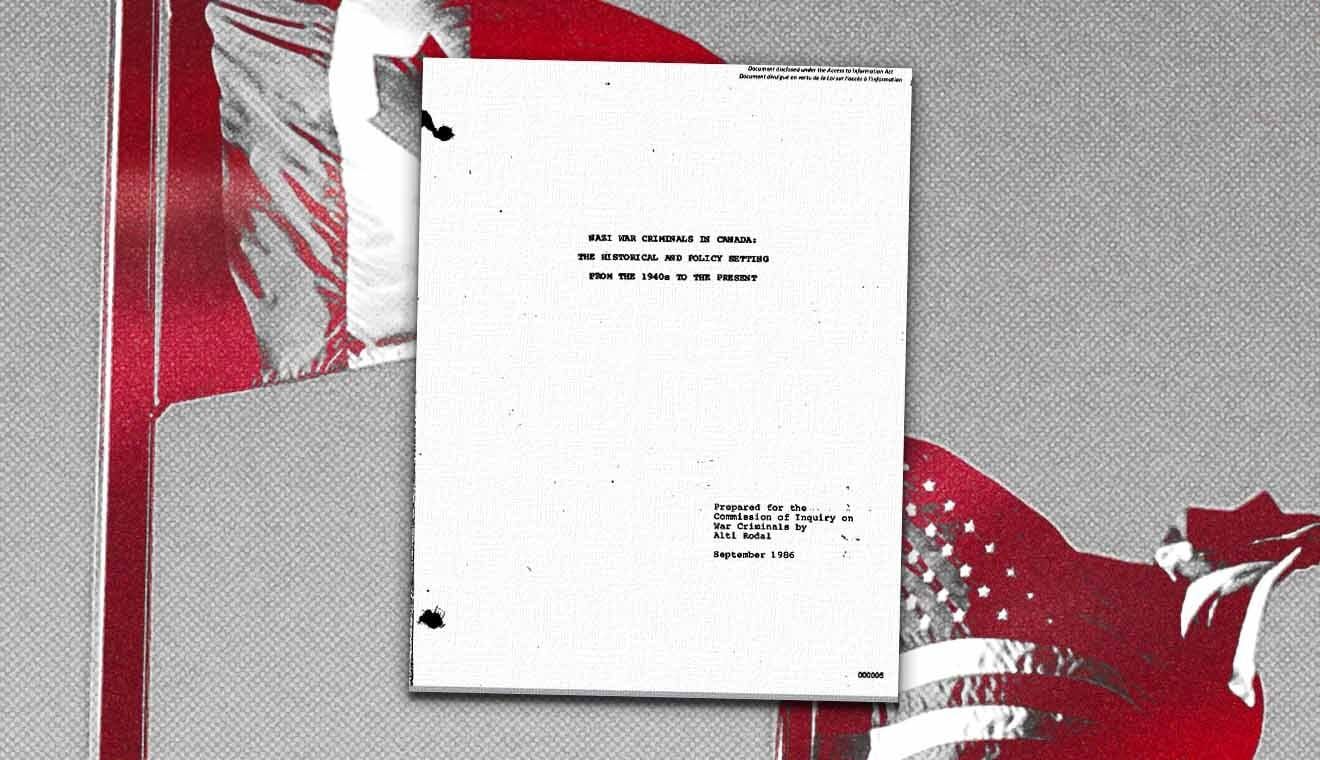
The report, known as the “Rodal Report,” was written by historian Alti Rodal in the 1980s as part of an investigation into alleged Nazi war criminals in Canada. Previously redacted sections were released earlier this month following a Federal Court order that resulted from a legal challenge.
“When the Federal Court ordered LAC to release some of the previously protected information in the Rodal Report, the Government of Canada advised the United States of the court decision and the release of information deemed injurious to international affairs,” wrote Guertin in a statement to The Maple.
“No advice was requested or received, but Canada did advise them that the information would be released.”
The newly released sections of the Rodal Report confirmed that the CIA lied to Canadian security officials in the 1950s as it resettled Nazi collaborators in Canada.
At least 35 individuals identified as Nazi collaborators were resettled in Canada in 1953 alone, thanks to fake identities and documents furnished by a CIA front organization operating in West Germany.
The recently disclosed sections also revealed the Canadian government was aware of the CIA’s duplicity in the effort. The Maple discovered that the individual in charge of the resettlement effort — George McManus — was later posted to Ottawa as the U.S. Embassy’s CIA liaison officer.
Guertin did not identify which U.S. officials the Canadian government spoke with ahead of the report’s release.
The Maple asked the Prime Minister’s Office whether Mark Carney was aware of the fact that Canada was advising the U.S. on items pertaining to the transparency and accountability of the Canadian government.
The PMO did not respond to The Maple’s questions.
Neither Global Affairs Canada nor Canadian Identity Minister Marc Miller – who had previously indicated an interest in greater transparency on the subject – answered The Maple’s questions on the matter.
Federal Court Justice Simon Fothergill ordered the federal government to disclose some of the previously redacted sections of the Rodal Report in early September 2026.
The Maple received a largely unredacted copy of the report on Oct. 8, 2026, after the federal government did not appeal the court’s decision.
One section remains redacted, pursuant to paragraph 13(1)(a) of the Access to Information Act, an exemption that requires the refusal of access to records received in confidence from a foreign government.
In the context of the Rodal Report chapter detailing CIA efforts to resettle Nazi collaborators in Canada, a November 2025 “Respondent’s Memorandum of Fact and Law” issued by the Attorney General of Canada indicates that this redaction “consists of a U.S. official’s comments on a piece of legislation from the United States.”
The legislation in question is the so-called “100 aliens” proviso that refers to a section of the Central Intelligence Agency Act of 1949, which gave the CIA the authority to admit 100 foreign nationals to the U.S. per year for intelligence or national security reasons, bypassing immigration procedures and policies.
The Rodal Report’s remaining in-text redaction may elaborate on why the U.S. government wouldn’t accept known Nazi collaborators who were ultimately sent to Canada, even though the proviso permitted their resettlement to the U.S.
The memo indicated that the government of Canada reached out to the Americans to see if they would consent to the disclosure of this section, to which the Americans replied their preference that the information continue to be withheld.
Neither the American nor Canadian governments ever gave an official explanation for why the CIA resettled Nazi collaborators in Canada.
Other documents reviewed by The Maple reveal that the government of Canada sought U.S. consent to disclose the other redacted sections.
An Aug. 2, 2024 email from a Canadian representative at the Canadian Embassy in Washington reads: “Nothing on Rodal, no. I can ask again, but in practice, my sense is this means they will not agree to removing any further redactions.”
An affidavit provided by Kristina Lillico, director general of LAC’s access to information and privacy branch, further indicates that LAC worked with Global Affairs Canada to pursue consultations with the U.S. government for months after the release of an earlier, partially unredacted version of the Rodal Report in February 2024.
In the affidavit, Lillico noted that requests between the government of Canada and a foreign government seeking consent to disclose information rarely results in formal correspondence. As such, Lillico noted the informal discussions, such as those mentioned in the August 2024 email.
Lillico further indicated LAC consulted the Canadian Security Intelligence Service (CSIS), which “confirmed the importance of maintaining these redactions.”
The Attorney General’s memo further indicates that “the events at issue in the Rodal Report concern the resettlement of war criminals in Canada, and to expose efforts of a foreign ally to provide safe harbour for war criminals and to undermine Canada’s immigration system.”
Despite that, the memo shows the government of Canada was primarily concerned about how disclosing redacted sections of the report might harm Canada’s relationship with the U.S.
According to the memo, the government noted that “tensions exist between these nations and are likely to be exacerbated by disclosing this information.”
Historian Jared McBride told The Maple it would be helpful to know how the ultimately disclosed report was presented to U.S. officials and how they responded.
He said that if the U.S. government did in fact object to releasing information about sending people with compromised backgrounds to Canada, their objections deserve further scrutiny.
McBride noted that U.S. involvement in evacuating notorious Gestapo officer Klaus Barbie was confirmed publicly in the mid-1980s, and that the U.S. Nazi War Crimes Disclosure Act has been in effect since 1998.
“In the late 2000s the U.S. government declassified the CIA, FBI, and INS files, with few redactions, of one particular individual with ties to the Holocaust and interwar terrorism who was sent to the U.S. through the one hundred persons [proviso],” said McBride, “and there are many other examples of such releases.”
“But now the U.S. and/or Canada is concerned about this history being accessed by the public?”