
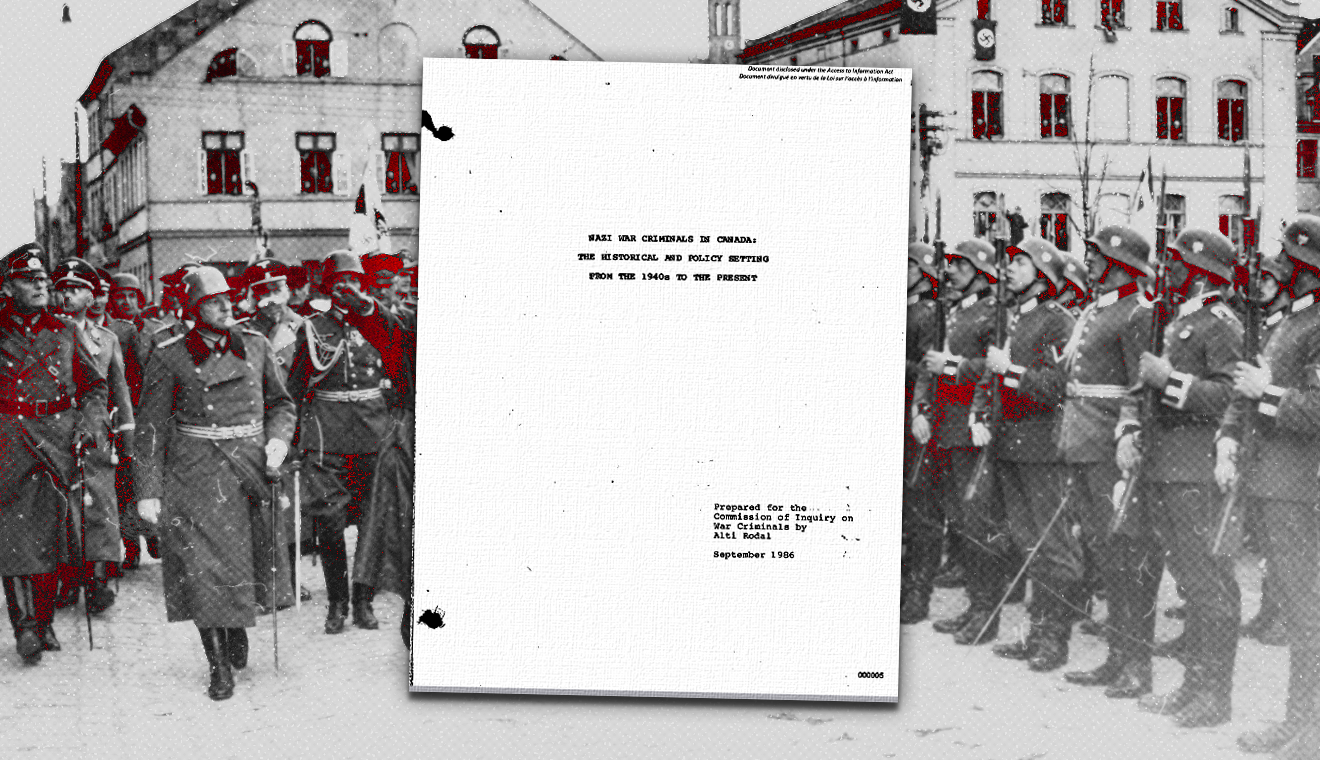
After 40 years the Canadian government has finally released a nearly fully unredacted version of historian Alti Rodal’s investigation into alleged Nazi war criminals in Canada.
The previously redacted sections reveal that the CIA was actively involved in resettling alleged Nazis in Canada after the Second World War, that the CIA deceived Canadian officials, and that a leading CIA officer in charge of resettlement operations was later the CIA’s representative in Ottawa.
“It was a ratline,” said historian Jared McBride, referring to the escape routes used by the Nazis and their collaborators to flee Europe in the aftermath of the Second World War. “In an operational sense, this is what a ratline is.”
While the newly unredacted version of the Rodal Report doesn’t name the specific individuals who gained entry into Canada, it does reveal that Canadian visa control officers posted in Stockholm were aware of falsified documents coming from American sources as early as 1953.
Further, former RCMP deputy commissioner W.H. Kelly was informed in early 1954 of suspicious applications for security screenings coming from the U.S. zone of occupation in postwar Germany.
Kelly was subsequently contacted by a U.S. intelligence official named George McManus, who requested Canadian security personnel accept certain immigrants recommended by U.S. authorities without conducting background checks.
In March of that year, Kelly reported to Ottawa that nearly 40 people had already been accepted into Canada in 1953 alone based on American recommendations. Some of those people, the Rodal Report alleged, were known to be Nazi collaborators.
“This isn’t old news; this is new,” said McBride in an interview with The Maple. Among others, McBride pointed to the revelation that the Americans provided individuals slated for resettlement with false documentation.
“It’s not surprising they did this,” said McBride, “but where are the records? We really need to see the U.S. documentation on this.”
One previously redacted section of the Rodal Report tells of an individual who had been rejected by Canadian officials in 1953, yet who was presented again three months later — with a completely different set of documents and a new identity — by an American intelligence officer working for U.S. Armed Forces Europe (USAREUR) named Oscar Holtz.
Holtz is also identified in the unredacted sections as having supplied Canadian officials with a list of 35 individuals who had made it to Canada in 1953 with the assistance of USAREUR.
Another four had been identified by Canadian officials separately. USAREUR is also said to have advanced another 52 applicants for resettlement to Canada who were rejected by the RCMP, mostly on security grounds.
“Not only did the Canadian government know at the time that it was being deceived by U.S. intelligence, but Canadian officials learned of this again in the 1980s,” McBride said.
McBride noted that the Canadian government has consistently sought to bury the story rather than demanding transparency from the United States.
“The lack of self-respect amazes me,” said McBride.
The new version of the Rodal Report is not completely unredacted: there remains one censored line that appears to explain why, according to Oscar Holtz, the United States wouldn’t accept known Nazi collaborators, even though there was a standing provision to permit entry to as many as 100 per year at the time.
McBride told The Maple he wonders what individuals would have been so disreputable they would be considered inadmissible for entry to the United States, but still valuable enough — or such a security risk — they merited resettlement in Canada instead.
The report has been gradually unredacted over the course of the last few years.
McBride, a University of California, Los Angeles professor of 20th century Russian, Ukrainian, and Eastern European history, provided expert witness testimony in a legal action against the government of Canada demanding the release of the report.
In September, the Federal Court ordered the government to publish sections of the report that had been redacted for 40 years. The Maple received a copy on October 8 after the federal government chose not to appeal the court’s ruling.
Officially titled “Nazi War Criminals in Canada: The Historical and Policy Setting from the 1940s to the Present,” the Rodal Report was written in the context of the Commission of Inquiry on War Criminals in Canada, also referred to as the “Deschênes Commission,” which investigated the subject of war criminals in Canada in 1985 and 1986.
The second part of the Deschênes Commission’s final report, which lists the suspected war criminals identified and investigated by the commission, remains secret.
Earlier this year, Canada’s Information Commissioner decided that releasing this information to the public could potentially damage Canada’s international relations.
While the unredacted version of the Rodal Report provides important new information about the CIA’s resettlement programs as they relate to Canada, McBride told The Maple it also raises new questions: “Is it known that the CIA was creating false documentation to get people into allied countries? Where’s the scholarly literature on ratlines to Canada?”
While the newly unredacted sections are often little more than numbers, names, or short sentences, they have considerable implications.
The section discussing the individual presented to Canadian officials with new documents and a wholly different identity now clearly connects that incident with the Counter Intelligence Corps (CIC), a U.S. Army intelligence agency that was involved in a variety of secretive activities during the Second World War and its immediate aftermath.
It was the CIC that recruited notorious Gestapo officer Klaus Barbie, among others, as an intelligence asset, and then smuggled him to Bolivia. Barbie’s extradition to France to face war crimes charges in 1983 played a major role in revealing American involvement recruiting ex-Nazis as intelligence assets.
Rodal noted the Barbie case in particular at the start of her chapter examining American resettlement efforts as they related to Canada.
The Rodal Report states that the CIC’s involvement was a cause for concern given that they were generally considered to be the best and only dependable source of information in the American occupation zones of Germany and Berlin, and yet they also appeared to be responsible for creating false documentation to aid in their resettlement efforts.
According to the report, Kelly testified to the Deschênes Commission that it wasn’t possible to independently verify applicants’ backgrounds or war service records, or whether individuals from Eastern Europe had collaborated with the Nazis, apart from whatever information had been provided by the Americans.
Canadian officials therefore decided to tread lightly when it came to dealing with American intelligence officials and the individuals they proposed for resettlement in Canada, even though it was clear the Americans were not being completely forthright in their activities.
Unredacted sections reveal the RCMP was in contact with the Department of External Affairs and had resolved that higher levels of the Canadian government ought to take up the problem with the CIA.
The report notes that External Affairs did eventually receive what the Americans claimed was all the relevant information pertaining to the individuals who entered Canada, but that “suspicions about the authenticity and completeness of the information received lingered.”
According to McBride, some information contained in the unredacted sections is poorly understood and/or under-researched.
One item of particular interest, McBride said, is USAREUR’s Research and Resettlement Branch, which the Rodal Report identifies as a “cover organization for the CIA and other American intelligence agencies engaged in the resettlement of persons who had rendered them services.”
“I’ve only ever seen this organization referred to in one other place,” said McBride, referring to a memoir published in 1989 by James L. Carlin, the former Director General of the U.S. Intergovernmental Committee for Migration (ICEM).
The unit is mentioned only once in Carlin’s memoir, described as providing “careful handling” for the “high value people” who wound up at the Defector Reception Center in Frankfurt, Germany.
“It’s not clear who these people are,” McBride told The Maple in an interview, “but if identifications are being changed that means they’re probably important. This could mean war criminals as much as communist defectors. That said, if they were high value, why send them to Canada? It’s easy enough to move these guys, why lie about it?”
It is possible that additional documentation may be available in American archives.
In her report, Rodal notes that she had been told by John Tipton, formerly a senior evaluator with the General Accounting Office (a U.S. government watchdog group), that he had discovered intelligence material bearing on Canada during his own investigation into Nazi war criminals employed and resettled by U.S. agencies.
Tipton told Rodal that access to the material “would not be possible without a formal application from the Government of Canada.”
The Rodal Report doesn’t indicate whether the Canadian government ever made such a request. Rodal told The Maple that she is “not aware of any such request being made by the Deschênes Commission or the government of Canada.”
The Maple reached out to Canadian identity and culture minister Marc Miller, asking whether the government of Canada had ever made this request, or whether it would. No response was received.
The Maple also contacted the CIA, asking whether they had in fact provided the Canadian government with all relevant information concerning these cases, and whether this information might be publicly accessible. They did not reply by publication time.
‘U.S. Intelligence Official’ Later Served In Ottawa
Perhaps the most important revelation from the unredacted sections of the Rodal Report is the identity of the previously unnamed “U.S. intelligence official,” now revealed to be George McManus.
McManus served as the CIA’s representative in Ottawa in the late-1950s. Though information about McManus is limited, it is known that he was the first director of the Defector Reception Center (DRC), also known by its CIA cryptonym CABEZONE.
The DRC, along with Camp King, were sites operated by the U.S. Army and CIA where Nazis and Nazi collaborators were interrogated at the end of the Second World War and during the early years of the Cold War.
A career CIA officer, McManus worked with the organization from its creation in 1947 until 1970, when he retired and moved to apartheid South Africa for three years.
In the early 1960s, McManus was involved in Operation Mongoose, a covert CIA effort to destabilize and overthrow the communist government of Fidel Castro in Cuba.
McManus finished his career serving as the CIA’s director of cover, as an assistant to director of central intelligence Admiral Rayburn, as well as a CIA station chief for several years in the late-1970s.
“The full history of the DRC and, to an extent, Camp King — where these individuals were debriefed and given new lives — remains under-researched,” said McBride in an emailed statement. “This section of the Rodal Report provides important insights into that history.”
McBride told The Maple that both the Canadian and U.S. governments should declassify all records related to clandestine resettlement efforts, as well as records concerning the connection between the DRC and Camp King, and the individuals who were sent to Canada.