
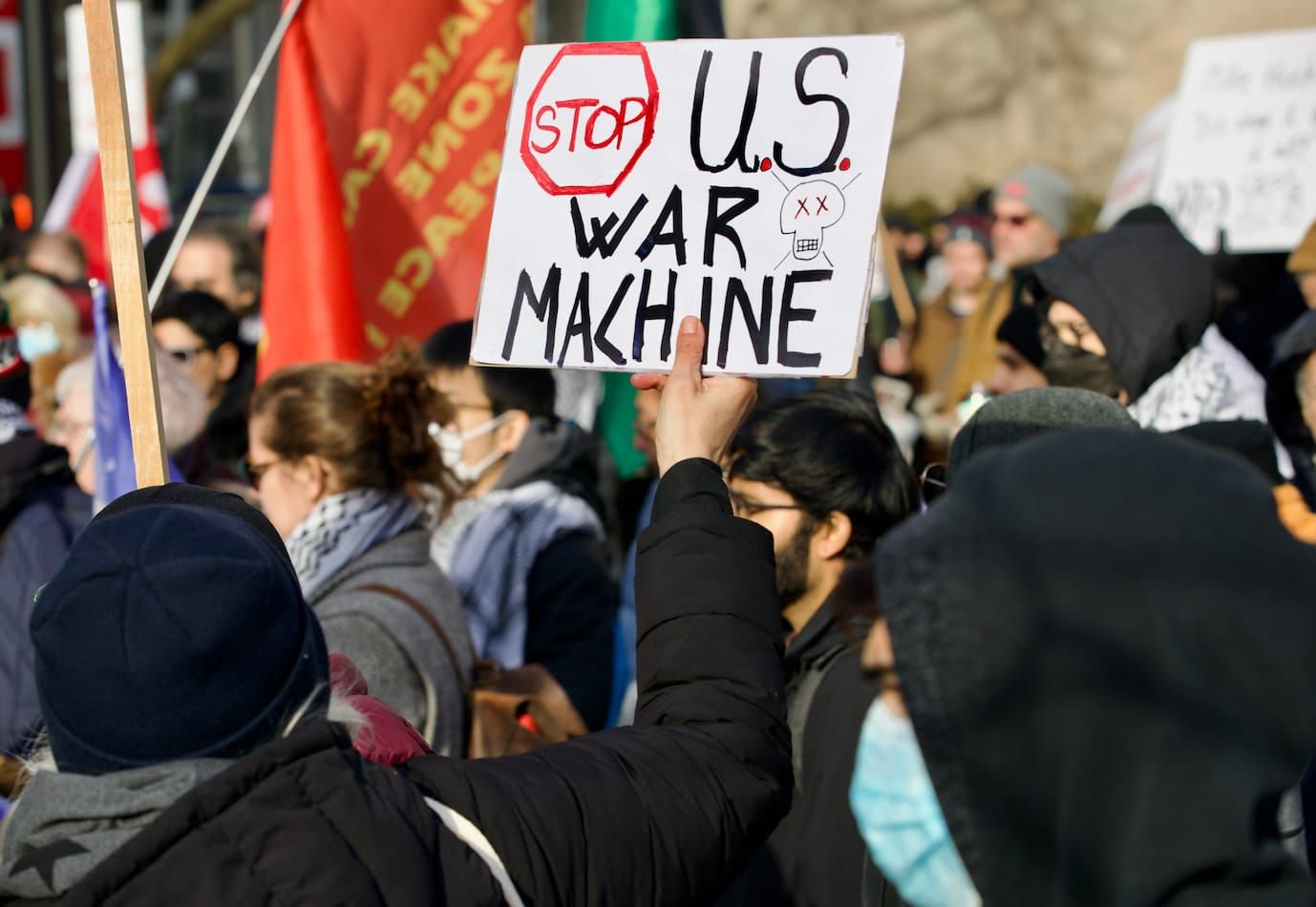

As the United States and Israel continue their illegal war on Iran, some Canadian unions and labour organizations are speaking out.
On March 5, Bea Bruske, president of the Canadian Labour Congress (CLC), condemned “the escalating cycle of violence launched by the United States and Israel against Iran and by Iran’s retaliatory strikes across the region.”
“The actions taken by the United States and Israel reflect a frightening and reckless pattern of relying on unilateral military force and coercive measures to exert political influence — a pattern we have seen in places such as Venezuela and Ukraine,” Bruske said.
Bruske continued, “Our position is clear: the United States and Israel are violating international law by committing the crime of aggression against a sovereign state. The UN Charter explicitly prohibits the use of force against the territorial integrity or political independence of any state. International law must be respected.”
Further, Bruske said that the CLC, through the International Trade Union Confederation (ITUC), has stood “shoulder-to-shoulder” with Iranian workers in their first for “democracy, dignity, safety, and the fundamental right to organize.”
“Our solidarity is rooted in the shared understanding that working people everywhere deserve livelihoods free from fear, repression, and violence. The CLC stands in unwavering support of Iranian workers, the independent unions, and the people of Iran,” Bruske said.
The ITUC, along with the CLC and other international affiliates, is calling for an immediate ceasefire and de-escalation, strict respect for international law and the UN Charter, commitment to nuclear disarmament, and “regional security arrangements based on dialogue” and “respect for freedom of expression, freedom of association and democratic rights across the region.”
As welcome as calls for peace and de-escalation are, they are complicated by Iran’s unwillingness to enter negotiations until it feels a reasonable deterrence from future American or Israeli aggression has been re-established. Given the actions of the governments of Donald Trump and Benjamin Netanyahu over the past year, it’s difficult to argue with their position.
Canadian Union of Public Employees (CUPE) national president Mark Hancock and CUPE national secretary-treasurer Candace Rennick both condemned the attack on Iran in a statement released by the union on March 3.
“We are deeply troubled by the recent escalation of violence involving military strikes and retaliatory attacks that have engulfed Iran and the broader Middle East, resulting in significant loss of life and the destruction of vital civilian infrastructure, including schools, hospitals, and essential public services,” they said.
Hancock and Rennick, while pointing out the Iranian government’s repression of unions, women, students and minorities, nevertheless warned that “illegal military attacks only bring more devastation for workers and civilians whose lives have already been severely impacted by sanctions, economic hardship, and state repression.”
The CUPE leaders expressed “solidarity with the people of Iran, including the workers and trade unions who continue to fight for freedom, equality, and self-determination — free from both domestic authoritarianism and foreign military intervention.”
The Public Service Alliance of Canada (PSAC) joined public service unions from around the world to denounce “the escalating violence caused by the United States and Israeli attacks on Iran and the dangerous expansion of the conflict by Iran across neighbouring countries.”
“Public service workers and the civilians they serve have been targeted at schools, hospitals, and other public institutions that must be protected under international law. Targeting or endangering civilian infrastructure is unacceptable. We affirm our solidarity with these workers who continue to carry out vital work in their communities under extreme and life-threatening conditions,” PSAC said.
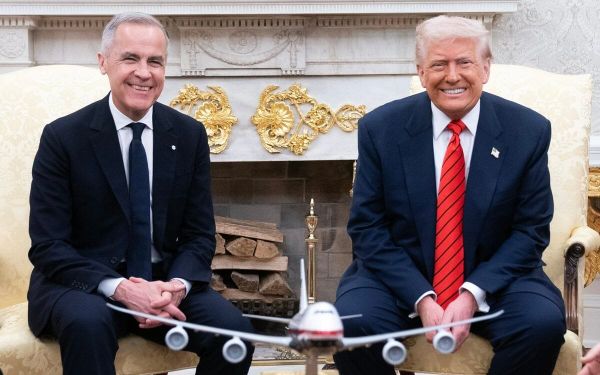
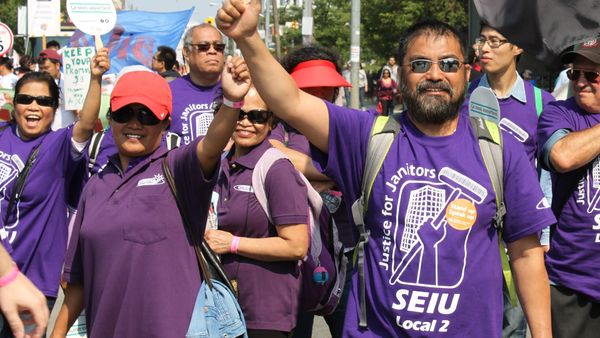
Also adding a voice of opposition, the Service Employees International Union Local 2 pointed out the hypocrisy of Prime Minister Mark Carney being “lauded for his speech at the World Economic Forum in Davos” only to initially express support for “what is an illegal US-Israeli war against Iran.”
“Canada should be a voice for de-escalation, diplomacy, and international law, not for normalizing unilateral strikes. Now more than ever we need to decouple our foreign policy from the United States and Israel,” the union said.
The International Alliance in Support of Workers in Iran (IASWI), an independent, non-partisan campaign formed in 1999 to strengthen worker-to-worker solidarity in defence of workers’ rights and struggles in Iran, also issued a statement condemning the joint U.S.-Israeli war and calling for solidarity with the Iranian people.
As IASWI rightly pointed out, the U.S. and Israeli war of aggression was undertaken without regard for the aspirations of people in Iran, irrespective of claims that the bombing is somehow in support or might redound to the benefit of Iranians. “This destructive war is not about liberating the Iranian people. On the contrary, it distorts, undermines, and destroys the very struggles for freedom, equality, workers’ rights, and social and economic justice in Iran,” the IASWI statement reads.
The IASWI further calls on labour and socialist movements around the world to support the Iranian working class in their internal fight against the repressive policies of the Iranian government. The organization urged workers, unions, socialists, anti-war activists and other progressive forces to strengthen international solidarity against “militarism, imperialism, capitalism, authoritarianism, and repression,” and support the Iranian people’s fight for “freedom, equality, and self-determination without any interference from foreign governments.”
Unions have an added reason to oppose the war. The U.S. and Israel’s increasingly aggressive bombing in the Middle East has produced an entirely predictable global energy disruption, which has driven up oil and gas prices and further exacerbated the cost-of-living crisis.
As the CLC has pointed out, workers in Canada are paying the price in the form of higher fuel and transportation costs. While these hardships pale in comparison to the suffering of Iranian civilians, they nevertheless highlight how war and imperialism threaten the interests of workers the world over.
There are also indications that the broader public is largely against the U.S.-Israeli war. According to Leger polling from last week, 58 per cent of Canadians oppose the war while just 25 per cent support it. In addition, 67 per cent of Canadians thought Canada should remain neutral.
Statements of solidarity from Canadian labour are thus a promising start, and can play a role in generating further opposition to the war. Unions ought to be a principled voice of resistance against what is often a chorus of support for war in the mainstream media.
However, calls for peace, de-escalation and solidarity with workers in Iran need to be paired with action. Unions should leverage their power to ensure Canadian governments respect international law and oppose the U.S. and Israel’s illegal war. This can involve pressuring the government directly. But most importantly, it ought to mean mobilizing members against war and aggression and supporting workers who self-organize and engage in protest.
Canadian unions and workers have nothing to gain from war in the Middle East or anywhere else. Their interests lie with workers in Iran and across the world.
Recent Class Struggle Issues
- March 16 | Canada’s Richest 86 Families As Wealthy As Poorest 6.2 Million
- March 10 | Government Denies Unpaid Work Exists In Canadian Airlines
- March 4 | Amazon ‘Breached’ B.C. Labour Code By Denying Pay Increase
- February 23 | Liberals To Blame For CUPE’s Subpar Air Canada Settlement