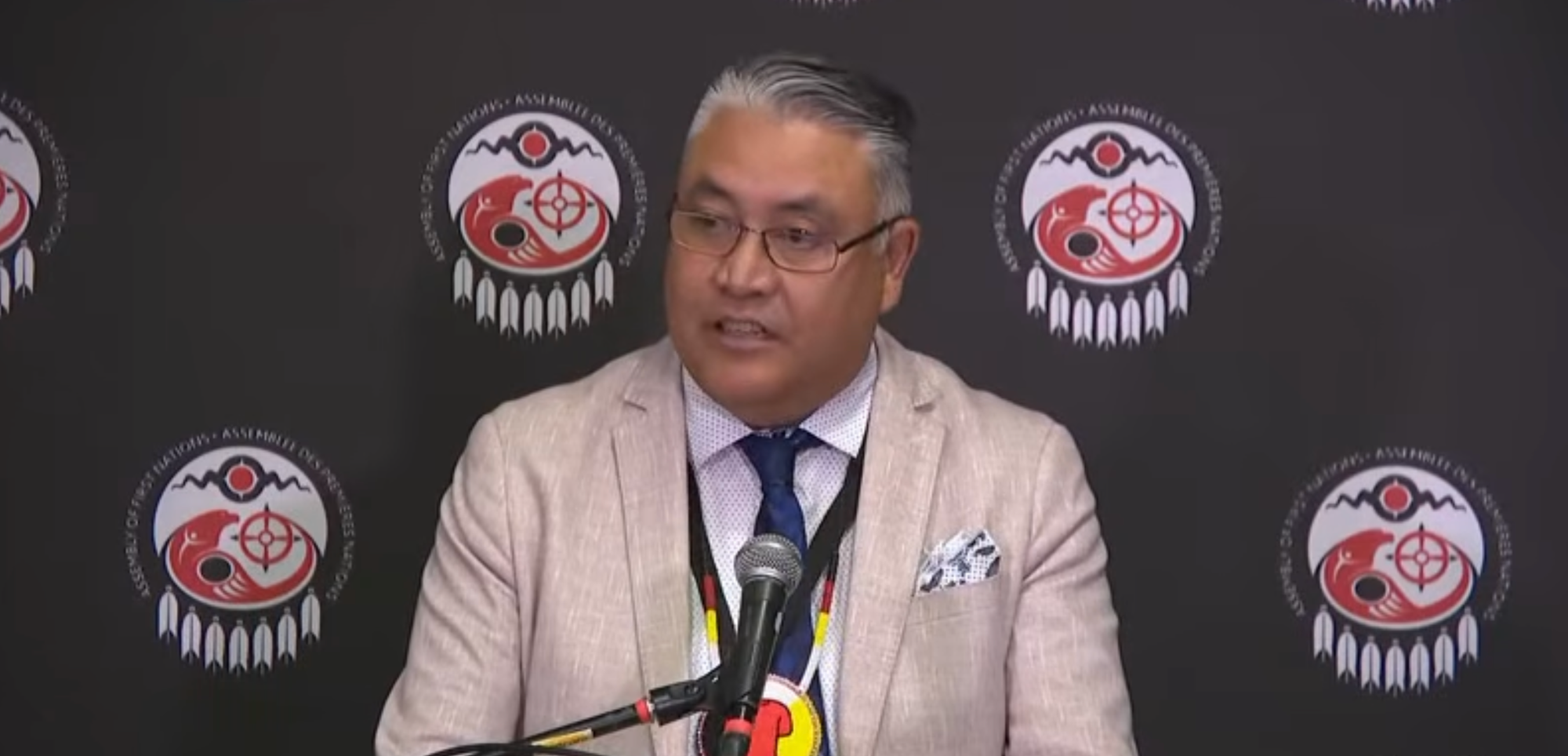
Anti-Indigenous hate speech is rising “exponentially” across Canada, British Columbia Assembly of First Nations regional chief Terry Teegee told reporters at a press conference Wednesday.
Teegee was speaking at the Assembly of First Nations (AFN) annual general meeting, where chiefs passed a motion calling on the federal government to criminalize residential school denialism as a hate crime.
“In my region, in British Columbia, we’ve definitely experienced that, many of our First Nations, not only by the general public, but also by elected officials,” Teegee said.
“That denialism is not an academic debate. It’s hate speech and it is fact. It re-traumatizes survivors, harms entire communities, disrespects children who never made it home, denies historical facts, and undermines truth and reconciliation.”
Both denialism and hate speech have been on the rise since U.S. President Donald Trump was elected, the regional chief said, which “emboldened a lot of people here in Canada.”
The possible discovery of 215 unmarked graves on the grounds of a former residential school in Tk’emlúps te Secwépemc territory further contributed to the rise in hate, he said, as did recent court rulings that could have implications for private property holders in B.C.
In Tk’emlúps, a group of “denialists” tried to break into the grounds where the possible burial sites are located in the middle of the night, carrying shovels, according to an interim report by a special representative on unmarked graves.
“Canada has failed to take the necessary steps to follow its own legislation and has failed to protect First Nations people from the rise of this racism and hate speech and rhetoric that we are all experiencing,” Teegee said.
“Part of reconciliation is accepting the hard truths of this genocidal history so we can collectively move together to a better place and make Canada what it should be.”
Senators Nix Amendment
Teegee and the other leaders at the press conference called on the federal government to criminalize residential school denialism. But just last month, senators voted down an amendment to a bill that would have done just that.
At a Senate committee, wording was introduced to amend the Liberals’ Bill C9, a hate crimes bill, to make residential school denialism a criminal offence.
“We feel and have felt this is very simple for Canada to do in the criminal code of Canada. Presently, Holocaust denialism already exists,” said Anishinabek Nation grand council chief Linda Debassige at the press conference Wednesday.
“The criminal criminal code states it is illegal to willfully promote antisemitism by condoning, denying, or downplaying the Holocaust through statements communicated anywhere other than private conversations.”
Senators representing both the Liberal government and Conservative opposition voted against the amendment. And on June 18, Parliament passed the bill without any mention of Indigenous peoples or residential schools.
“Denialism seeks to minimize, distort, and deny the harms of residential schools. That’s what the Senate did,” said David Monias, chief of Pimicikamak Okimawin, at the press conference Wednesday.
“This country still tries to commit genocide, still tries to take away our languages, our culture. They’re still denying and they won’t speak the truth and they won’t do the right thing.”
Monias, who said his own parents were survivors of residential schools, also said that about 185 children from his own community went missing while at residential schools.
Conservative MP Promoted To Critic
The chiefs’ call for the criminalization of residential school denialism comes after Aaron Gunn, a Conservative MP, was criticized during the last election for arguing that Canada did not commit genocide against Indigenous people.
“There was no genocide. Stop lying to people and read a book,” Gunn wrote on X in 2022. Gunn was replying to someone who referenced “the Canadian genocide against indigenous people.”
He has also written that Indigenous bands in Ontario “asked for” residential schools.
Last month, Conservative leader Pierre Poilievre gave Gunn a critic portfolio, which will raise his profile in the House of Commons.
Spokespeople for Gunn and Poilievre did not immediately respond to questions sent by email Wednesday.