
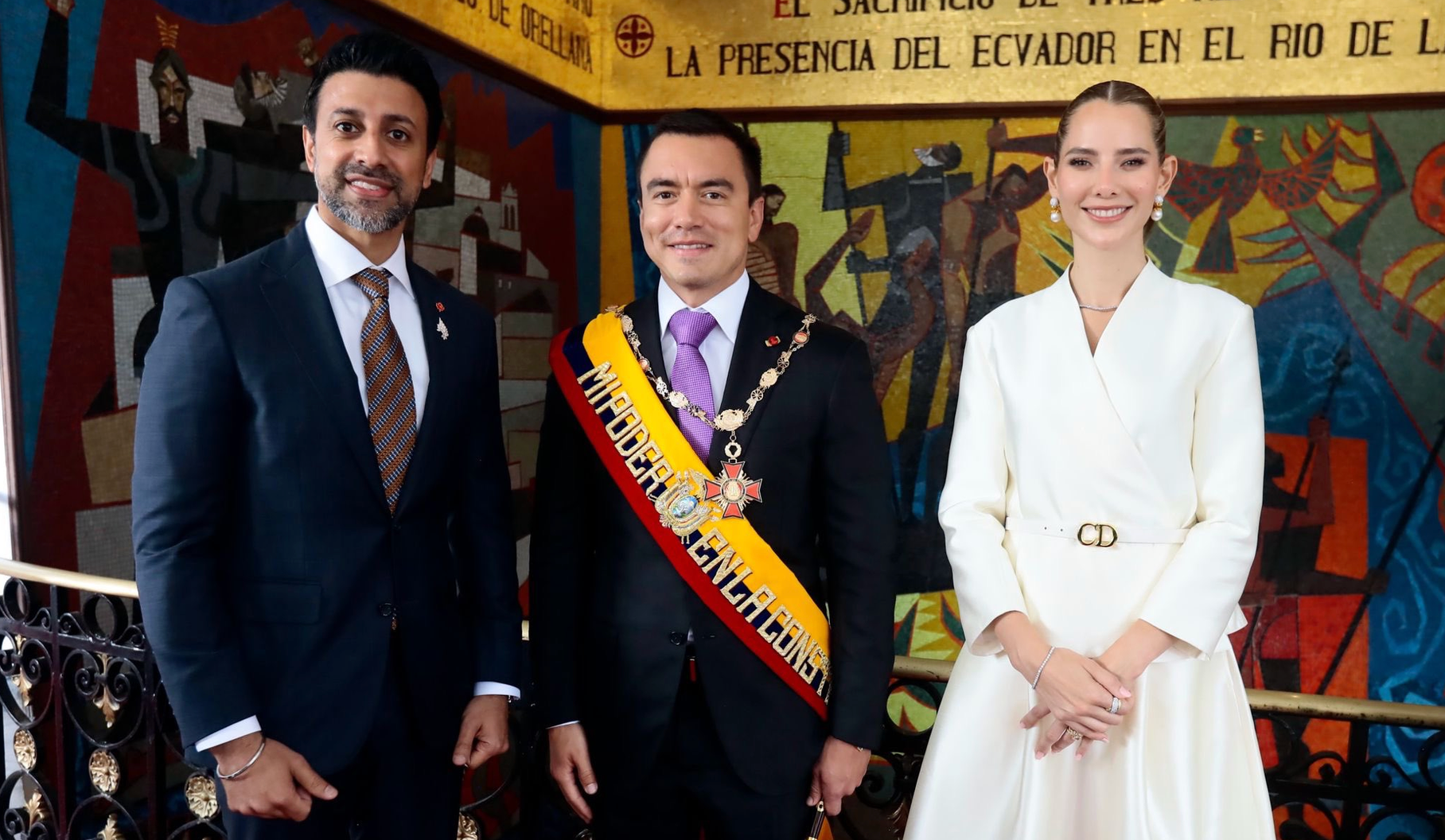
Prime Minister Mark Carney’s government was poised to lobby Ecuadorian officials to urgently speed up approvals for Canadian mining projects during last year’s presidential inauguration, briefing documents obtained by The Maple show.
The push for faster mining permits came during a period in which Ecuador’s right-wing government had launched crackdowns on Indigenous protesters who opposed major Canadian-owned mining projects.
Talking points prepared for Minister of International Trade Maninder Sidhu ahead of meetings with Ecuadorian officials in May 2025 said Canada is “pleased to see stalled Canadian mining projects gradually moving forward,” but also claimed there is an “urgent need to accelerate permits and agreements to demonstrate commitment to investors.”
The note added: “Canadian companies exemplify how responsible mining can transform regional development while generating national economic benefits.”
In a separate briefing document, Sidhu was instructed to tell newly re-elected Ecuadorian President Daniel Noboa that Canada hoped the “new Government and National Assembly can move forward rapidly on key priorities for critical mineral development and [is] looking forward to seeing existing Canadian projects move forward more rapidly.”
The demands came after Ecuador’s government already attempted to speed up environmental consultations for mining projects with a decree signed in 2023. The order was ultimately struck down by Ecuador’s constitutional court, but was nonetheless allowed to remain in effect until new laws were passed.
Sidhu’s meetings in Ecuador came after security forces cracked down on protests against the La Plata mining project the previous year. Indigenous communities said the project poses a threat to local farmland and water sources.
The country manager of Atico, the Canadian company that owns La Plata, was listed as one of seven expected participants in a round table meeting with Sidhu during the minister’s visit to Ecuador, according to the briefing binder.
La Plata was designated by the Ecuadorian government as a “security zone,” a status that allows security forces to protect early-stage mines and that critics said was used to militarize nearby communities and crack down on anti-mining protests.
“People are being criminalized because there exists no basic guarantee of the right to protest,” activist Juan Carlos Carvajal Silva told Ricochet’s Brandi Morin last year.
The company contended that opposition to the project was mounted by “violent anti-mining groups,” that the local community “invited” the police and that “organized crime” members were seeking to illegally exploit the natural resources.
In an interview with Ricochet, the company also stressed its commitment to “standards” and “responsible mining.”
The Maple contacted Atico for comment for this story but did not receive any response.
Sidhu’s briefing binder also flagged concerns about the “strong anti-extractives movement in Ecuador, with prominent international supporters, including in Canada.”
Another project owned by a subsidiary of two Canadian firms saw 29 opponents charged and 13 convicted by Ecuadorian authorities with sentences of up to four years.
In 2020, a former president of an Indigenous advocacy group, Pueblo Shuar Arutam, alleged that a vice-president from the company Solaris sent her a death threat. The VP in question strongly denied making any such threat.
Despite a formal complaint, the Ecuadorian authorities have taken no action against the company.
The Maple contacted Solaris, a formerly Canada-based company that relocated to Switzerland last year, for comment, but did not receive any response.
Despite opposition to mining projects within Ecuador, Sidhu’s briefing notes hailed Noboa for “promoting the mining sector as an engine of national development.”
The president’s 2025 inauguration came four months after the finalization of the Canada-Ecuador Free Trade Agreement (FTA), which was signed in July this year. Both countries are still in the process of domestically ratifying the agreement.
In talking points prepared for the round table discussion with mining company representatives, Sidhu was instructed to tell the participants: “Canada’s investments in mining have been critical to the development of Ecuador’s extractive sector, and a core component of our bilateral relations.”
“Once in force, the FTA will provide opportunities for both Canadians and Ecuadorians – including marginalized groups – to benefit from the increased trade it will bring.”
Another listed participant in the round table meeting with Sidhu was the director of external affairs at Dundee Precious Metals, a company that owns Ecuador’s Loma Larga mining project.
Indigenous communities similarly raised environmental concerns about this project, and argued that free, prior and informed consent had not been obtained.
In September 2025, massive national protests rallied to demand that the license for Loma Larga be revoked. The licence was revoked the following month.
In a public statement, the company said: “We are deeply concerned by the decision to revoke our environmental licence, which was issued in June following a rigorous process by the government to ensure high Ecuadorian standards are applied in the development of Loma Larga.”
“We are confident that our environmental management plan and the robust environment protection measures in place for Loma Larga are in compliance with those standards.”
The Maple contacted Dundee Precious Metals for this story but did not receive any response.
Also listed as an expected attendee at the round table meeting was the president and country manager of Gran Tierra Energy, a Calgary-based company whose stockholders recently voted to sell its assets in Ecuador and Colombia for $1.3 billion USD.
Communities in the Ecuadorian Amazon opposed the company’s oil extraction projects, with one farmer telling the publication Undisciplined Environments in 2024: “When you know that a foreign company is threatening your only clean water sources, you don’t think twice before taking part in the resistance.”
The Maple contacted Gran Tierra for this story, but did not receive any response.
The government of Canada estimates that Canadian companies own approximately $1.8 billion worth of mining assets in Ecuador.
Global Affairs Canada, which frequently ignores media requests, did not respond to an emailed request for comment for this story.
The department also delayed releasing the briefing records, which The Maple obtained through an access to information request, by over a year.