It was January 2026 when Canada’s anti-war organizers realized what they were dealing with. Activists from groups like World Beyond War and Davenport For Palestine jumped on a Zoom call to discuss Toronto’s bid to host a new global bank that will fund the arms industry.
The organizers, who mostly knew each other from Palestine solidarity protests and Signal chats, created a document and got together online to look for information about the bank.
“Could it really be that this was a financial institution whose sole purpose was to channel money into arms manufacturing?,” Rachel Small, an organizer for World Beyond War Canada, said they wanted to figure out. “Yes, that is indeed what it is.”
“That was definitely when we coined it a ‘war bank.’”
Since then, Small and her fellow activists held dozens of one-on-one conversations with organizers from the student movement, labour unions, and civil society groups to build what they hope will be a national movement to stop the bank from coming to fruition in Canada.
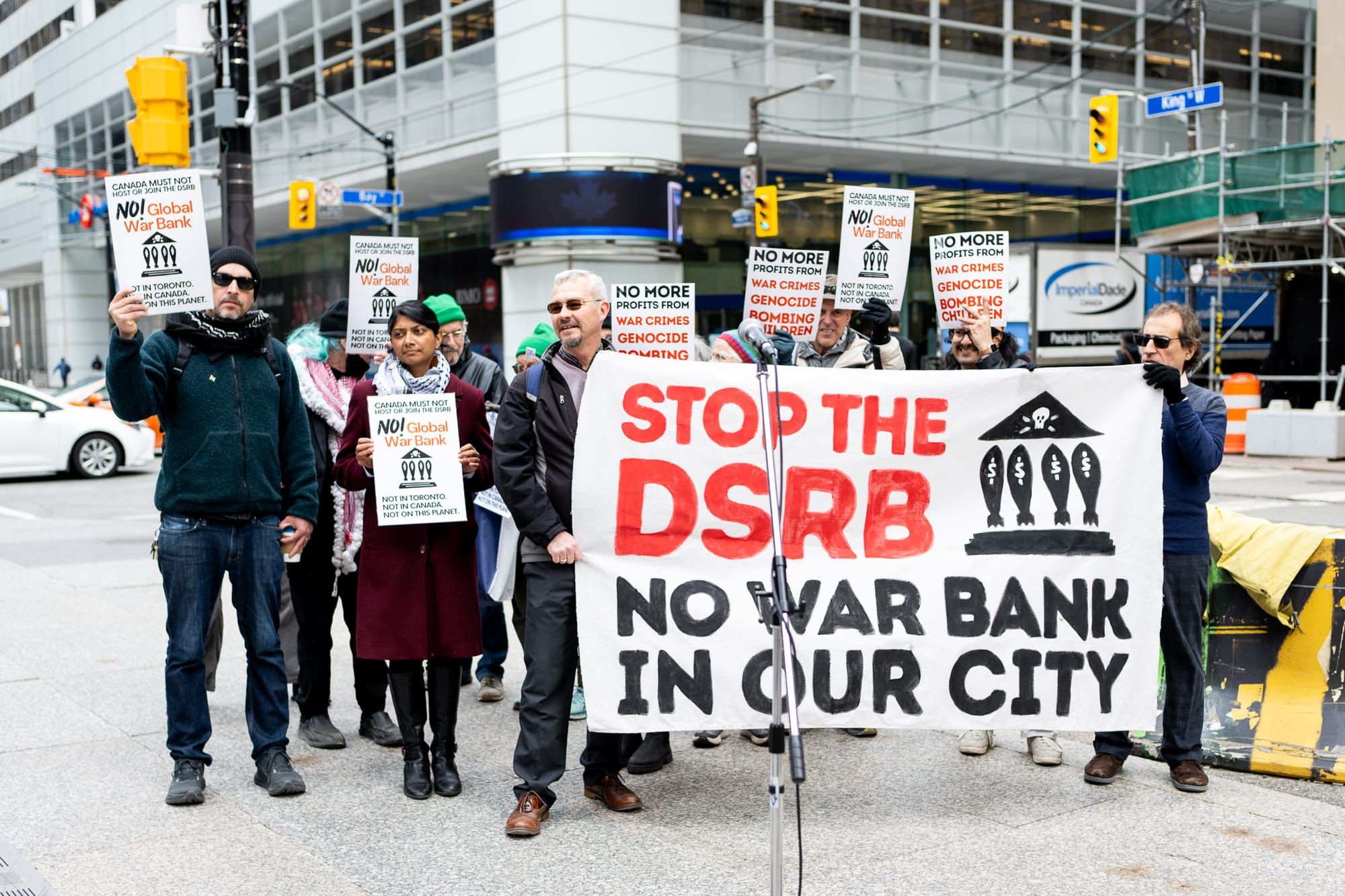
On Friday, at a press conference in the heart of Toronto’s financial district, they launched their campaign with the slogan: “Stop the DSRB: No war bank in our city.”
The “Defense, Security and Resilience Bank,” or DSRB, was originally an idea proposed by NATO. Last week, Canada was officially selected as the host country, and some of its major cities — Toronto, Vancouver and Montreal — are vying for the chance to host the bank’s headquarters.
“The last thing Canada needs is a new military financial arms race,” said Sharmeen Khan, a member of World Beyond War Toronto, at the press conference. “Security comes from funding homes, food and education. Security does not come from an economy built on war.”
Meanwhile, organizers of a neighbourhood Palestine solidarity group are turning their focus from lobbying elected officials to pushing financial institutions to divest from the war bank.
Toronto teachers are pressuring the head of their pension plan to drop it. University students are linking the fight against war profiteering to the fight against Ontario Premier Doug Ford’s cuts to tuition grants.
And groups that advocate for better health-care and a healthier environment are condemning the bank as an example of how increased militarism will take resources away from those priorities.
“I’m seeing already a huge range of reasons why people feel really passionate about not letting this take place,” Small told The Maple.
“It’s much harder to take down an institution that is established and that has been built, and this is a really unique opportunity to take down this war bank before it can launch.”
Rebranding War
Since 2019, NATO has been pushing for its own bank, according to the Atlantic Council, a pro-U.S. think tank that published a report on the benefits of such an institution.
The bank will help solve NATO’s money problems, the report said, by pooling investment from member countries and underwriting risks for commercial banks.
The DSRB Development Group, an organization that says it is co-creating the bank with various governments, lists RBC, BMO, Scotiabank, CIBC, TD, JP Morgan, Deutsche Bank and others as its supporters. Canada has said it is working with allies to establish the bank, but hasn’t identified which allies are involved.
NATO has specifically said the bank will address the perception that the weapons industry is at odds with guidelines that investors follow regarding the environmental, social and governance impacts of their investments.
The Atlantic Council said the bank can also solve another problem: that people in Canada and Europe want their public money spent on health care, education and infrastructure — not war.
Nikolas Barry-Shaw, a campaigner at the Council of Canadians, said that is exactly why his organization is opposed to the DSRB.
“It’s a big concern for the council, and I think for every progressive organization, because this push to undertake a really unprecedented military buildup is kind of gobbling up every other priority,” he told The Maple.
Barry-Shaw pointed out that while the Mark Carney government pours money and resources into military spending and the DSRB, it is poised to withdraw resources for health care.
The government could cut spending on Health Canada by $3 billion over the next three years. Three thousand public servants at Health Canada and one other department have been told they may lose their jobs.
In November 2025, CBC News reported that the Carney government wasn’t actively working on expanding pharmacare to any more provinces or territories.
“You can’t advocate for things like public health care, clean water or climate action without grappling with the fact that there’s this juggernaut of militarization barreling towards us,” Barry-Shaw said.
The Council of Canadians will support the fight to stop the war bank, he said, and will tie Carney’s agenda of militarization to the under-funding of health-care when the organization’s staff tour Atlantic Canada this summer.
A spokesperson for Canada’s Department of Finance said the government does not view defence and other types of spending as competing priorities.
“These objectives are mutually reinforcing and collectively essential to Canada’s economic resilience and security, particularly in a more uncertain global environment,” spokesperson Marie-France Faucher wrote in an email.
“On health care, the federal government continues to provide stable, growing transfers to provinces and territories, alongside targeted investments. Budget 2025 maintained the Canada Health Transfer, while national programs such as the Canadian Dental Care Plan continue to expand access to care.”
Omar Mousa, Ontario representative at the Canadian Federation of Students (CFS), tied opposition to the war bank to Ford’s recent cuts to student grants at Friday’s press conference.
For years, he said, Ontario’s education system was overly dependent on international students to fund the system. Now that Prime Minister Mark Carney has slashed visas for those students and Ford has slashed grants, students will be forced to take out loans from some of the same banks funding the DSRB.
“At the end of the day, this is a predatory system that feeds itself. The very loans that students will need to be taking out to access education will be used by these very same financial institutions and governments to fund their military expansionism,” Mousa said.
His colleague at CFS, York University undergraduate student Adaeze Mbalaja, told The Maple that the federation will try to channel students’ rage at Ford into fighting imperialism and war too.
“Students are really pissed,” Mbalaja said.
“Obviously, naturally, there’s a whole lot of ‘Fuck Doug Ford,’” chants at student rallies, she said. But organizers are also leafleting about the DSRB and war, and seeing a big response to chants like, “Drop fees, not bombs.”
Mbalaja said CFS organizers may escalate their fight against the war bank as more information becomes available.
Ontario has promised to provide funding to the war bank through funds like the $5-billion Protect Ontario Account, which invests in private companies, as well as the Ontario Shipbuilding Grant and tax credits.
NATO Spending to Soar
The bank’s supporters say it’s a creative way to finance the massive increase in military spending that NATO members have promised to undertake.
In March, Carney announced his government was spending billions of extra dollars on defence and had met Canada’s NATO commitment to spend two per cent of its GDP on defence.
However, NATO allies including Canada have agreed to more than double that spending target to five per cent of GDP by 2035.
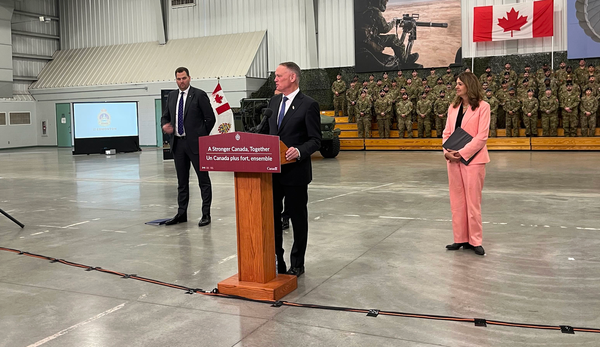
At a press conference in December, Doug Ford, Toronto Mayor Olivia Chow, Liberal MP Julie Dzerowicz, and the CEO of the DSRB Development Group Kevin Reed announced Toronto’s bid to host the war bank.
They said the bank would help fund NATO’s dramatic acceleration in spending — one that they say will transform Canada.
“All 32 NATO countries, including Canada, are working to turbocharge our defence spending. And this means mobilizing hundreds of billions of dollars and we need diverse sources of capital to do it,” said Dzerowicz.
“Our goal of raising defence spending to five per cent by 2035 represents one of the most ambitious industrial undertakings in Canadian history.”
Kevin Reed, a Canadian who is the president and CEO of the DSRB Development Group, said that NATO’s total spending will increase from $1.6 trillion a year to $4 trillion by 2035.
“For Canada, that means moving from $30 billion, roughly, a year to $150 billion. Now, really think about what that means for our country.”
The Maple’s attempts to reach Reed were unsuccessful and the DSRB Development Group does not list any contact information on its website.
Palestine Groups Change Tactics
Dzerowicz’s presence at the press conference inspired Tyler Delmore, a Toronto dad, to join the fight against the DSRB. Dzerowicz is the MP for Davenport, the west-end Toronto riding where Delmore and his family live.
Delmore has been a member of Davenport For Palestine since the beginning of Israel’s genocide in Gaza in 2023.
Back then, Delmore believed that elected MPs would change their positions to reflect the will of their constituents. But over the past two and a half years, he’s been devastated by the Liberal government’s support for Israel’s war and wants to refocus his energy.
“Supposed mechanisms for political action here in Canada have completely failed,” Delmore told The Maple. “Many of us have been radicalized by the fact that our government has done nothing.”
For six months, from September 2025 to March 2026, Delmore and his neighbours in Davenport For Palestine poured their energy into lobbying Dzerowicz.
She hadn’t announced her stance on the No More Loopholes Act, which would have subjected Canada’s arms exports to tighter controls, and they wanted to convince her to support it.
The neighbours called Dzerowicz’s office every day, Delmore said. They met with her in person on December 5, and knocked on doors to meet other people who could contact her. They handed out leaflets at the subway station and organized a rally at her office.
The whole time, Dzerowicz and her staff said she was still considering the bill, according to Delmore and a screenshot of a January 14 email from Dzerowicz’s office viewed by The Maple.
Then, on March 11, the day of the vote, Dzerowicz voted against the bill.
“It was just a realization of darkness, like in a comic book movie where all of a sudden Superman’s eyes go black,” said Delmore of that moment. “Like, oh, there’s complete moral bankruptcy here.”
Dzerowicz’s office did not respond to an email and voicemail from The Maple seeking comment.
Equipped with recent experiences in mind, Delmore said, Davenport For Palestine is changing tactics. Instead of lobbying their MP, members are focusing their energies on investors like banks and pension funds that will fund the new war bank if it’s established.
The strategy has been successful in the past.
Earlier this year, for example, Scotiabank dropped all of its remaining investments in the Israeli weapons manufacturer Elbit Systems. A grassroots campaign — which included protests, sit-ins, and a boycott by artists of the Scotiabank-funded Giller Prize — successfully put pressure on the bank to cut ties with Elbit.
Teachers Target Pension Plan
One of the investors that organizers want to see divested from the war bank is the Ontario Teachers’ Pension Plan (OTPP). The plan is one of the largest pension funds in the world with $279 billion in assets.
Jo Taylor, CEO of the OTPP, has signed multiple documents calling for the war bank to be based in Toronto.
“We are pleased to support the Ontario government in its efforts to have Toronto host the new global headquarters of the Defence, Security and Resilience Bank,” Taylor was quoted as saying in a document announcing Toronto’s bid to host the bank.
World Beyond War and Davenport For Palestine have built relationships with the teachers already calling for OTPP to divest from weapons manufacturers and other companies that are boycotted because of their connections to Israel.
On April 16, teachers rallied outside the OTPP’s annual general meeting — and disrupted the proceedings inside — to tell Taylor not to invest in the DSRB.
The teachers held huge banners that said, “Stop the DSRB. No war bank in our city.”
They gave speeches about how the violence in Gaza has affected them and their students. And they reminded other teachers who were present that they are complicit in war for as long as their pensions are invested in weapons manufacturers.
“We don’t want to be making money from war,” said James Campbell, a Toronto teacher who participated in the action. “We don’t want to be fueling war profiteering.”
Government Asked for War Investments
At the AGM, Taylor, the CEO of the pension plan, said the government had specifically asked the plan to invest in the weapons and defense industry.
“Our exposure to defence businesses is relatively low, less than one per cent of the fund,” Taylor told the crowd, according to a recording of his remarks obtained by The Maple.
“We also think that the defence sector more broadly is becoming more investible for some reasons. Firstly, we’ve been asked to do it. We’ve been asked to do it by our local government here to help them build national security and the defence of Canada.”
“Secondly, it’s been a successful sector, delivering high return for those who’ve been investing in it, and is in line therefore with our desire to make sure to deliver returns for you as part of the plan.”
The Maple asked both OTPP and the federal government whether a member of the government asked the pension plan to invest in the DSRB specifically.
Spokespeople for OTPP did not respond. The Department of Finance’s written statement did not address questions about the pension plan.
Campbell said he was shocked by Taylor’s comments, which came after two and a half years of advocacy by teachers to divest their pensions from weapons and war.
“For him to stand up on stage and say, ‘Well, we’re doing this because the government has asked us,’ felt like very much a slap in the face.”
The campaign against the war bank has another important reason to consider divestment strategies, according to Barry-Shaw, the campaigner at the Council of Canadians.
If the bank goes forward, weapons companies would have a permanent source of funding that is less vulnerable to pressure campaigns than individual companies currently are.
“It means yes, effectively, that popular movements against genocide, against militarism, are going to face an added barrier to putting pressure on private investors to pull out,” said Barry-Shaw.
That is one of the reasons why Small, the World Beyond War organizer in Toronto, says the fight against the war bank is about the future of Canada and the whole world.
“These major decisions Canada is making now about ramping up the military budget, about buying new weaponry from the U.S., about launching a global war bank, about refusing to regulate Canadian arms [...] That’s them committing to wage war alongside the U.S. for decades to come,” she said.
“I think we’re at a really critical turning point where either we put up roadblocks in this war agenda, we make it clear that it’s absolutely unacceptable for Canada to be contributing a single antenna to a single missile that’s being dropped on school kids anywhere in the world, or we will […] ramp up a military strategy that makes this country and its role in the world unrecognizable in the coming decades.”