


As the federal NDP leadership race continues toward the convention from March 27-29, members from across the country are vying to shape the direction of the party. Candidates are making their pitches to members through their respective platforms, while delegates and local party organizations are drafting policy proposals to submit for debate.
When it comes to the labour agenda, there appears to be growing support for sectoral bargaining. For example, leadership hopeful Avi Lewis’s bold labour platform features a plan to expand sectoral bargaining.
Other layers within the party are also pushing to expand union access through sectoral bargaining. In late January, the Mission—Matsqui—Abbotsford electoral district association (EDA) in British Columbia released a convention resolution package, placing sectoral bargaining as a central policy demand.
Jules Côté, who ran as the NDP candidate for Mission—Matsqui—Abbotsford in the last federal election and now serves as the EDA president, told Class Struggle that local voters’ concerns about affordability encouraged her to consider how to expand access to unionization and collective bargaining. “Before running as a candidate, I door-knocked for the provincial Party, asking folks what their main concerns were. Affordability was overwhelmingly the top issue,” she said.
As a candidate, Côté began drafting her platform in response to voters’ economic concerns. Her ideas included sectoral bargaining, the constitutionalization of workers’ rights and giving workers the right to take over firms that are closing or going out of business.
These ideas “resonated with many of the folks I talked to on the doors,” Côté said. “Now, our EDA is working to get sectoral bargaining added to the Party’s Policy Book.”
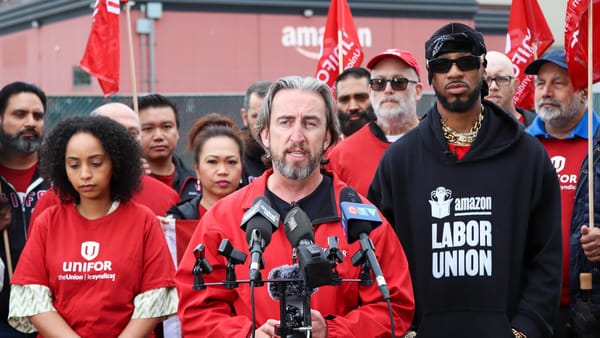
Many labour law scholars have long argued that structural changes in the private sector necessitate a new labour relations framework for Canada. Our post-Second World War model of worksite-level unionization and collective bargaining was built with large industrial firms in mind. With many people now working in small workplaces, franchised establishments and in various forms of contracted work, this model leaves the majority of private-sector workers shut out of collective bargaining. Even where workers manage to unionize, for example at Starbucks locations across North America, winning contracts remains a challenge, while extending union coverage to more than a small share of stores is next to impossible.
As the Mission—Matsqui—Abbotsford proposed sectoral bargaining resolution puts it, “Our current system of decentralized collective bargaining results in uneven and fractured representation, leaving most workers without a strong voice and living in precarity.” As it further elaborates, “this system has allowed for the erosion of the labour movement and the loss of many hard-won gains.”
In addition, “fissured” employment relationships often combine with concentrated corporate power to make it exceedingly difficult for unions to organize new members.
Côté and her local EDA recognize that responding to corporate power requires structures that facilitate broader unionization. “I believe the best means we have of uplifting depressed wages is to give unions the ability to bargain at the scale corporations operate, and secure decent wages and dignified conditions for all,” Côté told Class Struggle.
In contrast to Canada’s decentralized labour relations system, sectoral bargaining would allow unions to negotiate contracts covering whole industries, occupations or regions. There’s evidence from all over the world that sectoral systems encourage high levels of union coverage, greater income equality, higher overall employment levels and in many cases, higher productivity. Sectoral, broader-based bargaining systems are the norm in most other industrialized capitalist economies, raising union density and contract coverage well above Canadian levels.
The question has always been how to implement sectoral bargaining in Canada, where two major challenges exist.
First, employers, unions and governments all tend to have their own reasons for persisting with Canada’s decentralized model. Unsurprisingly, employers oppose any arrangement that would provide unions with more structural power. But within the labour movement as well, there remains a lack of consensus, and in some quarters, opposition to a sectoral system. While this is changing as more unions recognize the need for reform to grow the movement and reverse private sector union decline, much work remains to be done to build broad labour support.
Second, pursuing deep labour law reform is difficult because employment and labour law are largely the jurisdiction of the provinces. Co-ordination across provinces is immensely challenging, meaning that, in practice, labour would need to choose one progressive jurisdiction within which to fight for, and hopefully test, a sectoral bargaining alternative.
Côté and the Mission—Matsqui—Abbotsford EDA are seeking to meet these challenges through a federal NDP policy based on Quebec’s “decree” system. Under Quebec’s model, unions can make requests to the labour minister to extend existing collective agreements to multiple employers or whole sectors.
As Côté told Class Struggle, “For decades, unions in Quebec’s public and para-public sectors have negotiated agreements at the sector level. Our resolution calls for this system to be expanded federally. It would grant unions the authority to request that the minister of labour extend agreements across sectors via decree.”
For Côté and the Mission—Matsqui—Abbotsford EDA, federal legislation could test the viability of broader-based bargaining and allow unions and progressive policymakers in the provinces to build from the federal example. “I believe that adopting this resolution at the federal level is a necessary step toward pushing for its adoption provincially, where 80-90 per cent of Canadian workers are employed,” she said.
Côté and her riding association are also situating their call for sectoral bargaining within a broader slate of reforms meant to build the power of the Canadian working class.
As the preamble to the riding association’s policy package puts it, “More and more wealth and power is being concentrated in the hands of fewer and fewer [...] Unchecked corporate power has left workers struggling to put food on the table and keep a roof over their heads [...] It is no longer enough to advocate only for more funding for public services or a broader welfare state; we must fight for: workers’ democracy through sectoral bargaining, codetermination, and cooperatives; the rights of migrants by ending closed work permits and opening a clear path to permanent residency for temporary foreign workers and the undocumented; for Indigenous sovereignty by supporting the full implementation of the [Truth and Reconciliation Commission] Calls to Action and advancing land restitution measures; for farmers’ rights by creating a National Land Bank, guaranteeing seed sovereignty, and rebuilding the Canadian Wheat Board; an end to Canada’s corporate oligopolies.”
As Côté explained to Class Struggle, these ideas fit together into a vision for building the power of ordinary, working-class people in Canada. “Our resolutions go beyond sectoral bargaining; we’re also calling for codetermination, the constitutionalization of workers’ rights, and workers' right of first refusal, among many others. I believe sectoral bargaining, along with these reforms, is essential, not just to redistribute wealth, but power.”
The first step, however, is winning broad support and shifting party policy. Côté thinks this is achievable. She told Class Struggle, “I believe, while it may not yet be at the forefront of Canadians’ minds, New Democrats are the only party willing to do the work of building the political will for sectoral bargaining, and the only party that can hold the federal government accountable to implement it. To rebuild our party and our movement, to position ourselves to hold the federal government accountable again and one day form government, New Democrats must do so with clarity of purpose and vision.”
From income inequality to unchecked corporate power, the immense challenges of our time call for bold ideas and a radical vision. Sectoral bargaining may therefore be a policy whose time has come.
Recent Class Struggle Issues
- February 9 | Top-Paid CEOs Made More In 33 Hours Than Workers Will In 2026
- February 2 | Carney’s Job Cuts Undermine Canada’s Position Against Trump
- January 26 | Avi Lewis’s NDP Labour Plan Is A Remarkable Document
- January 19 | Trump’s Xenophobic Crackdown Will Destroy Labour