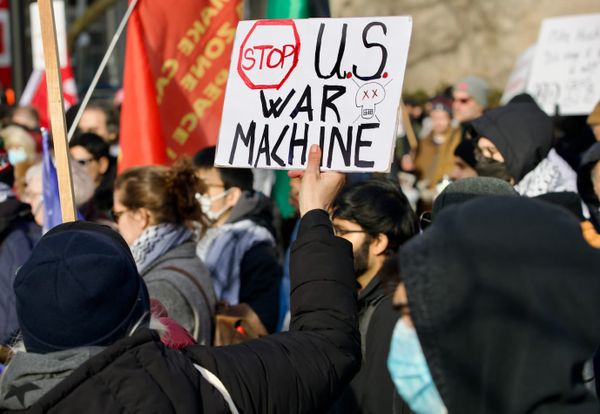



The Trump administration’s immigration enforcement crackdown has reached new levels of violence in Minneapolis, as residents escalate their protests following the killing of Renee Nicole Good, 37, by an Immigration and Customs Enforcement (ICE) officer on January 7.
Thousands of federal ICE agents have been sent to the Twin Cities in this latest episode of the administration’s immigration crackdown.
Skirmishes with protesters and bystanders have been a daily occurrence. Citizens have been detained without explanation, leading the ACLU to file a class-action lawsuit. Along with immigrants and other racialized people, members of Minneapolis’s sizable Indigenous community have also been targeted by ICE agents.
On January 14, ICE shot a Venezuelan-born man in the leg after attempting to detain him in a traffic stop. The day before, agents aggressively pulled a disabled woman from her car after smashing her passenger window.
In response to protests, United States President Donald Trump threatened, yet again, to invoke the Insurrection Act in order to deploy federal troops.
Minneapolis is of course just the latest episode in a violent and racist targeting of immigrants and their allies. Federal agents, frequently armed with military-grade weapons, have been terrorizing communities across the U.S., training their weapons not only on immigrants but also on American citizens.
Thirty-two people died in ICE custody in 2025, the deadliest year since the agency was founded in 2003.
This so-called enforcement activity is not only an unjustified targeting of immigrants and racialized people, but also an assault on the entire working class.
The immigrants in ICE’s crosshairs are invariably workers. But it’s also important to understand that Trump’s immigration crackdown is economically harmful for all workers, wherever they were born.
Contrary to those on the populist, nationalist right who have tried to sell attacks on immigrants as pro-worker policy, there is strong evidence that the interests of foreign- and U.S.-born workers are strongly aligned.
This past summer, the Economic Policy Institute (EPI), a progressive think-tank based in Washington, published a detailed report by Ben Zipperer showing how Trump’s deportation agenda could harm the American job market. Assuming the success of the administration’s plan to deport 4 million immigrants, Zipperer modelled the negative economic consequences for all workers.
The report argued that Trump’s deportation agenda would not simply remove immigrants from jobs, but would in fact destroy millions of jobs presently held by both immigrant and U.S.-born workers.
Challenging the narrative that removing immigrants would open job opportunities for ‘American’ workers (in fact, some are falsely claiming that U.S.-born employment has surged due to deportations), Zipperer showed that, through a number of mechanisms such as reducing labour supply and choking off consumer demand, deportations would actually lead to job losses across the entire workforce.
As Zipperer put it, “Regardless of the exact mechanisms, deportations can cause a sharp and abrupt enough fall in labor supply that some employers will respond by shutting down operations entirely.” He added: “Because jobs held by U.S.-born and immigrant workers are often complementary and economically linked, the shrinking supply of immigrant labor can adversely affect employer demand for jobs held by both groups of workers.”
Additionally, because the threat of deportation and immigration enforcement reduces immigrant workers’ leverage with employers, this makes these workers more reluctant to enforce their employment rights. Such fears can also prevent immigrant workers from moving freely in the labour market, choosing instead to stay in bad jobs to protect their status in the country. These labour market restrictions then push wages down and undermine the working conditions of both immigrants and U.S.-born workers.
According to the EPI’s calculations, if the Trump administration proved successful with its full deportation plan, the result would be 3.3 million fewer employed immigrant workers and nearly 2.6 million fewer employed U.S.-born workers.
The administration’s extended immigration crackdown would have especially concentrated impacts on particular sectors that are highly dependent on immigrant workers. Employment in construction, for example, would drop sharply, with a fall of 1.4 million jobs currently held by immigrant workers and 861,000 jobs held by U.S.-born workers. The report also estimated that about 15 per cent of all child-care jobs would disappear, potentially crippling the sector.
Approximately one in five workers in the U.S. is an immigrant, and roughly half of this group are non-citizens, according to the report. As the EPI’s study makes clear, immigrant workers are an integral part of the American labour market. Deporting large numbers of immigrants won’t result in better job prospects for U.S.-born workers, but rather fewer available jobs for all workers.
In fact, there’s already evidence that the immigration crackdown is causing labour shortages and economic strain in certain sectors.
The Guardian reported this past summer that employers in the food, hospitality, construction, transportation and care sectors were starting to feel the pain, as workers either lost status in the country, were deported, or stopped showing up for work out of fear. In some cases, hundreds of unionized manufacturing workers in the U.S. legally for years abruptly lost their status.
Tourism and hospitality has also been hit hard by the immigration crackdown and the decline in international patrons travelling to popular destinations such as Las Vegas. Visitors to the latter city, where many Latino workers in casinos and hotels are union members, were 11.3 per cent lower in June 2025 than June 2024. A large chunk of the decline resulted from Canadians ceasing travel to the U.S.
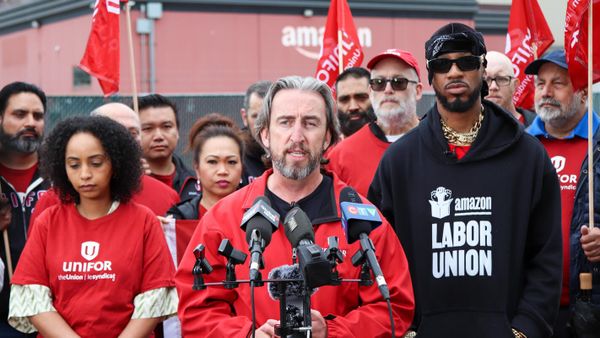
Across the U.S., workers and unions are organizing to fight back against the attacks on immigrants. In education, construction, manufacturing, health care and other industries, union activists are stepping up to protect their fellow workers and support their neighbours. In some, more traditionally conservative, unions, this has meant challenging leadership and accommodations made with Trump and other right-wing politicians.
Across cities and states, immigrants, racialized people, and their allies have organized “rapid responders” to alert neighbours when ICE agents are nearby and to support those swept up in its violent dragnet.
Good herself was a member of a network of these rapid responders who tried to protect their Latino and Somali neighbours in Minneapolis from the out-of-control and violent federal immigration regime that descended on their city.
This grassroots activism is both inspiring and unfortunately necessary. While many unions have come a long way when it comes to immigration and support for immigrant workers, there’s still much work to do to mobilize the union resources required to successfully fight the anti-immigrant agenda.
Canada is of course not immune to the anti-immigrant backlash either. We’re watching the worst excesses of nativism and xenophobia south of the border now. But fighting this anti-worker agenda wherever it manifests is incumbent on us all.
Recent Class Struggle Issues
- January 12 | Alberta Unions Continue To Deliver For Workers Despite UCP Attacks
- January 5 | Here’s How Canadian Workers And Unions Fared In 2025
- December 15 | The Government Is Withholding Data On Labour Relations
- December 8 | Manitoba Workers Will Finally Be Protected From Asbestos