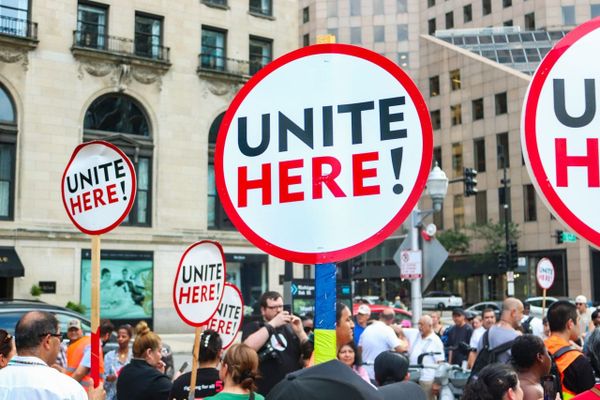


On October 30, dockworkers at more than 100 ports across 22 countries participated in an extraordinary day of strikes and protests against Israel’s genocide in Gaza, the global arms trade and the increasing militarization of commercial ports.
From Italy and Greece to France, Morocco, and India, workers withheld their labour, disrupted shipping operations, and demonstrated their opposition to the use of civilian ports to transport weapons and military equipment. More than 25 unions took part in the co-ordinated mobilization, one of the largest international actions of its kind.
The action was organized under the slogan “Ports for Peace – Jobs with Dignity,” following a meeting of European and Mediterranean dockworkers’ unions in Istanbul earlier this year. It also responded to repeated appeals from Palestinian trade unions for workers to take concrete action internationally against companies and governments complicit in Israel’s destruction of Gaza.
The Palestine General Federation of Trade Unions welcomed the mobilization. “Dockworkers around the world, on this historic day, you are writing a proud chapter in the history of trade union and humanitarian solidarity,” said general secretary Shaher Saed in a statement published by the International Transport Workers’ Federation.
The strikes illustrated the enormous potential of workers to exercise power beyond their immediate workplaces. While governments continue to arm Israel and facilitate international military trade, port workers demonstrated that the movement of goods, including weapons, ultimately depends on their labour.
Italy has been at the forefront of this growing movement. The militant Unione Sindacale di Base (USB) called a 24-hour general strike, extending the mobilization beyond dockworkers to other sectors. In Genoa, where workers have repeatedly organized against arms shipments to Israel, the latest action built on years of opposition to the port’s involvement in military trade.
Italian dockworkers have increasingly connected opposition to war with domestic struggles over wages, pensions and public services. As USB has argued, workers are being asked to accept deteriorating living standards while governments devote growing resources to militarization.
Elsewhere, approximately 3,000 workers participated in a walkout at Greece’s Piraeus port, disrupting cargo operations and ferry services. French dockworkers organized a 24-hour stoppage, while unions in Turkey, Morocco and Spain also mobilized. Although the extent of disruption varied, the co-ordinated action represented an important effort to prevent military shipments from simply being redirected between ports.
Swedish dockworkers have also provided an important example of international solidarity. In December 2024, 68 per cent of voting members of the Swedish Dockworkers’ Union supported the proposal to blockade military equipment travelling to or from Israel.
The union subsequently announced a six-day blockade, which began in February 2025 after Sweden’s Labour Court permitted the action to proceed. Employers challenged the blockade, while union vice-chair Erik Helgeson was subsequently dismissed by his employer, a move the union condemned as retaliation.
The Swedish example illustrates both the possibilities of worker-led international solidarity and the risks confronting union members and leaders who attempt to put it into practice.
North American participation in the October 30 day of action was more limited, although workers and Palestine solidarity activists have continued organizing against the arms trade.
In Oakland, Calif., members of International Longshore and Warehouse Union (ILWU) Locals 10 and 34 joined community supporters for an October 30 rally opposing the genocide in Gaza and international militarism. The demonstration drew on the long tradition of political activism among West Coast dockworkers, although it did not constitute a port-wide work stoppage.
In Canada, the most significant recent development came just days before the international strike. On October 28, the Canadian Labour Congress (CLC) announced that its Canadian Council had adopted a resolution supporting workers who refuse to handle weapons and military equipment destined for Israel.
The decision followed sustained organizing by Labour 4 Palestine, the Canadian BDS Coalition and other activists demanding that Canadian unions declare military shipments to Israel “hot cargo.” Earlier this year, CLC convention delegates also voted to sever ties with the Histadrut, Israel’s national trade union federation.
These are important steps. But there remains a significant difference between adopting solidarity resolutions and actually interrupting the supply chains that sustain Israel’s military operations.
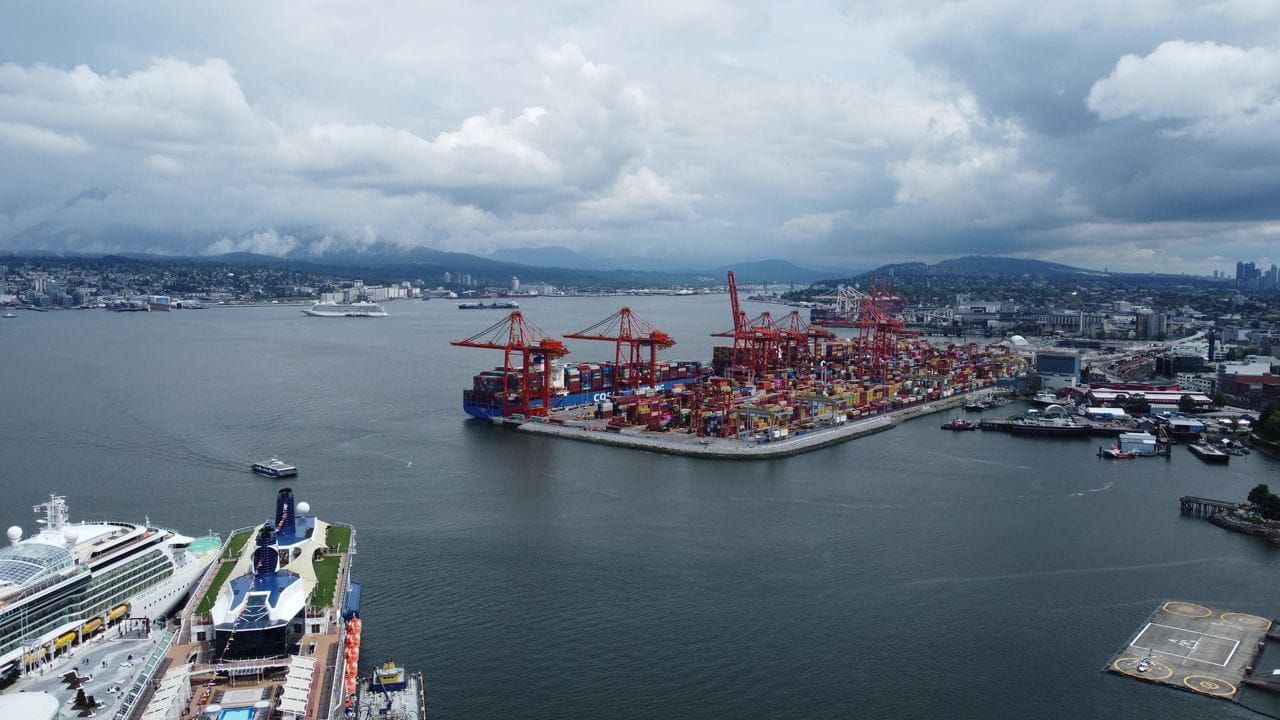
With unions in Canada largely absent, activists have taken matters into their own hands. In February 2024, more than 100 demonstrators blockaded truck access to the Port of Vancouver, demanding an arms embargo against Israel.
Two months later, Palestine solidarity activists blocked access to the Deltaport container terminal in Delta, B.C., disrupting operations for several hours. In June 2024, activists also blockaded a railway south of Montreal, targeting what organizers described as a supply route for goods travelling through Halifax to Israel.
These actions demonstrate that opposition to Canada’s involvement in the war is hardly absent. Yet, unlike in many European countries, much of the disruptive activity in Canada has been initiated by community activists rather than unions themselves, despite the commendable effort of groups such as Labour 4 Palestine working to put pressure on Canadian unions from the inside.
This raises an uncomfortable question for Canadian labour: After everything that has been documented about Israel’s crimes in Gaza as well as the complicity of supportive governments around the world, why have more unions not mobilized their members to interrupt military trade?
The CLC’s latest resolution offers an opportunity to change that. But meaningful solidarity will require unions to organize collectively, defend members who refuse military cargo and use their resources and industrial leverage.
There is a long history from which to draw inspiration.
For 11 days in 1984, members of ILWU Local 10 in San Francisco refused to unload South African cargo in protest against apartheid. Solidarity from other West Coast locals prevented the ship from simply diverting elsewhere. Workers in Canadian unions also organized significant opposition to apartheid South Africa.
In May 2008, thousands of ILWU members shut down 29 West Coast ports for an eight-hour shift in opposition to the Iraq War. The action demonstrated that workers could collectively challenge government foreign policy through their strategic position in the economy.
These historical examples offer an important lesson. International solidarity becomes considerably more powerful when unions move beyond statements of support and exercise their collective capacity to disrupt business as usual.
The latest international dockworkers’ strike should therefore be understood as more than a symbolic protest. It is a reminder that workers possess power capable of challenging the economic infrastructure of war.
Canadian unions have now endorsed the principle that workers should not be compelled to facilitate military shipments to Israel. It’s time to turn that principle into action.
Recent Class Struggle Issues
- November 2 | Nova Scotia Workers Win Estimated $470 Million Settlement
- October 27 | Can Unions Turn Worker Anger Into Real Power?
- October 19 | Canada’s Minimum Wages Are Rising, But Not Enough