
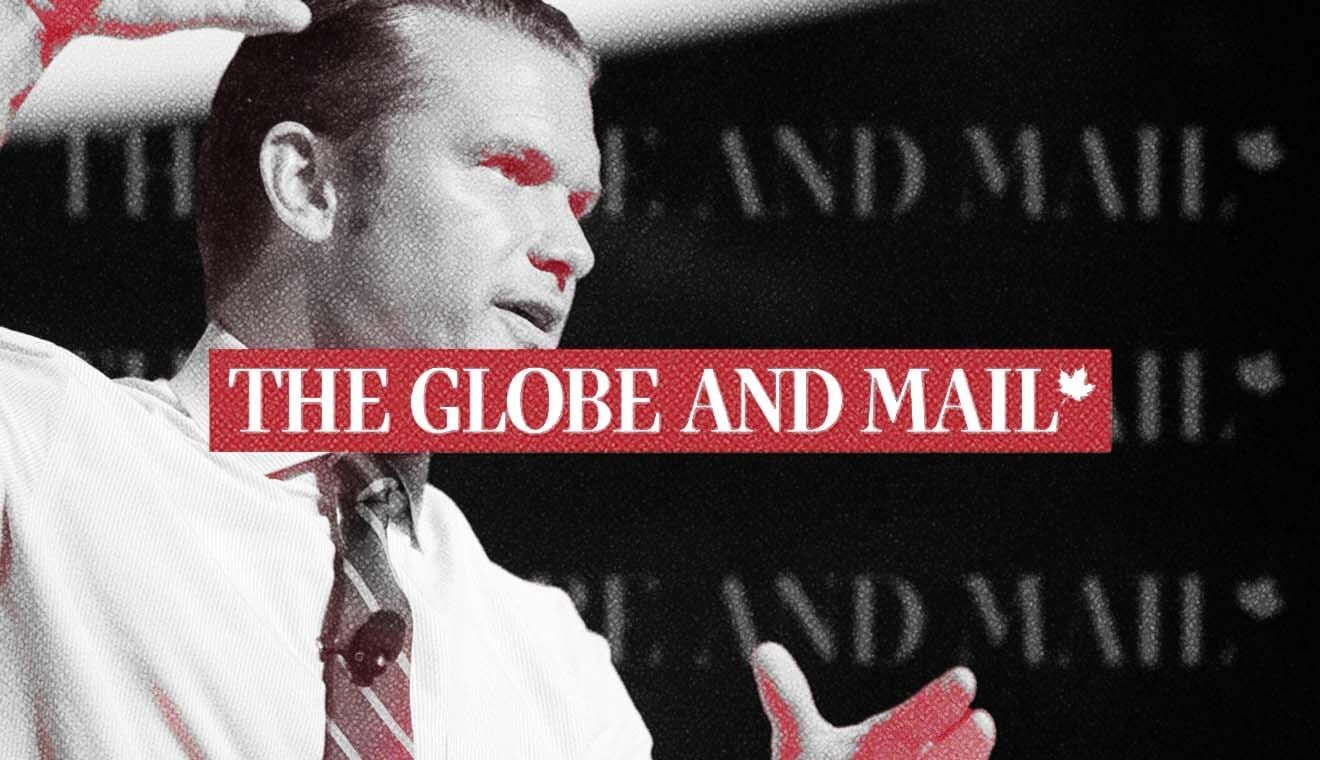
The Globe and Mail expressed support this week for United States War Secretary Pete Hegseth’s “fact sheet” pushing for more and faster military spending in Canada.
While Canada’s newspaper of record expressed some objections to the tone of the document, it claimed in an editorial published Thursday that the document is “accurate for the most part.”
This month, Hegseth released the document titled “Fact Sheet: Canadian Defence Shortfalls,” which said: “underinvestment in defense has atrophied the Canadian Armed Forces (CAF) and limited Canada’s ability to contribute to the defense of North America.”
It added: “Unfortunately, Canada has yet to make the hard decisions and tradeoffs needed to put it on track to fulfill its NATO Defense Investment Pledge and become a credible partner in the defense of our shared continent.”
“The Department stands ready to get to work with the CAF to make our alliance stronger than ever, but Canada must get serious and focused.”
The document expressed concern about the fact that Canada has supposedly not set out a “resourced path” to spend 5 per cent of its national GDP on the military by 2035.
Prime Minister Mark Carney pledged to work towards that target in 2025 after U.S. President Donald Trump demanded it. At the time Trump first floated the figure, even longtime defence hawks criticized it as unnecessary and unrealistic.
Former defence minister Jason Kenney told the Globe in January 2025: “Even though I’m a defence and security hawk, I have to express a degree of skepticism about the new 5-per-cent target that’s suggesting all of NATO should be back to full Cold War levels of spending.”
Despite the Liberal government’s commitment to that pledge, which Carney said will amount to $150 billion in military spending per year, Washington believes Canada isn’t moving quickly enough.
Hegseth’s “fact sheet” included a list slamming Canada’s “operational readiness,” “examples of capability shortfalls,” and “flawed prioritization.”
“Canadian political leadership continues to pursue unfocused global commitments, resulting in personnel and platform overextension, deferred modernizations for key equipment, and low readiness rates,” the document claimed.
The Globe’s editorial board agrees. It claimed that while Carney’s recent federal budget deserves “credit” for projecting a spending plan through to the end of the decade, it “provides clarity that Ottawa has no intention of making much progress toward the NATO goal over the next four years.”
“The Carney government is, unlike its predecessors, starting to address that vulnerability. But it is not moving fast enough. That is a fact, a most worrying one,” the editorial concluded.
Carney’s latest budget included $451.3 billion in core military spending over the next five years, plus an additional $320 billion in “defence and security related funding.”
It also committed to a massive 60 per cent budget increase for the Canadian Security Intelligence Service, Canada’s spy agency.
Hegseth’s jabs against Canada come in the midst of the Trump regime’s ongoing war of aggression against Iran, which American voters decisively rejected in the recent midterm elections. The Carney government expressed qualified support for the war when it began back in February.
Hegseth’s “fact sheet” also comes as the Liberal government continues to review plans to purchase a full fleet of 88 American-made F-35 fighter jets.
The Liberals announced the review amid Ottawa’s ongoing trade war with Washington, and Trump’s repeated calls to turn Canada into the “51st” American state.
The “fact sheet” appeared to make an indirect reference to the F-35 review, stating that:
“Canada can maximize its limited but growing defense funds by prioritizing missions important for its homeland defense and meeting NORAD and NATO obligations by committing to the best miliary [sic] platforms.”
Despite concerns about the U.S. government retaining control over key software updates needed to maintain the jets, dominant Canadian media outlets have over-represented voices who support the deal.
According to an analysis conducted by The Maple in February, champions of the deal were quoted 41 per cent more often than critics in articles published by CBC News, the Toronto Star, The Globe and Mail and National Post.
Canada has already committed to purchasing 16 jets, and has continued to make payments for the infrastructure needed to maintain them. CBC News further reported this week that the Liberal government has made payments for parts and components that could bring the size of the fleet up to 48 jets.
Meanwhile, Defence Minister David McGuinty has repeatedly downplayed any notion of friction between Canada and the U.S. on military matters.
Back in July, he said that he sees “very little daylight” between Canada and the U.S. on military and intelligence affairs.
When pressed on that statement by The Maple in October, McGuinty said: “I’m in regular touch with different folks in the United States. We are cooperating on many different areas. That continues. That will continue.”
More recently, McGuinty said in response to questions about reports of a secret memo issued by Hegseth restricting Canada-U.S. military cooperation that “as far as we’re concerned, it’s business as usual.”