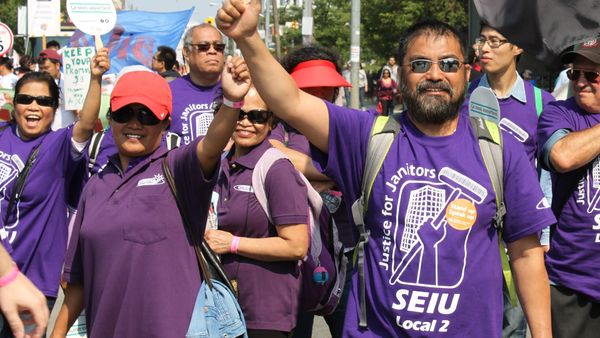


Thousands of Amazon workers and their supporters across the world took action over the weekend to protest the company’s labour practices, political influence, and poor environmental record.
Under the banner of the “Make Amazon Pay” campaign, a coalition of more than 80 organizations planned events across six continents to coincide with the company’s Black Friday and Cyber Monday sales.
The Make Amazon Pay campaign is co-convened by UNI Global Union, a global labour federation bringing together millions of union members from more than 150 countries, and the Progressive International, a member-based organization uniting progressive activists and politicians.
In a press release ahead of the weekend protests, UNI Global Union general secretary Christy Hoffman said: “Amazon, Jeff Bezos and their political allies are betting on a techno-authoritarian future, but this Make Amazon Pay Day, workers everywhere are saying: enough. For years, Amazon has squashed workers’ right to democracy on the job through a union and the backing of authoritarian political figures. Its model is deepening inequality and undermining the fundamental rights of workers to organize, bargain collectively, and demand safe, fair workplaces.”
This was the sixth year of international Black Friday actions. According to Make Amazon Pay, the size of the movement has grown each year, drawing in more organizations and activists and spreading into more countries.
Hoffman, writing at The Wire, noted: “The scale of this year’s protests is unlike anything we have seen. Strikes and demonstrations are planned at warehouses in Germany, rallies will sweep through major Indian cities, garment workers in Bangladesh will march for safety, and allies from Canada to Brazil to South Africa will confront Amazon’s growing influence over our governments, our communities, and our planet.”
With a focus on the service sector internationally, UNI Global Union has been especially active when it comes to Amazon and its negative impacts across this sector globally.
However, the Make Amazon Pay campaign remains focused on much more than the corporate giant’s notoriously bad labour practices. Amazon’s growing role in government repression, war and surveillance were also highlighted, as was its environmentally unsustainable business model.
“Amazon is no longer just a retailer — it is a pillar of a new authoritarian order built on surveillance and exploitation. From ICE [United States Immigration and Customs Enforcement] raids to the repression of Palestinians, Amazon’s technologies are woven into systems of violence worldwide. But Make Amazon Pay shows that workers and communities can confront this power — and build a future based on dignity and democracy instead,” said David Adler, co-general co-ordinator of the Progressive International.
As well, Sanna Ghotbi, senior campaigner at Greenpeace International, underlined Amazon’s “expanding, destructive impact on people and the planet.” “Billionaire-owned Big Tech companies like Amazon are an increasing risk to our rights, while they repress dissent and wreck the planet. It’s time to resist Big Tech’s overreach into our lives and to make Amazon pay!” Ghotbi continued.
In the United States, activists in Chicago, Newark, New York City, Washington and cities in California were especially focused on Amazon’s complicity in the Donald Trump administration’s targeting of immigrants. Amazon Web Services provide a good deal of the technological infrastructure that supports the Department of Homeland Security’s Immigration and Customs Enforcement.
Meanwhile in Seattle, thousands signed onto an open letter addressed to Amazon CEO Andy Jassy penned by Amazon Employees for Climate Justice that raised alarms about the company’s rollout of artificial intelligence (AI). The group is demanding “no AI with dirty energy,” “no AI without employee voices” and “no AI for violence, surveillance, or mass deportation.”
A broader coalition of American groups urged an expanded boycott of firms, such as Target and Home Depot, that have caved to the Trump administration or are actively supporting its anti-immigrant policies. The “We Ain’t Buying It” campaign is aiming to apply countrywide economic pressure ahead of the holiday season.
In Europe, more co-ordinated actions were planned, with Amazon workers in Germany planning walkouts, and protests scheduled in Denmark, Spain, Greece, the United Kingdom, Poland, and Luxembourg.
Further campaign actions and events were also organized in Australia, Indonesia, Taiwan, Nepal, Palestine, Brazil, Colombia, and South Africa. Many focused on the appalling conditions in Amazon facilities and those of its contractors in the Global South.
As the Progressive International points out, Amazon refuses to sign onto the Bangladesh Accord on Fire and Building Safety that was established in the wake of the 2013 Rana Plaza collapse, an industrial accident that killed more than 1,100 garment workers. Amazon is now the biggest apparel retailer in the U.S., and it sources many of its products from Bangladesh. By refusing to abide by this essential worker protection, Amazon not only directly puts worker health and safety in jeopardy, but also exerts downward pressure on safety standards in the garment industry overall.
Although Canada was listed as a participating country, actions here were less publicized than in previous years.
Unifor, despite remaining part of the international coalition behind Make Amazon Pay and encouraging members to participate in last year’s actions, did not issue a press release or any other promotional material ahead of Make Amazon Pay Day this year.
According to Make Amazon Pay’s website, three “actions” were scheduled in Canada: two led by Unifor in Ontario and British Columbia and one led by Confédération des syndicats nationaux in Quebec.
Unifor tweeted that it would be encouraging workers to sign union cards outside Amazon facilities in B.C.’s lower mainland. Of course, Unifor is also in the midst of fighting for a first contract at Amazon’s Delta facility in B.C. after a remedial certification this past summer.
Meanwhile, CSN continues its ongoing boycott over Amazon’s decision to shutter its Quebec facilities following workers unionizing at a Laval sortation centre in May 2024. The union federation is also contesting Amazon’s decision to leave Quebec at the provincial Labour Tribunal.
This weekend’s actions, like those of the past five years, were inspiring and drew attention to both the global reach of Amazon and its deleterious impacts on workers the world over.
As Hoffman wrote: “Black Friday is a symbol of consumption at any cost. But the workers who pick, pack, lift, sort, and deliver billions of items every year are saying something important: the real cost of Amazon’s model is becoming intolerable. If we continue down the current path, we risk entrenching a future where technology is used to squeeze workers rather than empower them, and where climate change amplifies exploitation rather than prompting reform. Amazon will not change voluntarily. But workers, united with communities and allies around the world, are already forcing a reckoning.”
Global days of action bring public attention to these issues and spotlight Amazon workers’ struggles. At the same time, boycotts on their own will not bring Amazon to heel. Only workers organized into unions, with power at the point of production, can truly tame this corporate behemoth.
Let’s hope these annual Make Amazon Pay Days are helping to build toward that end.
Recent Class Struggle Issues
- November 24 | Trans And Non-Binary Workers Are Worse Off Than Cis Peers
- November 17 | The CAQ Forced An End To Montreal’s Transit Strike
- November 10 | Employment Inequalities Will Persist Until More Industries Unionize
- November 3 | Alberta Forcing Teachers Back To Work Is A Historic Loss