

Last week, the Government of Manitoba announced new and stronger rules to protect workers from asbestos. The Manitoba labour movement is celebrating this as a long-awaited victory, and rightly so.
Following years of steady pressure and advocacy from labour, there will finally be a strict certification program in the province to ensure that workers who handle this dangerous, cancer-causing material are adequately protected, and that employers who break the law are punished.
Commonly found in older buildings, asbestos becomes hazardous when disturbed and released into the air. Exposure can lead to lung cancer and mesothelioma, a particularly aggressive and usually fatal form of cancer.
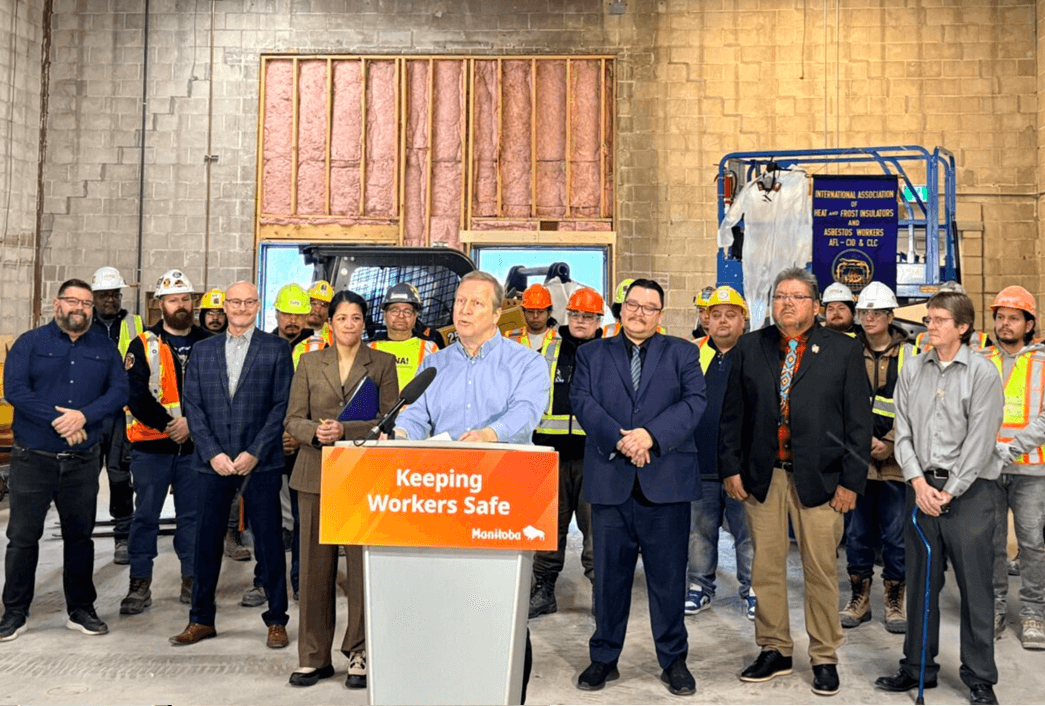
“The safety of Manitobans is always our top priority, and they told us they wanted clearer rules and stronger protections for asbestos work – we listened,” Minister of Labour and Immigration Malaya Marcelino said in a government press release. “These updates will help keep workers safe by ensuring asbestos work is done by trained, certified professionals and with clear responsibilities for employers and building owners.”
While the province previously set basic requirements for training, inventories and safety measures available through Safe Work Manitoba, a division of the Workers’ Compensation Board (WCB), these did not require certification and lacked strong enforcement mechanisms.
The new amendments to The Workplace Safety and Health Act will: ensure that any worker handling asbestos has proper training and certification; require employers who work with asbestos to register with the province so there is a system for tracking certified employers; set clear responsibilities for employers and building owners; and enhance the capacity of government safety officers to verify that employers comply with the law.
According to the amended legislation, the Workers’ Compensation Board will keep a registry and publish information about employers who are certified. The certifications of employers who fail to meet their statutory requirements can also be suspended or revoked.
The new rules build on expert advice provided through the recently reinstated Advisory Council on Workplace Safety and Health, an advisory council where labour has seats at the table and can raise issues directly with government and employer representatives. The previous Progressive Conservative government had suspended this important committee in 2018, but thankfully the Manitoba NDP reinstated it in November 2024.
“Having stronger protection against asbestos is literally a life-and-death issue for the Manitobans whose work brings them into contact with it,” said Kevin Rebeck, president of the Manitoba Federation of Labour (MFL).
Asbestos is the leading occupational killer in Canada, including in Manitoba. According to the MFL, more than 60 workers have died from asbestos-related diseases in the past decade alone in the province.
Across the country, asbestos has been responsible for more than half of work-related occupational disease deaths since 2000 and roughly one-third of work-related deaths overall. The latest figures from the Association of Workers’ Compensation Boards of Canada indicate that there were 1,057 workplace fatalities recorded in 2023, with well over half being the result of various occupational diseases and disorders.
It’s widely recognized that such figures are a vast undercount, reliant as they are on claims accepted by provincial workers’ compensation boards. By some estimates, work-related deaths could be as many as 13 times higher than the official figures suggest.
The Manitoba government will allow a phased transition of the new asbestos rules to give workers and employers time to comply with training and certification requirements. While most of the amendments will take effect the day the regulations are registered, certification and registration rules will apply as of June 1, 2027.
Yet these changes can’t come soon enough. Asbestos exposure is far from a thing of the past. Particularly in building renovation and demolition, workers still frequently encounter this deadly substance.
In its last “report card” reviewing the province’s health and safety record, the MFL noted that workplace safety and health officers in Manitoba issued 68 stop work orders related to work with or around asbestos in the first eight months of 2024.
Yet prior to the new legislative changes, the decision to comply with safety and training standards rested entirely with individual employers. For workers in precarious situations with limited bargaining power, pressure from employers to work without complaint could be an eventual death sentence.
While the MFL remained critical of the Manitoba NDP government’s health and safety record last year, legislative changes since have signaled progress.
In June 2025, Bill 29 made a number of important changes, including: new requirements that employers maintain “psychologically safe workplaces”; higher monetary penalties for employers who fail to report serious safety incidents; stronger powers to collect money owed to workers who have been the victims of employer reprisals for exercising health and safety rights; and a new ability to hold two or more employers jointly responsible for workers’ safety. The bill addressed a number of labour’s key priorities.
Finally addressing the lack of protection against asbestos exposure is a significant win. Most provinces still lack similar measures and continue to put workers’ lives in jeopardy needlessly.
In January 2024, British Columbia led the way by becoming the first province to institute a licensing requirement for employers and workers handling asbestos. These changes resulted from amendments made to the Workers Compensation Act in 2022 and, like in Manitoba, followed concerted pressure from the provincial labour movement.
B.C.’s experience suggests the costs associated with enhanced asbestos protection are likely to be marginal. Training costs, for example, can range from $150 to $950 per worker. There will be additional costs associated with certification, registration and enforcement, but overall the economic burden on employers will be minimal.
That governments have allowed workers to be exposed to this lethal substance for this long is criminal. In Manitoba and B.C. at least, we’re on the path to putting those days behind us, finally.
However, strict enforcement will remain vital to ensure that workers who lack the power to refuse are never again put in harm’s way by employers who skirt the law for a quick buck.
The acceptable number of workplace deaths is zero. We’re a long way from that number, but Manitoba’s new law is a step in the right direction.
Recent Class Struggle Issues
- December 1 | Make Amazon Pay For Its Abhorrent Labour Practices
- November 24 | Trans And Non-Binary Workers Are Worse Off Than Cis Peers
- November 17 | The CAQ Forced An End To Montreal’s Transit Strike
- November 10 | Employment Inequalities Will Persist Until More Industries Unionize