
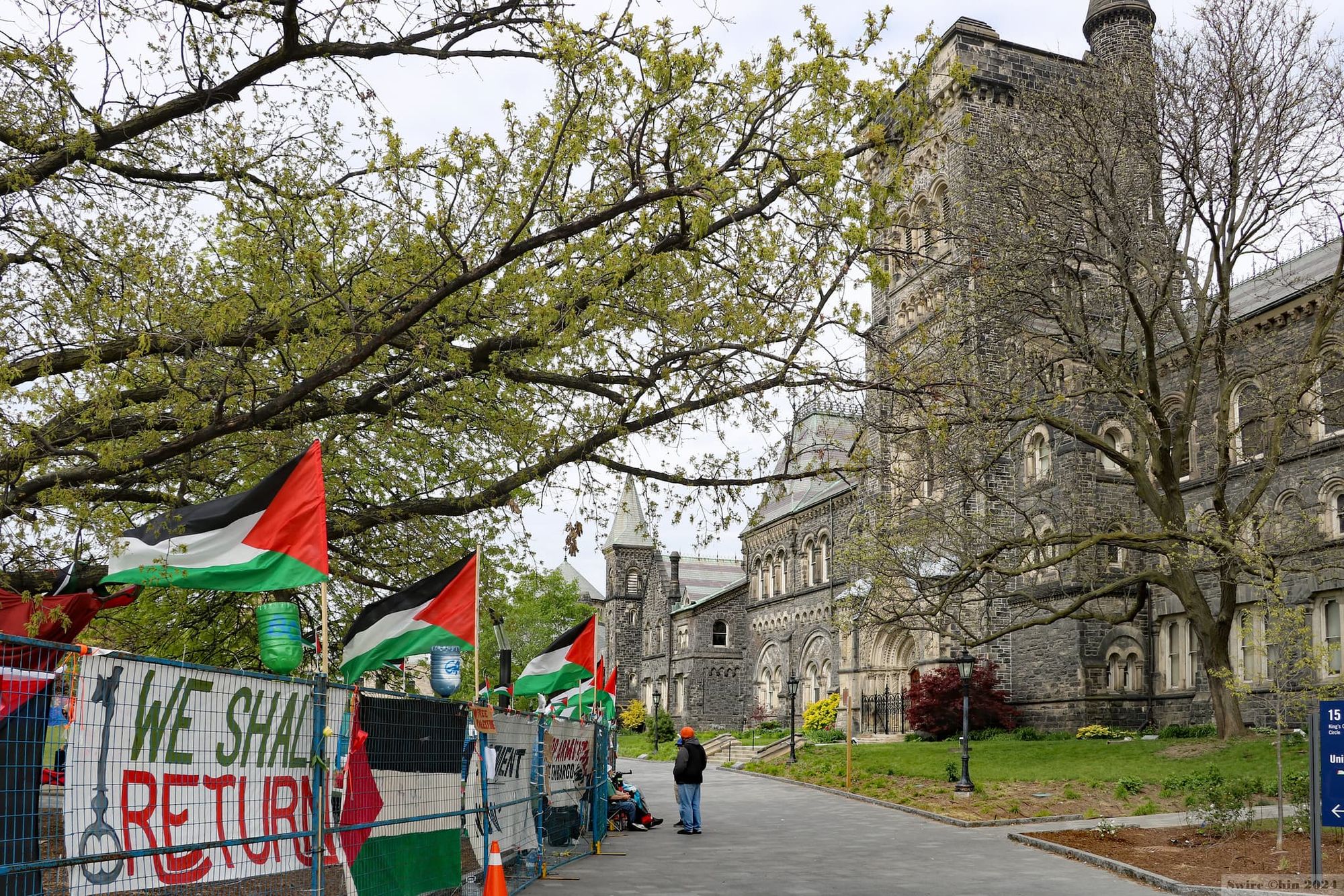

Union members at several post-secondary institutions across Ontario are demanding that their pension fund, the University Pension Plan (UPP), divest from firms tied to Israel’s illegal occupation of Palestine.
The Workers’ Campaign for UPP Divestment consists of workers from unions and faculty associations across the province, including members of: the United Steelworkers (USW) local 1998; Canadian Union of Public Employees (CUPE) locals 3902 and 1230; the University of Toronto Faculty Association (UTFA); CUPE 3913 and the University of Guelph Faculty Association; the Trent University Faculty Association (TUFA); and the Queen’s University Faculty Association.
The campaign is calling on the UPP to adhere to its own responsible investment policy and divest from military industries, “including but not limited to Israel’s military,” and illegal occupation, “including but not limited to Israel’s illegal occupation of Palestine.” The coalition is also demanding the UPP exclude any new investments that meet these criteria.
The UPP covers more than 44,000 members across six universities and 19 sector organizations and holds $12.8 billion in assets. The jointly sponsored pension fund also has an “investment exclusion policy” that upholds “environment, social and governance” (ESG) principles.
The Workers’ Campaign describes itself as following “the grassroots tradition of internationalist worker solidarity by upholding the principle of divestment.” Moreover, the coalition of labour organizations is responding to the call from Palestinian civil society organizations for Boycott, Divestment and Sanctions (BDS) “until Israel meets its obligation to recognize the Palestinian people’s inalienable right to self-determination and fully complies with the precepts of international law.”
Pension divestment has become an important part of the BDS movement, Fraser McCallum, a member of USW 1998 and a staff member at University of Toronto involved in the campaign, told Class Struggle.
“Many pension plans are invested, without their members’ knowledge, in instruments such as weapons and surveillance technologies that sustain the oppression and occupation of Palestinians,” he said.
Another campaign organizer, Kirsten Francescone, chair of Trent’s Committee against Scholasticide in Gaza and a member of TUFA, told Class Struggle that after passing a BDS motion at Trent, workers started to map the UPP’s investments in “companies associated with the ongoing military assault on Gaza.”
“We used this research to start having conversations with our colleagues about Palestine and the need for divestment and discovered quite quickly that many of our colleagues across the university campus were strongly supportive of the need to take action,” Francescone said. Trent’s faculty union then passed a divestment motion in June 2024.
The Workers’ Campaign estimates that at least $790 million of the UPP’s portfolio consists of investments that violate the fund’s ESG principles and contribute to militarism and Israeli occupation and apartheid.
For example, the UPP has disclosed investments of $10-25 million in Safran Corporation, which has sold arms to Israel and collaborates with Israeli arms manufacturer Elbit Systems. The UPP also holds between $5-10 million in Booking.com, which lists hotels in illegal settlements in the occupied Palestinian territories.
The proxy voting record of the UPP also allows the Workers’ Campaign for UPP Divestment to track holdings that the fund hasn’t publicly disclosed. According to the coalition of labour organizations, the pension fund holds investments in a wide range of companies complicit in Israel’s occupation, including General Dynamics, Lockheed Martin, L3 Harris, Teledyne Technologies, Raytheon, Textron, Northrop Grumman, Huntington Ingalls and Axon Vision, an Israeli company that specializes in artificial intelligence weaponry.
The UPP also holds additional investments in firms that the Workers’ Campaigns says facilitate and profit from the illegal occupation of Palestine, such as Hyundai, whose excavators are used to destroy Palestinian homes in the occupied territories.
Thus far, the Workers’ Campaign for UPP Divestment has made considerable strides, with seven labour organizations covering more than 12,000 active pensioned workers across four of the five UPP member universities passing divestment motions.
Following TUFA’s vote, member unions at the University of Toronto joined the call for divestment, with the U of T faculty association passing its motion in May 2025 in a vote that saw a record turnout.
As Whitney Kemble, a member of UTFA and a librarian at the University of Toronto, told Class Struggle: “Universities are a special site of struggle for a number of reasons: they maintain research partnerships with Israeli universities to develop military and surveillance technologies; they erase the history of Palestinian dispossession in decisions about hiring and course content; they neglect to act on questions of anti-Palestinian racism, and even criminalize their own students and employees for speaking up on these issues; and they launder the ongoing, violent history of settler colonialism by hosting events and speakers in support of the Israeli government, thus lending these discourses a veneer of respectability.”
As the Workers’ Campaign website points out, the UPP has a joint governance structure, which is supposed to offer members agency over investment decisions. Yet, the fund has made no effort to respond to members’ demands to divest from war and occupation, despite regularly reporting on its sustainable investing practices.
“In response to the demands for divestment presented by our campaign, UPP claims that divestment is too difficult and represents a threat to its fiduciary duty. Given that divestment was possible in the case of fossil fuels, we can only draw the conclusion that the refusal to divest from genocide, apartheid and illegal occupation of Palestinians is a political decision made in violation of members’ rights as jointly governing partners,” the campaign’s website states.
Moreover, as campaign member Samantha King, professor and director of the School of Kinesiology and Health Studies at Queen’s University, told Class Struggle, there are lessons to be drawn from Ontario’s history of divestment from apartheid South Africa.
“In 1990, the province passed the South African Trust Investments Act, which permitted all pension funds to dispose of South African investments without breaching the trustee’s statutory or other legal duties. This historical legal precedent for refusing complicity with apartheid demonstrates that it is indeed possible for the province to divest pension funds without compromising fiduciary duty, when political will is present,” King said.
As Jessica Copley, an academic worker and political member of CUPE 3902 at the University of Toronto, further put it: “As we know from the struggle against apartheid in South Africa, which inspired our movement, divestment works. It applies both economic and moral pressure, thereby increasing the financial and reputational risks for companies profiting from human rights abuses.”
The campaign directed at UPP is one among many demanding divestment from war and occupation. The Public Service Pension Plan, which covers workers in the Ontario public service, is also facing similar pressure. Moreover, the Ontario Secondary School Teachers’ Federation and the Elementary Teachers’ Federation of Ontario, which together represent more than 140,000 members, have both called on the Ontario Teachers’ Pension Plan to stop investing in weapons and war.
“We are continuing to build our base within existing labour organizations, while applying pressure on the UPP and demanding accountability and transparency,” McCallum said. “We do not want our pensions paid with blood money. This means meeting with UPP and with our union leadership to make sure the wishes of members are enacted.”
Recent Class Struggle Issues
- April 13 | Avi Lewis’s Victory Is A Chance For Labour To Revitalize
- March 30 | Union Members View Migration More Positively Than Other Workers
- March 23 | Canada’s Unions Should Mobilize Against The Iran War
- March 16 | Canada’s Richest 86 Families As Wealthy As Poorest 6.2 Million