
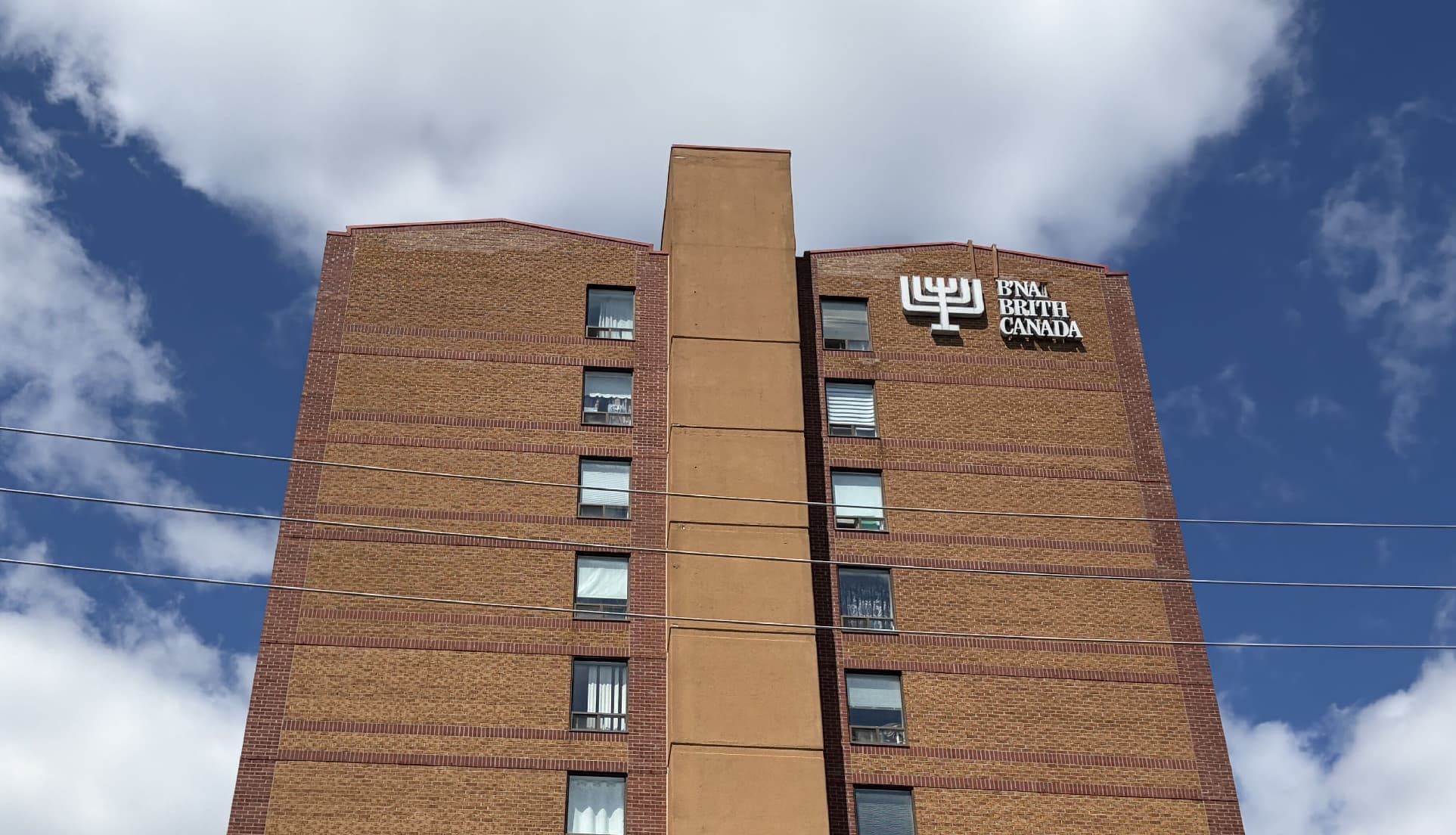
B’nai Brith Canada (BB), which describes itself as “the country’s oldest human rights organization,” has a policy of rejecting non-Jewish rental applicants, according to two reps at the company that manages its apartment buildings.
BB claims it has been a “premier provider of sustainable, affordable housing in Canada” since 1979.
Its website lists three apartment buildings it owns, two of which are for seniors. The other is described as a “family building.” The apartments are in Toronto, cumulatively contain about 259 rent‑geared‑to‑income (RGI) units and 88 market rent units, and are managed by Greenwin, an Ontario property management company.
In 2023, BB cited a report finding that the average cost for a rental unit in Toronto was around $2,520, and claimed that the “fair market price for a one-bedroom apartment and two-bedroom apartment in one of our Toronto buildings is $1,232 and $1,563, respectively.”
The buildings have cumulatively received tens of millions of dollars in funding from Canadian governments.
Earlier this year, I received a tip from someone claiming another person was told that BB no longer rents units in its buildings to non-Jews.
Upon receiving this tip, I called the contact number listed on the BB website for market rent units in the two senior buildings and said I wanted more information about them for my parents. I called from a private number and didn’t provide my real name.
The Greenwin agent who answered immediately asked, “Your parents are seniors, I believe, and Jewish, right?”
I replied, “My parents are seniors, but they’re not Jewish. Is that an issue?”
They stated, “This is a residence facility for seniors who are Jewish.”
I asked if this was because of a law. They replied, “No, like I said, you said you are not Jewish, right?” After I answered, they stated, “So you need to find another facility for seniors.”
The next day, I called the contact number listed on the BB site for market rent units in the family building and spoke with a different Greenwin agent.
For the first couple minutes of the call I discussed general details about the building. I then claimed I’d heard about the building from a friend who said they weren’t sure if it was only for Jews.
The agent replied, “Actually, the landlord is Jewish, and the priority are the Jewish people. So he is asking for people to have the Jewish faith, yeah.”
I asked if Jews were prioritized or given exclusive access. They replied: “Before it was a priority, but recently, the landlord actually made it as a mandatory.”
I replied saying this was too bad, as I’m not Jewish. The agent added, “I know, but it’s the landlord that changed the policy.”
BB doesn’t state anywhere on its housing page that its apartment buildings are only or primarily for Jewish people. In contrast, the oldest of the two senior buildings is described in a 1989 Ottawa Citizen article as an “apartment building for seniors of all races and religions,” and a 1988 Toronto Star article stated the second senior building will “serve all faiths.”
The housing page on the BB website also doesn’t mention any specific programs these buildings offer for Jewish people. It states BB’s housing offers a “culturally familiar setting” (without specifying to whom it is familiar) and that its buildings “help ensure that members of the community have access to subsidized, affordable, and well‑maintained housing” (without defining “community”).
B’nai B’rith International (BBI), of which BB is the Canadian chapter, has a page on its site listing locations of BBI housing in the United States and Canada, including the three BB buildings in Toronto. That page states that the housing program’s mission is to provide affordable housing to seniors regardless of their background, including religious background.
I reached out to BB and Greenwin to ask if BB has a policy of rejecting non-Jewish rental applicants, and if so, when it started, why, and its legal basis.
They didn’t reply.
The Legality Of Alleged Discrimination
The Ontario Human Rights Code states that every person has a right to equal treatment in housing without facing discrimination on protected grounds such as “ethnic origin” and “creed.”
A page about renters’ rights on the City of Toronto website states: “A landlord is not allowed to ask [...] your religion or ethnic background,” and, “A landlord must adhere to the Human Rights Code and cannot select or refuse tenants based on: [...] ethnic origin, religion.”
These rights aren’t absolute, as the Code contains several exceptions that can allow for legal discrimination.
The City of Toronto runs a mandate housing program, which consists of agreements between it and “housing providers” with RGI units to allow them to restrict accommodation to certain groups, such as members of religious or ethnic communities. The City is typically in charge of determining who can live in RGI units, but the mandates apply to both RGI and market rent units in the buildings.
The City maintains a public list of these buildings, which is divided into two categories: “housing for specific groups” and “housing for seniors.” Most of the buildings on the list fall into one category or another, but some fit into both.
For example, the Hellenic Home for the Aged Inc. (Hellenic) has two buildings designated by the City as being for “seniors of Greek origin.” This restriction is noted on the Hellenic website, which informs applicants they need to provide a Greek passport, birth certificate or permanent residency status to prove their connection to the country.
This program has been criticized in the media.
In 2015, Global News and the Toronto Star published articles about a man who was taken off the waiting list for another building in Toronto by the City because he wasn’t Muslim.
The Star wrote that the incident “raises concerns that accommodations for cultural and religious groups could be limiting access to affordable housing,” while Global quoted the disabled man’s mother, who said, “It’s prejudiced, it’s racist [...] It’s wrong on every single level: this goes against everything Canada represents to me.”
A representative from the Advocacy Centre for Tenants Ontario speaking to the Star claimed the incident was “appalling,” and a lawyer told the publication, “That sounds like a whites-only washroom. [...] It’s a very, very thin line.”
In that case, the apartment building had, and maintains, a mandate from the City to serve “member[s] of Ahmadiyya Muslim Jama’at.”
Unlike the Ahmadiyya or Greek buildings, the BB buildings don’t have a City mandate to serve a specific religious or ethnic group. The BB buildings for seniors have a mandate for seniors in general, not Jewish seniors in specific. The other building doesn’t have any mandates.
I asked the City’s Housing Secretariat, the Ontario Human Rights Commission and the Landlord and Tenant Board if a building in Toronto without a mandate can deny applicants for market rent units because of their ethnic or religious background. None of them gave me an answer.
I then asked the Canadian Centre for Housing Rights the same question. Lee Webb, the organization’s director of client services, told me they can, in some cases.
Webb pointed to section 18 of the Code, which states, “The rights under Part I to equal treatment with respect to services and facilities, with or without accommodation, are not infringed where membership or participation in a religious, philanthropic, educational, fraternal or social institution or organization that is primarily engaged in serving the interests of persons identified by a prohibited ground of discrimination is restricted to persons who are similarly identified.”
Lee told me the test for determining if section 18 applies to a housing provider is if it:
“a) Is a religious, philanthropic, educational, fraternal or social institution or organization?;
b) Is ‘primarily engaged in serving the interests of persons identified by a prohibited ground’?;
c) Has membership or participation in the institution or organization restricted to those identified by that prohibited ground?”
The section has been used to successfully respond to a range of claims of discrimination in the past, including at a Christian private school, a First Nations hockey league and a social club for Italian men.
There’s just one public case I was able to find about alleged housing discrimination that made its way to the Tribunal in which the defendants invoked section 18.
In that 2012 case, a couple filed a human rights complaint against Hellenic and branches of the City of Toronto after they were bumped off a waiting list for an RGI unit in one of Hellenic’s buildings by the City because they aren’t Greek.
The defendants cited section 18 in their response to the complainant, and vice-chair Ian R. Mackenzie sided with them, stating that it applied and is a “complete defence to what would otherwise be a discriminatory practice.”
In order to come to this conclusion, Mackenzie determined that Hellenic met the three criterion listed above, noting it is a “not-for-profit charitable organization” with a Letters Patent stating its main purpose is to serve Greek seniors and programming that reflects this mission, such as services in Greek.
Government Funding
BB has received money from all levels of government for its Toronto apartment buildings.
Taken together, the charities for the two seniors buildings received more than $30 million in federal, provincial and municipal government funding from 1990 to 2024, according to data published by the Canada Revenue Agency. The two have also received at least $112,000 in federal government grants since then, according to an online Government of Canada database.
The family building has received more than $320,000 from the federal government since 2019, according to the same database. Figures from other years and levels of government aren’t available for this building, however, as it doesn’t have an associated charity.
BB has also actively pushed for more co-operation with the federal government on housing.
In 2023, BB provided a written submission to the federal government for a House of Commons study on the financialization of housing.
In a press release about the submission, then BB CEO Michael Mostyn stated, “We strongly recommend that the Government of Canada partner with non-profit and charitable organizations such as B’nai Brith to create a federally supported rental property acquisition fund. As a trusted non-profit housing provider and charitable organisation, we are ready to serve as a partner in such an initiative.”
I reached out to the City of Toronto, Province of Ontario and Government of Canada to ask if they’re aware of BB’s alleged policy and have any comment on it.
The City stated that none of the BB buildings have a mandate to be for Jewish residents, and added, “All housing providers are governed by the Residential Tenancies Act and the Human Rights Code and must ensure their practices comply with both.”
The governments of Ontario and Canada failed to reply.
I’ve written about BB on several occasions in the past, including publishing critiques of its annual “Audit of Antisemitic Incidents” and “Seven-Point Plan to Combat Antisemitism.” BB has also publicly criticized my work in the past.
I haven’t published any articles mentioning Greenwin, but I have critiqued policies senior leadership members have supported. For example, Greenwin states that its chairman, who has been an advisor to BB on its affordable housing program, has been active on the board of the Association for the Soldiers of Israel and has “taken numerous politicians, Union leaders and business people on trips to Israel, building shared values and support with them.”
This article will be updated with comment from BB and Greenwin should they respond directly to The Maple or publish remarks elsewhere.