

When federal anti-scab legislation finally came into force last year, it marked the culmination of a decades-long struggle by Canada’s labour movement. For generations, unions had fought to ban employers from using replacement workers during strikes and lockouts, arguing that scab labour prolongs disputes, poisons labour relations, and undermines workers’ right to strike.
The passage of Bill C-58 was celebrated as one of the most significant labour law reform victories in many years. But as workers at Rogers Communications in Abbotsford, B.C., discovered, winning an anti-scab law and enforcing its spirit are not necessarily the same thing.
Earlier this month, NDP parliamentary leader Don Davies introduced Bill C-284, legislation designed to close a loophole in the Canada Labour Code that employers have begun to exploit to undermine the ban on scabs. The bill follows the experience of 25 striking United Steelworkers (USW) telecommunications technicians whose four-and-a-half-month strike against Rogers became one of the first major tests of the new federal anti-scab regime.
The Rogers Abbotsford strike showed that if employers can no longer hire scabs outright, they can still fly in managers from other locations to perform the work of striking bargaining unit members.
For unions like USW, that’s a distinction without a difference.
The Fight To Win Anti-Scab
The labour movement’s campaign for federal anti-scab legislation stretches back decades.
Quebec adopted an anti-scab law in 1977, while British Columbia followed in 1993. Like union members in other provinces, however, workers in federally regulated industries, such as airlines and telecommunication, remained without similar protections despite repeated attempts by the labour movement to secure them.
NDP members introduced anti-scab bills numerous times over the years, only to see them defeated by Liberal and Conservative governments.
The breakthrough came in 2022 with the supply-and-confidence agreement between the Liberals and the NDP. Under pressure from organized labour and the NDP, the federal government introduced Bill C-58, which finally prohibited federally regulated employers from using replacement workers during legal strikes and lockouts.
Unions, including the Steelworkers, celebrated the legislation as an historic victory. As I argued shortly after, however, enforcement would be key to ensuring that employers already angry about the new restrictions wouldn’t find ways to circumvent the law.
Rogers almost immediately put the new anti-scab provisions to the test.
The Rogers Technician Walkout
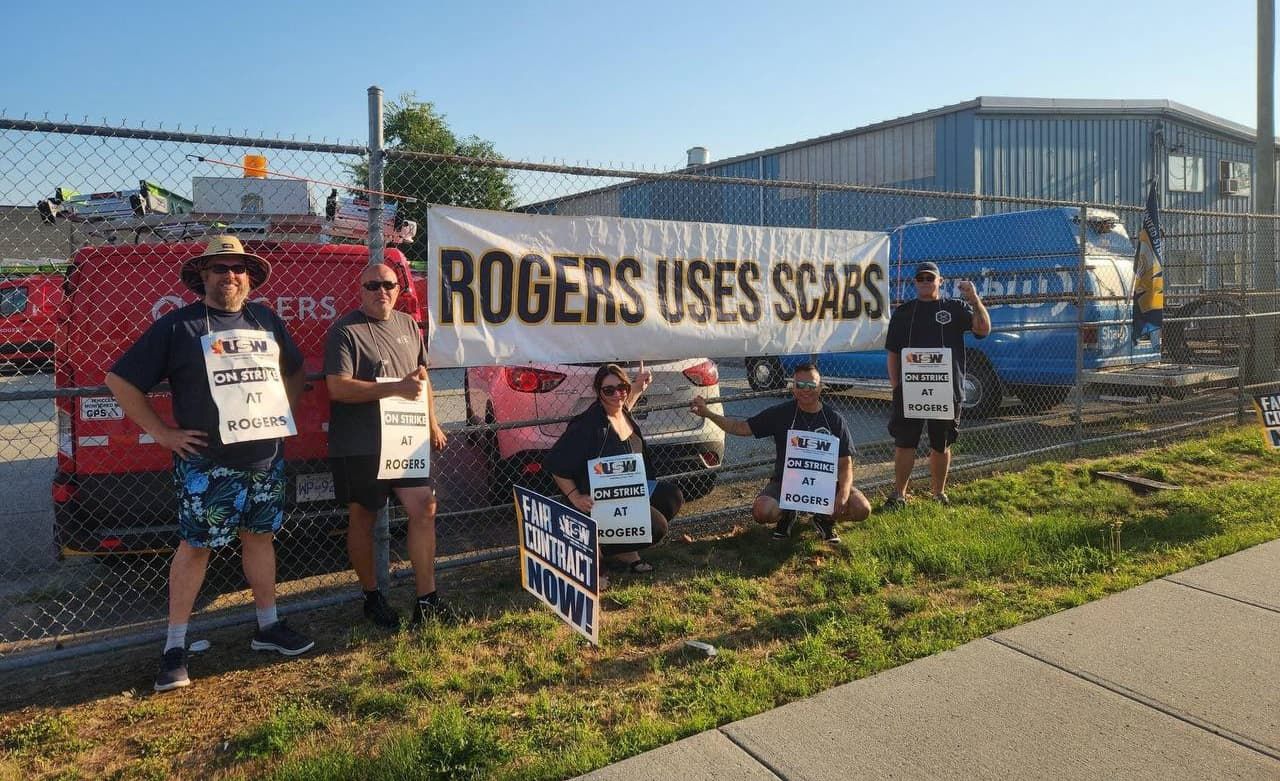
In June 2025, 25 technicians represented by USW Local 1944 issued strike notice after bargaining with the telecom giant failed to produce a new collective agreement.
The workers perform telecommunications installation and maintenance work in the Abbotsford area, and during bargaining were seeking wage improvements and equal pay with workers performing similar functions elsewhere at the company.
But according to the union, once the strike began, Rogers had little incentive to bargain seriously because the company found another way to keep operations running.
Rather than negotiating a settlement under the pressure of the strike, Rogers brought in managers from Alberta and other parts of B.C. to perform bargaining unit work that would ordinarily have been done by the striking technicians. The Steelworkers argued that Rogers had found and was exploiting a loophole in the newly implemented replacement worker ban.
After Bill C-58 received royal assent, section 94(4) of the Canada Labour Code was amended to prohibit employers from using a range of employees, contractors, managers or volunteers as replacement workers during work stoppages. Subsection a) bans managers at the worksite from performing bargaining unit work during a strike, while subsection c) is intended to prevent employers from utilizing staff from their other workplaces not on strike.
However, the latter subsection only refers to “employees,” which Rogers interpreted to mean that managers from outside could be transferred to the struck location. Under this reading of the law, Rogers utilized managers not just to perform maintenance activities necessary to protect public safety and the employer’s property — both of which are permitted — but to perform the work of striking USW members.
For months, the workers on strike watched as out-of-town managers crossed their picket line. Consequently, the dispute dragged on through the summer and fall of 2025.
The USW repeatedly accused Rogers of refusing to return to meaningful negotiations while relying on scabbing managers to keep the business operating. Union leaders argued that the company’s ability to continue functioning without bargaining unit workers undermined the very purpose of anti-scab legislation.
As the strike entered its second month, the union intensified public pressure, highlighting Rogers’ strong corporate profits while workers remained on the picket line seeking wage parity and a fair deal. Eventually bargaining resumed and workers ratified a new contract that ended the dispute.
But the broader issue remained unresolved, and Rogers had signalled to employers that the scab ban had a loophole.
Bill C-284: Banning All Scabbing Managers
The proposed legislation from Davies is straightforward: if passed, it would revise the Code to clarify that the prohibition on firms utilizing employees from outside the struck workplace during a strike or lockout includes managers.
In practical terms, this would prevent employers from doing exactly what Rogers did in Abbotsford.
Davies argues that the existing loophole “makes a mockery” of the anti-scab law. The proposed bill’s purpose, therefore, is to ensure that the intent of Bill C-58 is respected in practice, not merely in theory.
USW national director Marty Warren has framed the issue similarly, arguing that if employers can simply move managers around the country to perform struck work, the right to strike is fundamentally weakened and collective bargaining is undermined.
The concern also extends well beyond one Rogers bargaining unit. Large national corporations — many of which operate in the federal jurisdiction covered by the Canada Labour Code — possess resources that smaller employers do not. Telecommunications companies, banks, airlines and logistics firms often have extensive management structures spread across multiple regions. If these employers can redeploy managers whenever union members exercise their right to strike, anti-scab protections are rendered far less meaningful.
Defending The Right To Strike
The right to strike is the foundation of collective bargaining. Without the ability to withdraw their labour, workers lose their most important source of bargaining power.
Anti-scab laws are meant to make the strike weapon truly meaningful. If employers can simply replace striking union members, even if only temporarily, withdrawing labour holds far less leverage.
The Rogers strike demonstrated however that not only does the legislative prohibition on scabs need to be air-tight, but unions also need to remain vigilant to ensure the spirit of the law is respected and enforced.
The actions Rogers took against its technicians in Abbotsford risks becoming a roadmap for corporate Canada. What began as a local strike involving 25 telecommunications workers could become a precedent that weakens the anti-scab law for which labour struggled for so long.
The labour movement spent decades fighting for a federal ban on replacement workers. Any loophole that allows employers to skirt the law must be closed.
At a time when governments are attacking the right to strike from multiple angles, we can’t allow past victories to be undermined on a technicality. Closing the Rogers loophole is necessary to protect the scab ban as well as the right to strike.
Recent Class Struggle Issues
- June 22 | Doug Ford Has Billions For Corporations, Little For Workers
- June 15 | Walmart Workers Have Won A First-Ever Contract In North America
- June 9 | Ottawa Is Plotting New Ways To Contain Worker Power
- June 1 | Ontario’s Social Service Workers Have Had Enough Of Doug Ford