

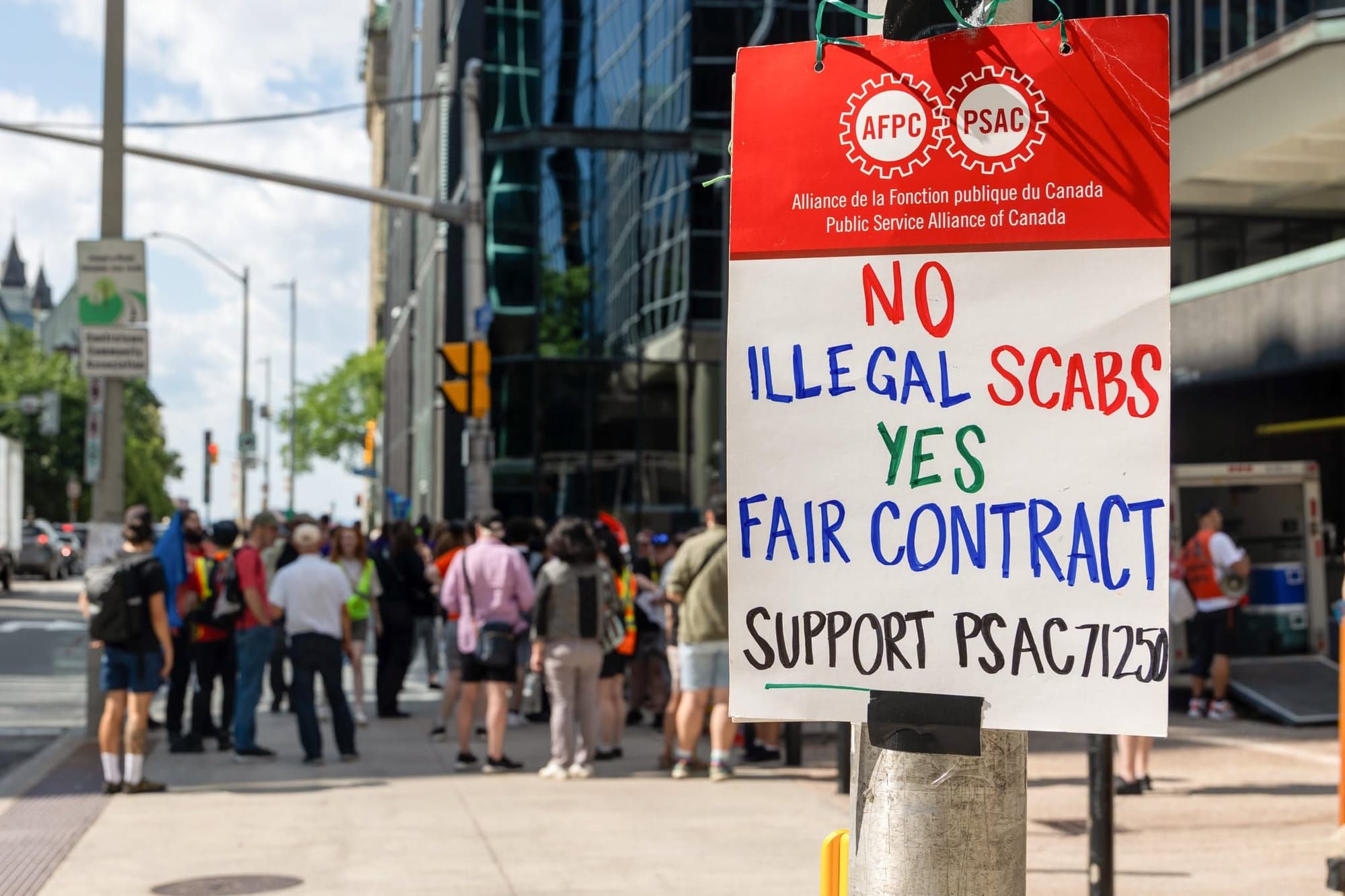

Winning a federal ban on scabs was a major victory for union members. It was supposed to increase workers’ bargaining leverage and help to rebalance the scales in federally regulated workplaces. Employers would no longer be able to simply hire replacement workers during legal strikes or lockouts, undermine the bargaining process, and prolong disputes until unions were forced to surrender. The law was supposed to mean what it said.
The Bank of Canada, however, appears determined to prove otherwise.
For more than a month, 49 security officers in Ottawa and Montreal represented by the Public Service Alliance of Canada (PSAC) have been engaged in a labour dispute with Canada’s central bank. The workers are seeking fair wages, stable schedules, secure benefits and protections against employer demands for concessions impacting seniority and maternity leave. The union also wants recognition of the additional duties regularly performed by members in Montreal, it told Class Struggle in a written statement.
Instead of bargaining seriously, the Bank escalated the conflict by issuing a lockout notice after months of failing to meet members’ concerns and reach a settlement.
Events since the lockout have quickly increased the stakes of the strike. The Bank of Canada has been employing private security guards as scabs to undermine striking PSAC members.
The labour action at the Bank has consequently become a major test of Canada’s still relatively new prohibition on the use of replacement workers. Twice the Canada Industrial Relations Board (CIRB) has concluded that the Bank of Canada has broken the law and ordered it to stop deploying scabs. As it stands, it remains an open question whether fines will be imposed.
This conflict has been building for months. In June, PSAC members at the Bank voted unanimously in favour of strike action after negotiations stalled. The union warned that management continued to demand concessions while refusing to address members’ concerns about compensation, scheduling and respect in the workplace.
The strike mandate reflected mounting frustration among security officers in Ottawa and Montreal who are responsible for protecting a central public institution.
Rather than treating the strike vote as an incentive to bargain, the Bank moved in the opposite direction. Shortly before workers were set to begin strike action in June, management issued their pre-emptive lockout notice. PSAC argued that the employer was attempting to weaken workers’ bargaining leverage while simultaneously preparing to maintain operations by using outside contracts.
The union’s concerns proved to be well founded.
Almost immediately after the strike began, PSAC filed complaints alleging that the Bank was violating the anti-scab provisions of the Canada Labour Code that came into force in June 2025. Those amendments prohibit federally regulated employers from using replacement workers during legal strike and lockouts, subject only to narrow exceptions designed to prevent imminent harm to public health and safety or serious property damage.
The reforms were widely celebrated by the Canadian labour movement and labour advocates after decades of campaigning against replacement workers, which have historically prolonged labour disputes, poisoned collective bargaining relationships, and undermined the constitutional right to strike.
In early July, the CIRB ruled that the Bank of Canada contravened the new Code provision by relying on contracted Garda security personnel as well as assigning bargaining unit work to a few PSAC members who crossed the picket line. The Code prohibits using contractors or bargaining unit members to perform struck work. This first decision ordered the Bank to stop using scabs within 48 hours.
Defying the order, the Bank instead switched contractors.
The union then returned to the CIRB with a second complaint alleging that the employer had replaced Garda personnel with contractors from Pinkerton Consulting & Investigations, one of the most infamous names in labour history. For well over a century, the Pinkerton name has been synonymous with strikebreaking, union surveillance and employer opposition to organized labour across North America.
Whether management appreciated the symbolism or not, hiring Pinkertons in the midst of one of the first few disputes under the new anti-scab law was an extraordinary decision.
The CIRB was also unimpressed. In a second ruling, released on July 22, the Board again concluded that the Bank had contravened the Canada Labour Code, this time by using Pinkerton contractors to perform bargaining unit work during the ongoing strike. Once again, it ordered the employer to cease using scabs.
The Bank responded by expressing disappointment, insisting that it believed it had complied with the law and indicating that it was considering “all of its legal options.”
Two rulings, two findings that the employer broke the law, and yet still no settlement or even a return to meaningful bargaining.
“It is deeply concerning to see a major Canadian institution repeatedly disregard workers’ legal right to strike,” PSAC told Class Struggle.
It is difficult to escape the conclusion that the Bank of Canada has behaved as though it is somehow above the law governing every other federally regulated employer (though there are other employers also looking for loopholes in the scab ban).
This current case is particularly striking given the institution involved. The Bank routinely emphasizes the importance of public confidence in its actions as well institutional credibility and adherence to legal frameworks in Canada’s financial system. Yet when faced with a legal strike by its own employees, it has instead sought to circumvent the law.
The CIRB decisions against the Bank could also have implications beyond this dispute or bargaining unit.
Every new labour law must eventually be interpreted against the events of actual disputes. Because the scab ban only came into force last year, relatively few cases have reached the CIRB thus far. The Bank of Canada lockout therefore represents one of the earliest and potentially most important precedents establishing how aggressively the Board intends to enforce the anti-scab regime.
Meaningful enforcement against the Bank, or other employers who break the anti-scab law, could signal that the replacement worker ban is more than symbolic. To prevent future transgressions, penalties must create a disincentive, otherwise employers will simply absorb them as a minor inconvenience or the cost of doing business and gaining the upper hand during a strike or lockout.
There is another revealing contradiction at the centre of this dispute.
As the strike unfolded, reports emerged that the Bank had significantly expanded remote work for many of its office employees because of the disruption to building security. In other words, when it became operationally convenient for management, employees who would ordinarily be expected to work on site suddenly found themselves working from home.
That flexibility stands in contrast with the federal government’s broader approach to remote work. Over the past two years, Ottawa has been insisting that public servants return to government offices despite sustained opposition from workers and their unions. The government’s return-to-office mandates have been justified with repeated claims about collaboration, productivity and workplace culture, even as evidence showed that hybrid and remote arrangements proved successful during the pandemic and improved work-life balance.
The Bank of Canada’s response to the strike demonstrates what many public servants have argued all along: remote work is often less a matter of operational necessity than managerial preference. When management’s own interests required fewer people in the building, remote work suddenly became entirely feasible. When workers themselves requested similar flexibility, government frequently insisted otherwise.
For the striking security officers, however, the central issue remains straightforward: they are demanding a fair collective agreement from an employer with substantial public resources and a legal obligation to bargain in good faith.
Instead, PSAC members have spent weeks watching their employer repeatedly test the limits of legislation specifically enacted to protect the integrity of legal strikes.
“PSAC remains committed to resolving this dispute and is ready to return to the bargaining table as soon as possible. We call on the Bank to abide by the Board’s rulings, stop using scabs, and negotiate a fair agreement,” the union said.
The outcome of this dispute will help determine whether the federal anti-scab law represents a genuine shift in Canadian labour relations or merely another reform whose effectiveness depends entirely on whether powerful employers choose to obey it.
So far, the CIRB has delivered a clear answer. The outstanding question is whether the Bank of Canada will finally accept that the law applies to it and reach a deal with its workers.
Recent Class Struggle Issues
- July 27 | WestJet Flight Attendants Are Ready To Make History
- July 20 | Manitoba Is Facing An ‘Epidemic’ Of Workplace Violence
- July 13 | Collective Bargaining Rights Are Being Undermined Across Canada
- July 6 | Uncovering The ‘Billionaire Coup Against Democracy’