

Nearly a year after Air Canada flight attendants forced unpaid work in the airline industry onto the national agenda, the issue is once again at the centre of a brewing labour dispute.
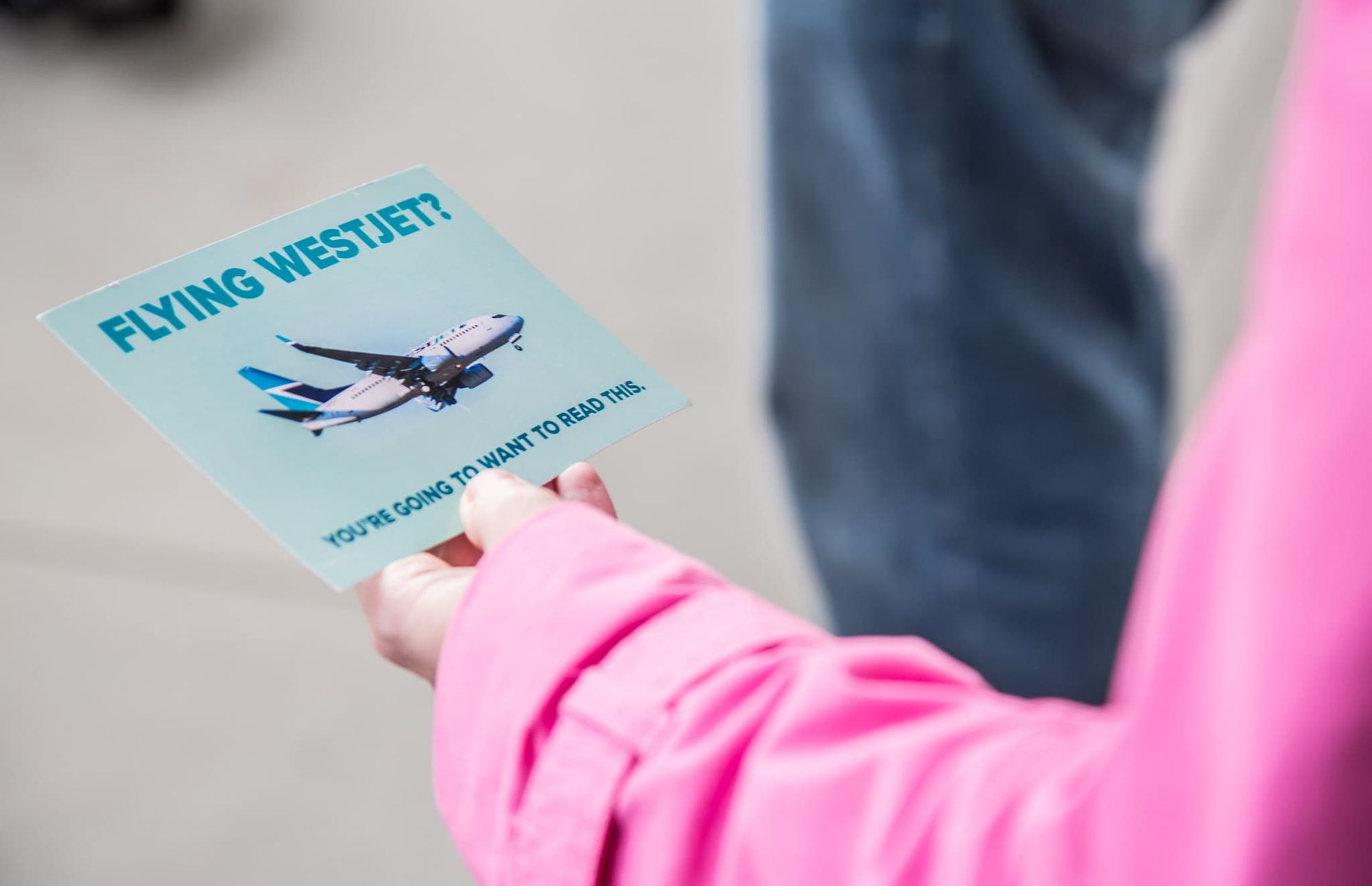
More than 4,400 WestJet flight attendants, represented by the Canadian Union of Public Employees (CUPE) Local 8125, have delivered an unmistakable rebuke to the company. On July 15, the union announced that 99.4 per cent of workers voted to authorize a strike, with a turnout of 97.3 per cent. As was the case with Air Canada flight attendants last summer, this is one of the strongest strike mandates in recent Canadian labour history.
The vote does not automatically trigger a walkout at WestJet, but it does authorize the union to call a strike with 72 hours of notice following a statutory “cooling-off” period. This puts the union in a position to hit the picket lines as early as August 2, over one of the busiest holiday weekends for air travel.
For airline workers, this is a dispute about much more than wages: it’s about challenging a compensation model that has normalized unpaid work as an industry standard for decades. It’s also about testing whether Prime Minister Mark Carney’s Liberal government will respect workers’ right to strike or intervene to do the bidding of the employer as it did with Air Canada last summer. Much is at stake.
Bargaining And ‘Cooling Off’
WestJet and CUPE have been bargaining since September 2025, after the union served notice to negotiate a new collective agreement. The previous contract expired at the end of 2025, and the parties entered conciliation this spring after negotiations failed to produce a settlement.
According to the union, negotiations have produced meaningful progress on a number of issues. Tentative agreement has been reached on language concerning discrimination and harassment, union flight release, accommodation, compassionate leaves, layoffs, recall and severance pay, and a range of administrative matters. The bargaining committee has described these as important gains that modernize the collective agreement and improve day-to-day working conditions for cabin crew.
But many of the issues of greatest importance to members remain unresolved.
The union says bargaining continues over issues related to compensation, job security, benefits, scheduling protections, health and safety, leaves of absence, and a host of other contract areas.
Above all, the central dispute concerns pay for work performed while aircraft are on the ground — a demand that has become a rallying point for WestJet workers and flight attendants across the industry.
The overwhelming strike vote reflects how central the issue of unpaid work has become. A nearly unanimous vote for job action signals extraordinary unity behind the union’s demand for change when it comes to how flight attendants are compensated.
WestJet, for its part, has attempted to downplay the significance of the vote, calling strike authorization a “common step” in the collective bargaining process and insisting it remains committed to reaching a deal that recognizes the work of cabin crews while maintaining the airline’s competitiveness.
Whether that optimism proves justified will depend on if the airline is prepared to move on the issue that has come to define bargaining throughout Canada’s airline sector.
The Fight Against Unpaid Work Continues
Thanks to CUPE’s years-long “unpaid work won’t fly” campaign, many more people are now aware of the wholly inadequate compensation system through which flight attendants are paid.
Under the industry’s long-standing, and increasingly outmoded, “credit hour” system, flight attendants are generally paid according to credited flight time rather than actual hours worked. A credit hour typically begins only once an aircraft pushes back from the gate, and ends when it arrives at its destination. Everything outside that window is compensated only partially or, in many cases, not at all.
As CUPE’s WestJet component explains, flight attendants typically report to work well before departure to conduct mandatory safety briefings, inspect emergency equipment, prepare the cabin, board passengers, assist travellers with disabilities, manage carry-on baggage, complete security procedures and respond to passenger concerns, all without receiving full compensation for this additional work. After landing, they continue assisting passengers, completing safety checks and securing the aircraft before their shift officially ends.
Delays make matters even worse. Flight attendants remain responsible for passenger safety and customer service throughout lengthy boarding delays and tarmac waits, yet much of this time either generates no additional pay or is compensated at a reduced rate. The result is that flight attendants perform dozens of hours of unpaid labour every month.
This pay system is a historical relic dating from a period when airlines treated cabin crew as an auxiliary service rather than the highly trained safety professionals they are today. Flight attendants in the modern airline industry are responsible in cases of emergency evacuation, medical incidents, security threats and for general regulatory compliance. Yet their compensation structure still assumes that their “real work” only begins when the aircraft starts moving.
This contradiction became impossible to ignore during last summer’s Air Canada strike and the government hearings held in its aftermath. Flight attendants at Air Canada likewise demanded payment for all hours worked.
Although the eventual settlement secured partial compensation for some ground duties, many workers remained dissatisfied with the imposed contract outcome. The strike then forced the issue onto the government’s agenda, resulting in a public consultation that disingenuously transformed the issue from one about whether flight attendants’ pay structure fairly compensates them for all hours worked into whether the airlines are in compliance with the minimum wage rules outlined in the Canada Labour Code.
It should be no surprise to anyone, WestJet executives included, that unpaid work is again a central issue in bargaining. It will remain so until the industry standard is changed and the unfair credit hours system is eliminated.
Will The Carney Government Intervene Again?
If negotiations fail, the most consequential question may not be what happens at the bargaining table but what happens in Ottawa.
During last summer’s Air Canada dispute, the federal government invoked its favourite tool for undermining workers’ rights: section 107 of the Canada Labour Code, which directed the Canada Industrial Relations Board to intervene and effectively end the strike. Labour organizations and legal experts widely condemned the move as yet another interference with workers’ constitutional right to strike.
The intervention also provoked enormous anger among Air Canada flight attendants, as the government’s overreach effectively removed their strongest bargaining leverage just as the campaign against unpaid work was gaining momentum and picket line pressure held the potential of forcing Air Canada to move. While flight attendants bravely defied the government’s return-to-work order, the settlement imposed from above proved lacklustre — a direct outcome of the Liberals’ heavy-handedness.
CUPE has already warned the federal government against recycling this script at WestJet, arguing that section 107 was intended for exceptional circumstances, not for ending politically inconvenient labour disputes.
Whether Carney’s government is prepared to intervene again remains an open question. The political calculation may be more complicated than it appears.
Interference at Air Canada generated sustained criticism from the labour movement and reinforced growing concerns that successive federal governments have become increasingly willing to curtail collective bargaining rights whenever large employers face disruption. For a government already facing criticism over its labour agenda from multiple angles, another strike intervention could be a bridge too far.
Public support also appears to be on the side of flight attendants. Last summer, workers’ frustration with the industry’s outmoded compensation model elicited understandable sympathy. Defending this relic in the face of worker hardship and a well-crafted union mobilization strategy proved challenging for Air Canada, which made government intervention on the latter’s behalf appear that much more unjustified.
By overwhelmingly voting to strike, WestJet flight attendants have already demonstrated extraordinary unity. The question now is whether the employer is prepared to negotiate seriously over unpaid work, or whether Ottawa will once again decide that upholding the right to strike is optional.
If the government again intervenes, the labour movement had better get serious about a co-ordinated response.
Recent Class Struggle Issues
- July 20 | Manitoba Is Facing An ‘Epidemic’ Of Workplace Violence
- July 13 | Collective Bargaining Rights Are Being Undermined Across Canada
- July 6 | Uncovering The ‘Billionaire Coup Against Democracy’
- June 29 | The NDP Is Trying To Close Rogers’ Anti-Scab Loophole