

For years, Manitoba’s labour movement fought to prevent employers from using replacement workers to undermine strikes. When the NDP government finally enacted anti-scab legislation in 2024, unions understandably celebrated it as a major victory.
But attached to that gain was a new essential services regime that gave the Manitoba Labour Board — and, crucially, the provincial government — considerably greater authority to determine what work must continue during a strike.
If the potential danger of those provisions wasn’t clear at the time, it certainly is now.
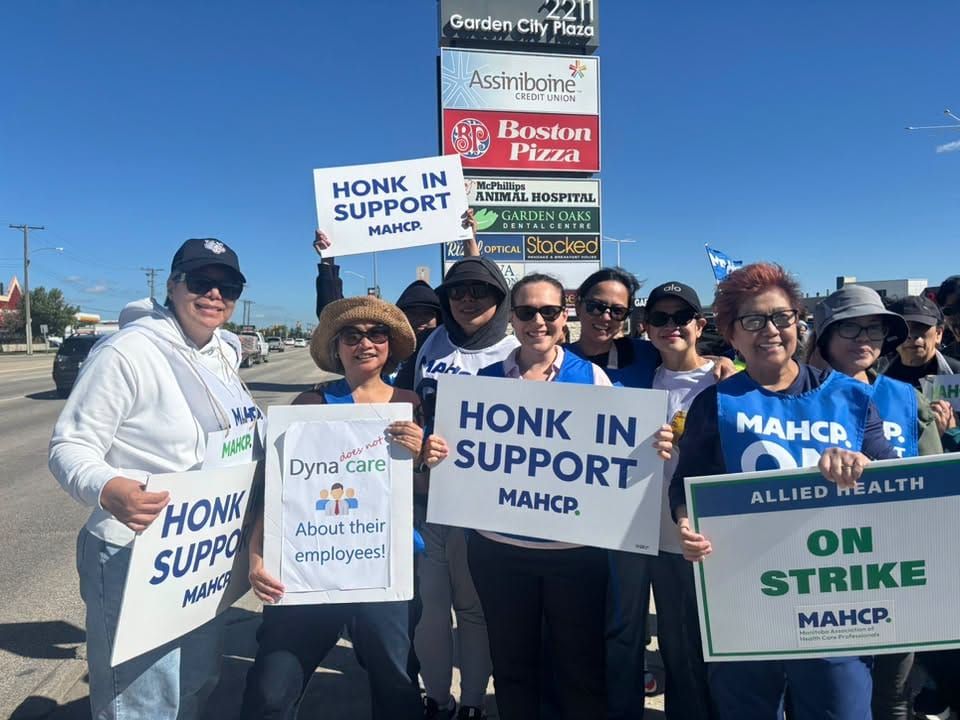
On September 8, about 350 laboratory technicians and technologists employed by Dynacare walked off the job after months of bargaining failed to produce an agreement addressing a massive wage disparity between the private company’s employees and laboratory professionals doing comparable work in Manitoba’s public health-care system.
Later that day, the Manitoba Labour Board ordered workers back to the job pending a final determination concerning whether their work is “essential.”
Perhaps most troublingly, this intervention occurred at the explicit request of NDP Labour and Immigration Minister Malaya Marcelino after both Dynacare and the Manitoba Association of Health Care Professionals (MAHCP) had already formally agreed months earlier that maintaining Dynacare services during a strike was unnecessary.
This case demonstrates how concessions related to essential services can provide governments with yet another avenue for interfering in collective bargaining precisely when a strike begins to impose meaningful economic or political pressure.
A Wage Gap Years In The Making
MAHCP represents nearly 350 laboratory technicians and technologists working at Dynacare’s 22 laboratory and health service centres in Winnipeg, Brandon, and surrounding communities, as well as its main Winnipeg processing laboratory. Together, these workers performed more than 15 million tests during the 2024/25 fiscal year, according to the union.
The previous collective agreement expired on March 31, with bargaining beginning in February and mediation starting in July after the parties failed to finalize a new contract.
The dispute increasingly centred on wages.
According to MAHCP, Dynacare laboratory professionals currently make between 20 and 50 per cent less than employees performing comparable work in Manitoba’s public laboratory system. The union says this gap has grown significantly since 2017.
The membership’s response was unequivocal. In August, 99.7 per cent of participating workers voted to authorize strike action.
In March, shortly after bargaining began, MAHCP and Dynacare jointly determined under Manitoba’s new essential services legislation that it was not necessary for Dynacare’s laboratory services to continue during a strike or lockout. The union noted that similar outpatient laboratory services were available through public hospitals and some public clinics. Under the new essential services regime, parties must file such a determination with the Manitoba Labour Board even where they agree that no essential services need to be maintained.
By late August, bargaining had moved through mediation and conciliation without resolving the wage dispute. Dynacare presented what the union described as an insufficient final offer, MAHCP countered and the employer ended conciliation.
Consequently, the union hit the picket lines Tuesday morning, briefly shutting down Dynacare’s facilities. Shared Health’s contingency plan redirected testing into other parts of the health system, prioritized emergency and time-sensitive testing according to clinical need, and extended hours at some public laboratories. Shared Health further said that less urgent testing could face delays but that critical services would continue, seemingly buttressing the parties agreement that no essential services were implicated.
Yet the strike still lasted barely a day.
The Essential Service Hurdle
The intervention that suspended the strike began the week before.
On September 1, MAHCP learned that Marcelino had applied to the Manitoba Labour Board asking it to determine whether Dynacare services should be considered essential. The union described this application as an attempt to force a reconsideration of the determination it had reached with Dynacare nearly six months earlier.
The significance of the minister’s move requires some background.
Manitoba’s 2024 labour law reforms prohibited the use of replacement workers during legal strikes and lockouts. But Bill 37 simultaneously established a province-wide essential services regime covering virtually all unionized workplaces.
Under section 94.3 of the current Labour Relations Act, services must continue during a strike or lockout to the extent necessary to prevent a threat to the health, safety, or welfare of Manitoba residents, maintain the administration of justice, or prevent serious environmental damage.
Unions and employers must first determine whether essential services need to continue during a work stoppage and file that determination with the Board. They must do so even if they jointly conclude that no essential services exist.
Where essential services are required, the parties must negotiate an Essential Services Agreement specifying the work that will continue and the number of workers necessary to perform it. A strike or lockout cannot legally begin until the ESA has been filed or settled by the Board.
This process can itself become a substantial legal and bargaining exercise. If the parties disagree over whether essential services exist, either party can apply to the Board for a ruling. Crucially, however, the labour minister can also make such an application to the Board if he or she disagrees with an ESA or with a determination indicating that no ESA is necessary.
That is the power the government invoked in the Dynacare dispute.
This expanded essential services framework agreed to in exchange for a ban on scabs now looks far less benign. While unions undoubtedly gained an important protection against employers using replacement labour to undermine strikes, the new system simultaneously opened the possibility of government interventions and the curtailment of the right to strike.
A similar bargain was embedded in the federal government’s anti-scab reforms. Federal Bill C-58 combined a prohibition on replacement workers with a revamped “maintenance of activities” process. Under the federal rules, unions and employers must reach an agreement within 15 days of notice to bargain about which activities, if any, must continue during a work stoppage. As in Manitoba, even an agreement that no activities need to continue must be filed. If the parties cannot agree, the Canada Industrial Relations Board decides.
Incidentally, this is precisely the power that then-minister of labour Seamus O’Regan exercised to delay a Teamsters rail strike before ultimately ending the subsequent work stoppage using section 107 of the Canada Labour Code.
The Dynacare case further demonstrates the danger of making essential service determinations an additional legal precondition to exercising the right to strike.
Every additional procedural hurdle creates another potential source of delay. Every disagreement creates another opportunity for Labour Board litigation. Canada already has one of the most restrictive rights to strike in the developed world. Further bureaucratic impediments are the last things workers need.
The Dynacare precedent should also worry unions contemplating what these powers could look like under a future government considerably more hostile to organized labour than the current NDP.
Labour Relations And The Costs Of Privatization
The immediate political damage is already apparent.
Following the Board’s interim order, MAHCP president Jason Linklater said there had been a “profound erosion of trust in this NDP government.”
“If government is willing to take away the rights of these laboratory professionals to save themselves money, then they will do the same to other Manitoba workers,” Linklater further noted.
In addition, this dispute is inseparable from the privatization and consolidation of Manitoba’s laboratory system.
Dynacare acquired Unicity Laboratory and X-Ray Services in 2017, becoming the sole private provider of community laboratory diagnostics in Winnipeg.
According to MAHCP, wages that had once been competitive with the public system subsequently fell dramatically behind. Meanwhile, documents obtained by the union through freedom-of-information requests show the province provided Dynacare with approximately $11.7 million in additional funding between 2018 and 2025, including a nearly $5 million top up following the previous round of bargaining in 2022.
According to the union’s calculations, this additional government funding was five to six times greater than what Dynacare workers received through wage increases over the same period.
That history complicates the government’s claim that its intervention is simply about protecting health care.
If Dynacare is so indispensable that allowing its employees to exercise their legal right to strike threatens the health and welfare of Manitobans, that raises an obvious question about why such an indispensable component of the health-care system is controlled by a private, for-profit company in the first place.
And if government believes continuity of laboratory services is so important, it has considerable leverage through its contractual relationship with Dynacare to insist that the company pay laboratory professionals wages capable of retaining them.
Although Manitoba’s Labour Board has yet to make its final determination about essential services at Dyancare, the precedent created by the government’s intervention is already troubling.
Anti-scab legislation was supposed to strengthen the right to strike by ensuring employers could not simply replace workers and continue operating. If the essential services machinery attached to that reform instead develops into another mechanism through which governments can interrupt strikes whenever they become economically or politically inconvenient, it will be a bitter outcome.
Union activists in Manitoba will need to consider how to respond. At minimum, solidarity with MAHCP members must be sufficient to put the government on notice that such intervention won’t be tolerated again. In the long term, a campaign to repeal the Labour Relations Act’s essential service requirements — or to limit the minister’s power to intervene — while a heavy lift, would help protect the right to strike in Manitoba and beyond.
Recent Class Struggle Issues
- September 7 | Here’s What Labour Day Is Really About
- August 31 | Trump And Carney Are Enemies Of Canadian Workers
- August 24 | SEIU Is Fighting For Justice For Toronto Janitors