

WestJet flight attendants have emerged from their brief strike with a tentative agreement that makes significant gains on one of the airline industry’s most persistent labour issues: unpaid work.
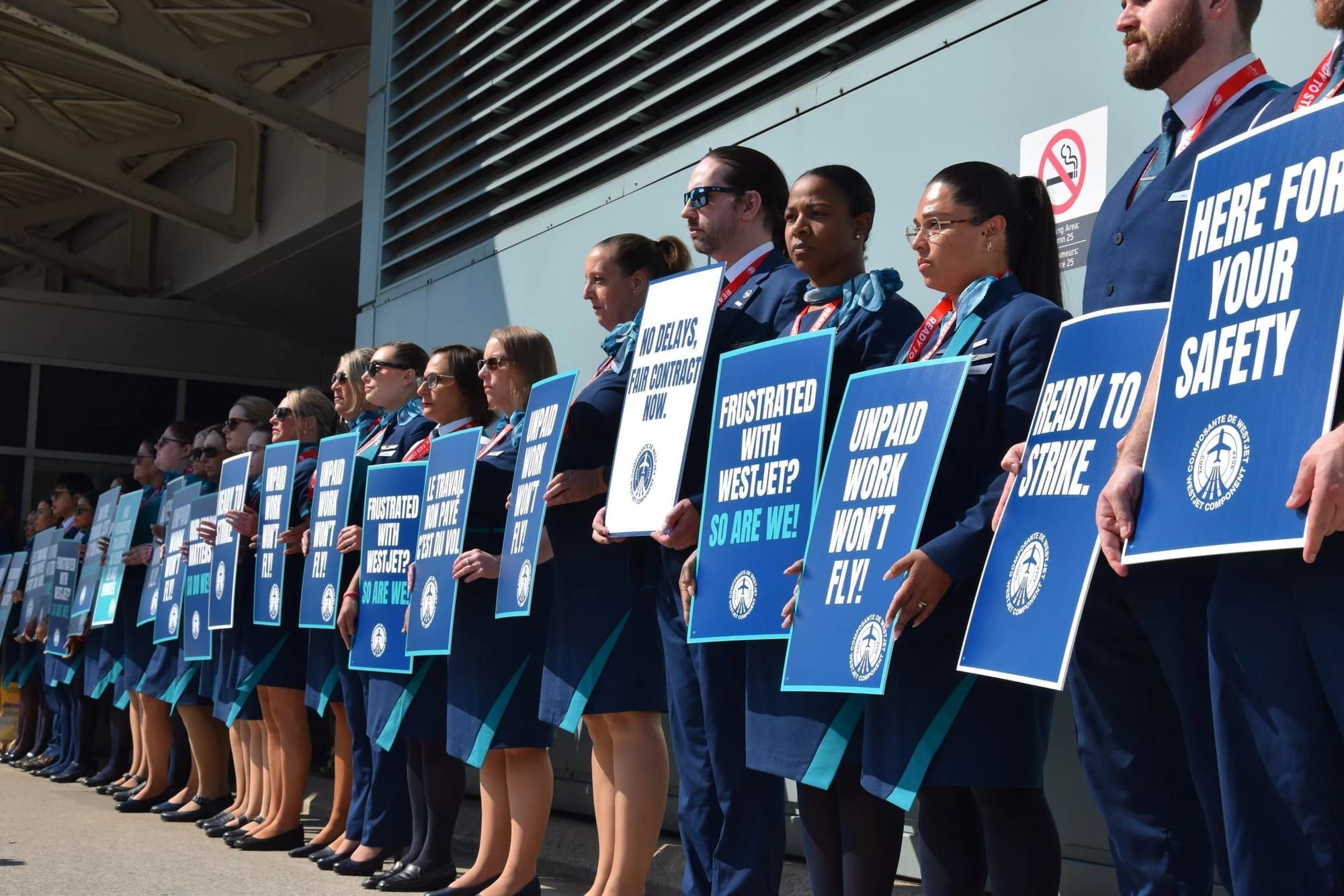
More than 4,400 flight attendants represented by the Canadian Union of Public Employees (CUPE) Local 8125 walked off the job shortly after midnight on August 2, grounding much of WestJet’s network during one of the busiest travel weekends of the summer. The next day, the union and company announced that they’d reached a tentative collective agreement.
The strike was short, but it appears to have been effective. Alongside substantial wage increases and improvements to sick leave, scheduling, union rights, health and safety protections, and other working conditions, the union negotiated a new Duty Period Premium (DPP) intended to compensate flight attendants for hours spent at work that aren’t captured by the traditional flight-credit system. By the end of the agreement, all qualifying uncredited duty hours will be included in the DPP calculation and compensated at half the employee’s regular hourly rate.
As CUPE 8125 president Alia Hussain said in a union press release, “This tentative agreement represents meaningful progress. It evolves the flight credit system by recognizing more of the work cabin crew are required to perform and with general increases to compensation for that work.”
It’s not a complete elimination of under-compensated work, but it’s a significant structural change to a system that has allowed airlines to benefit from flight attendants’ labour without fully paying for it.
From Bargaining To The Picket Line
As I wrote in this newsletter before the strike, WestJet flight attendants entered this dispute with an exceptionally strong strike mandate.
With the previous collective agreement expiring at the end of 2025, CUPE served notice to bargain and formally began negotiations last September. After months of meetings failed to produce a settlement, the union filed a notice of dispute on April 27, beginning the federal conciliation process.
By July, the two sides had made progress on several issues, but important disagreements remained over compensation, benefits, scheduling, health and safety, and job security. Most importantly, WestJet and the union remained divided over compensation for work performed while aircraft are on the ground.
Under the industry’s traditional credit-hour system, flight attendants’ principal compensation has been tied largely to flight time rather than total time on duty. Yet cabin crew report to work before departure, participate in safety briefings, inspect equipment, prepare cabins, board passengers, assist travellers and perform security and safety duties. They also continue working after landing, with delays substantially increasing this unpaid or poorly compensated work time.
Workers were clearly prepared to fight over the issue. In a strike vote held from July 8 to 15, 99.4 per cent voted to authorize job action, with 97.3 per cent of eligible members participating.
The vote put WestJet on notice that flight attendants were prepared to disrupt the airline’s operations to change how their work is valued.
A Short But Effective Strike
After last-minute bargaining failed to produce an agreement, flight attendants struck on August 2.
The impact was immediate: WestJet cancelled hundreds of flights as much of its network shut down. According to an aviation analytics firm, 922 of 2,365 scheduled flights were ultimately cancelled during the disruption, impacting about 250,000 travellers.
The strike barely lasted a day. Negotiations continued and, at 6:15 a.m. EDT on August 3, the union and WestJet announced a tentative settlement.
The short duration is worth considering in light of what happened at Air Canada last summer. During that dispute, the federal Liberal government invoked section 107 of the Canada Labour Code, leading to an order directing workers back to work and the dispute into arbitration. CUPE had already called on the government not to repeat such intervention this time.
As the WestJet strike approached, the federal government assigned a special mediator but declined to clearly say whether it would use section 107 again. Given the government’s penchant for interference over the past two years, neither the union nor WestJet could have been certain how long the Liberals would allow a national airline strike to continue.
As Steven Tufts, associate professor in York University’s Faculty of Environmental and Urban Change and co-ordinator of its global geography program, told Class Struggle, “In the air travel sector, the clock starts ticking toward a back-to-work order as soon as cancellations start piling up. CUPE knew they had no more than a day before a back-to-work order.”
In that context, there was considerable value for the union in converting the immediate pressure of a nation-wide shutdown into a negotiated settlement while workers still possessed maximum leverage, and before any heavy-handed government intervention.
What Flight Attendants Won
If accepted by members, the new collective agreement will run from Jan. 1, 2026, through Dec. 31, 2028. CUPE’s bargaining committee has unanimously recommended ratification.
The wage package secured in the deal provides for a 13 per cent across-the-board increase effective October 1, with retroactive compensation covering credit hours back to January 1 of this year. That will bring wages to between $32.63 and $60.58 per hour, depending on an employee’s length of service.
Wages will then rise another 2.75 per cent in January 2027 and 2.5 per cent in January 2028 — a compounded increase of more than 18 per cent over existing pay rates.
The union also made numerous other improvements. Full-time employees will be able to bank 24 sick days, up from 22. A new $300 annual health spending account begins in August 2027. The agreement adds or expands several statutory leaves and creates a maternity leave top-up program for the first time.
Union rights were also improved considerably. Company-paid union flight-release banks will rise from 1,200 to 2,100 hours for executive duties and from 2,300 to 4,600 hours for committees and other union work. WestJet will now pay 50 per cent of the minimum monthly guarantee for up to eight union representatives for a period of up to six months before the next contract expires so they can prepare for bargaining.
The new collective agreement will also increase the annual uniform replacement allowance from $350 to $375, add a $100 annual shoe allowance and raise reimbursement for lost or stolen luggage from $750 to $2,300. Recall rights following layoffs will increase from three to five years, alongside greater union involvement and additional protections during layoffs.
Health and safety language has also been strengthened in the new agreement, which includes increased representation on the policy committee, provisions concerning critical-incident support, and access to a system allowing flight attendants to monitor cosmic-radiation exposure.
Importantly, workplace violence has been explicitly added to the collective agreement alongside harassment and discrimination, while additional protections cover flight attendants who experience violence or harassment from passengers.
These provisions are especially notable given the recent settlement of a decade-long class action lawsuit against WestJet involving workplace harassment.
The case was launched by a former flight attendant in 2016 on behalf of female flight attendants who alleged WestJet failed to implement and enforce its promised harassment-free workplace. The British Columbia Court of Appeal eventually certified the case. WestJet has now agreed to a $4.5-million settlement covering 3,452 women who worked as flight attendants between April 2014 and February 2021. The settlement contains no admission of wrongdoing, but includes a third-party investigation into WestJet’s workplace harassment and reporting systems.
Julia Smith, an associate professor in the Labour Studies Program at the University of Manitoba who has studied the history of flight attendants’ union organizing, told Class Struggle that it’s common for such cases to take a long time to resolve and involve settlements that fail to fully compensate for the past damage.
As Smith put it, “It’s not surprising that in the 10 years it’s taken to settle the class action, WestJet cabin crew unionized, and in the most recent round of bargaining secured protections against workplace harassment and violence. Including these protections in the collective agreement will give workers more power to address workplace violence and harassment in the future.”
Not everything workers sought was achieved, however.
In response to workers’ desires for health benefit improvements related to massage therapy, mental health services and prescription drugs, the union explored moving members from their existing benefits program to a plan covering other WestJet employees. The bargaining committee ultimately concluded that the alternative plan failed to offer enough improvement to justify abandoning existing protections. Instead, the parties signed a letter of understanding allowing benefit discussions to continue during the life of the agreement.
The union also proposed joining the CAAT DBplus pension plan, with employee contribution options reaching 9 per cent and matching employer contributions. However, WestJet refused to establish a pension in this bargaining round, citing low member participation in an existing employee savings scheme.
Retirement savings will therefore need to be addressed in the future. As the union explained in its high-level summary of the contract for workers, “When members are struggling to cover rent, groceries and other basic expenses, contributing toward retirement may simply not be financially possible. Our goal in achieving higher wages was to help members move beyond merely surviving and create more disposable income so they can begin investing in their future.”
Another letter of understanding with the company commits the parties to continue discussing pension options while the new contract is in force.
These are significant, though unfinished, pieces of business.
Ending Unpaid Work
Perhaps the most innovative component of the settlement is the new DPP, meant to address the unpaid and under-compensated work flight attendants perform when planes are on the ground.
Beginning with the first full scheduling month after ratification, flight attendants will receive a temporary bridge payment based on the number of flight legs operated. On March 2, 2027, the permanent DPP compensation structure will start.
While the details are complex, the new payment system will ultimately see flight attendants at WestJet compensated for all qualifying hours worked when DPP is fully implemented.
The permanent system will work monthly. WestJet will total a flight attendant’s duty hours from report to release, then subtract the hours already compensated through flight credits and applicable guarantees. The remaining uncredited duty time then becomes eligible for the premium.
During 2027, 75 per cent of those uncredited hours will be compensated at 50 per cent of the employee’s regular hourly wage. In 2028, the proportion of uncredited hours rises to 85 per cent. On Dec. 31, 2028, it will reach 100 per cent. DPP earnings are also eligible for contributions under the WestJet Savings Plan.
As Tufts explained to Class Struggle, “The agreement is interesting as it is linked to the credit hour system, but will potentially compensate for all working time at a lower rate. If flight attendants are doing more work on the ground, they will attempt to increase ground rates beyond 50 per cent in the next round. Similarly, if ‘duty premium’ work is limited, they will want the credit hour rate increased. Overall, it’s a creative transition to compensating all time on the job.”
That last point is crucial. The settlement does not abolish the credit-hour system in favour of hourly wages, nor does it immediately compensate for every hour of work at the full flight-credit rate. It does, however, establish the principle that duty time outside traditional flight credits has monetary value and should be compensated, while protecting the advantages of credit-hour pay.
In an important respect, this appears to improve on what Air Canada flight attendants secured last summer. Their agreement provides a fixed ground-duty premium — 60 minutes on narrow-body aircraft and 70 minutes on wide-body aircraft — beginning at 50 per cent of the regular hourly rate and rising to 70 per cent by 2028.
WestJet’s formula instead reconciles total monthly duty time against credited hours and, by the end of the agreement, makes 100 per cent of the qualifying difference payable, albeit at only half the regular hourly rate.
That potentially makes the WestJet settlement an important development in CUPE’s broader campaign against unpaid work.
A Breakthrough, But More To Fight For
The tentative agreement isn’t everything WestJet flight attendants wanted — collective agreements rarely are. The benefit plan remains largely unchanged. A pension remains an objective rather than an achievement. Even when fully implemented, the DPP compensates previously unpaid time at only 50 per cent of the applicable hourly wage.
Those limitations will undoubtedly become bargaining issues again.
But collective bargaining victories should also be assessed according to whether workers change the terms on which future fights will occur. On that measure, WestJet flight attendants appear to have made substantial progress.
They turned an overwhelming strike mandate into a nationwide labour withdrawal. They did so without having their job action terminated by federal intervention. In the process, they secured a compensation mechanism that forces WestJet to recognize and compensate flight attendants for all of their working time.
Members are now receiving the full details of the settlement package through a series of union town halls. After having an opportunity to question their bargaining committee and examine the complete settlement, flight attendants will vote on whether to ratify the deal.
Whatever members ultimately decide, their strike has already helped move the industry-wide fight against unpaid work forward.
Last summer, Air Canada flight attendants forced the issue onto the national agenda. This summer, WestJet flight attendants have pushed it a step further.
Recent Class Struggle Issues
- August 10 | B.C. Workers Just Defeated Amazon In Court Again
- August 4 | Bank Of Canada Is Addicted To Illegally Using Scabs
- July 27 | WestJet Flight Attendants Are Ready To Make History
- July 20 | Manitoba Is Facing An ‘Epidemic’ Of Workplace Violence