

Amazon’s campaign to prevent a first collective agreement at its only unionized Canadian warehouse just suffered another legal defeat.
On August 4, the British Columbia Labour Relations Board (BCLRB) ordered that bargaining between Amazon Canada and Unifor Local 114 must be resolved through binding first-contract arbitration, accepting a mediator’s conclusion that the company, not the union, was responsible for the breakdown in negotiations. The Board also stripped Amazon of its right to lock out workers, rejecting the company’s argument that forcing arbitration would violate its Charter rights.
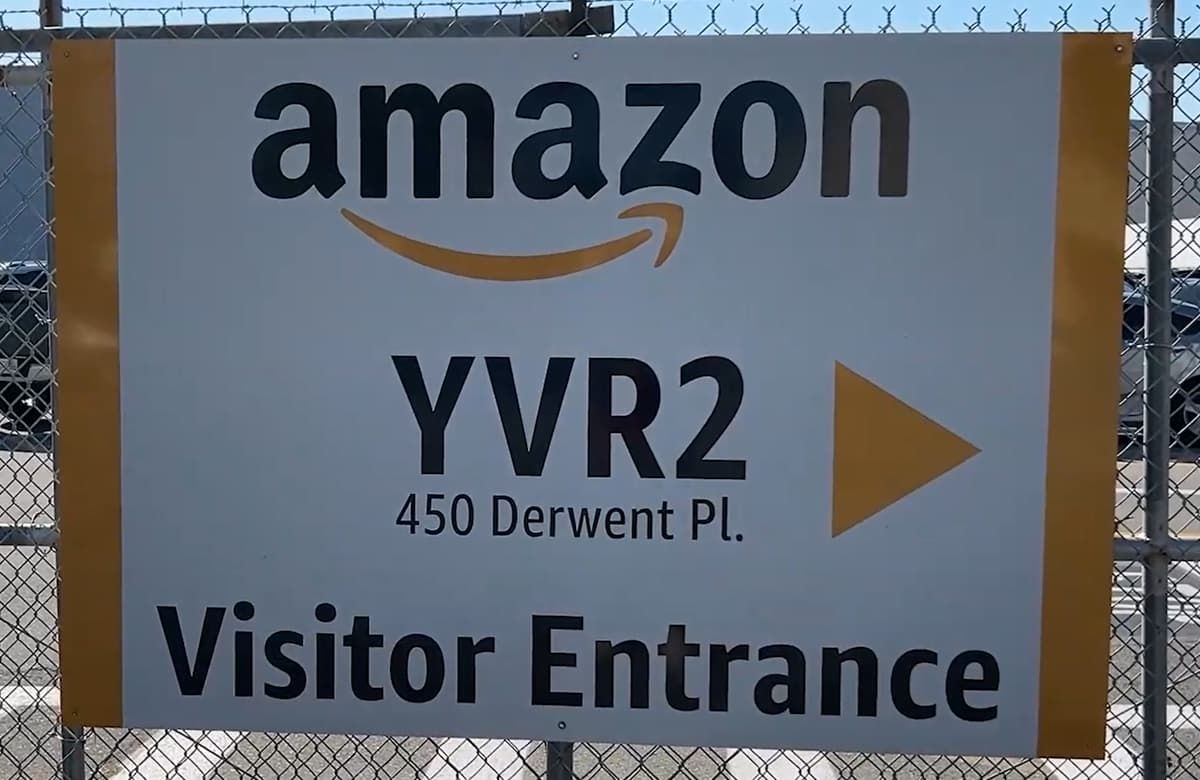
The decision is the latest in a string of Labour Board rulings against Amazon’s conduct at its Delta, B.C. (YVR2) warehouse. Over the past year or so, the company has been found to have unlawfully interfered in the unionization campaign, ordered to recognize Unifor through a rare remedial certification and ruled to have violated the Labour Code by denying wage increases to unionized workers — a decision expected to cost Amazon more than $1 million in back pay.
Taken together, these BCLRB rulings make clear that one of the world’s richest corporations is repeatedly testing the limits of Canadian labour law in an effort to avoid meaningful collective bargaining.
The Board’s latest decision brings Unifor members in B.C. one step closer to a first collective agreement. Should arbitration produce a first contract, it will be an important victory.
Amazon’s Year Of Foot Dragging
The arbitration order is the culmination of a difficult first year of bargaining.
Workers at Amazon’s YVR2 fulfillment centre became the first Amazon warehouse employees in Canada to win union certification after the Labour Board issued the extraordinary remedy of remedial certification in July 2025.
Rather than holding another vote, the Board certified Unifor because it found Amazon had engaged in unfair labour practices serious enough to undermine employees’ ability to freely choose union representation. Among other violations, the Board concluded the company’s hiring practices during the organizing drive were intended to thwart the certification effort by flooding the proposed unit with new employees.
This earlier decision represented a remarkable rebuke to Amazon’s conduct. Remedial certification is reserved for situations where employer misconduct has made a fair vote impossible.
Conflict with Amazon didn’t end with certification, however. Shortly after, the e-commerce giant withheld scheduled wage increases from employees at the Delta facility while granting raises to workers at its other Lower Mainland warehouses.
Earlier this year, the Labour Board ruled that decision violated Section 45 of B.C.’s Labour Relations Code, which prohibits employers from unilaterally changing wages or working conditions during the statutory freeze period following certification. The ruling is expected to result in more than $1 million in compensation for workers.
Meanwhile, bargaining itself moved slowly. Negotiations formally began in December 2025, but the parties remained far apart after months of meetings.
Unifor argued Amazon had adopted inflexible positions on core workplace issues while delaying meaningful progress toward a collective agreement.
Following the wage-freeze decision, the union sought first-contract mediation under the Labour Relations Code, arguing that continued bargaining had become futile.
The mediator, Mark J. Brown, ultimately agreed.
In his report to the Labour Board, Brown concluded that Amazon had caused the bargaining impasse. Among other findings, he noted Amazon insisted the union permanently surrender the ability to challenge production-rate expectations through the grievance procedure and informed the mediator it would “never” move from that position. Brown recommended that the dispute proceed to binding arbitration rather than allowing the parties to continue toward a strike or lockout.
The Board Opts For Arbitration
The August 4 decision largely accepts the mediator’s recommendations and delivers a comprehensive rejection of Amazon’s objections.
The company argued that arbitration shouldn’t be imposed because the parties hadn’t bargained long enough and because negotiations could still succeed voluntarily. Amazon maintained opportunities for compromise remained and that mandatory arbitration would improperly replace free collective bargaining with state intervention. (It’s a rare occasion when an employer like Amazon argues for free collective bargaining.)
The Board, however, disagreed with Amazon’s argument.
Instead, it found that the bargaining relationship had reached a genuine impasse and that further negotiations were unlikely to produce an agreement. More importantly, the Board concluded that the impasse resulted primarily from Amazon’s bargaining conduct rather than any failure on the union’s part.
The Code’s first-contract arbitration provisions exist precisely to address situations where normal bargaining has broken down in a manner that threatens employees’ ability to secure the benefits of union representation.
Amazon also raised a broader constitutional challenge.
The company contended that ordering arbitration and depriving it of the ability to lock out its employees infringed the freedom of association protected by Section 2(d) of the Canadian Charter of Rights and Freedoms.
According to Amazon, employers enjoy a constitutional right to use the economic pressure of a lockout during collective bargaining, and mandatory arbitration unjustifiably interferes with that right. (Again, it’s interesting to see Amazon making a case for protecting freedom of association, but desperate times call for desperate measures, I suppose.)
The Board also rejected this argument.
It concluded that first-contract arbitration is a longstanding statutory mechanism designed to facilitate meaningful collective bargaining rather than undermine it. The Labour Relations Code expressly authorizes the Board to direct arbitration when mediation fails and the statutory criteria are met. In those circumstances, the legislation also requires the parties refrain from strike or lockout activity while arbitration proceeds.
The Board further held that even if the Charter interests identified by Amazon were engaged, any limitation would be justified because the legislation pursues an important public objective (i.e., ensuring newly certified union members have a realistic opportunity to obtain a first collective agreement after choosing union representation).
The decision also rejected Amazon’s argument that arbitration would somehow reward the union or encourage strategic bargaining. Instead, the Board emphasized that first-contract arbitration is not punitive. Rather, it serves to restore balance where ordinary collective bargaining has been frustrated and to prevent employer misconduct or bargaining intransigence from undermining employees’ statutory rights.
In all, last week’s decision is a significant setback for Amazon. In practical terms, the ruling means an arbitrator — not economic pressure through a strike or lockout — will settle the terms of a first contract if the parties can’t do so themselves, which at this point seems highly unlikely.
The Stakes In Delta
What happens in B.C. will have significant implications for Amazon organizing across the country.
Amazon is widely recognized as one of the most aggressively anti-union multinational corporations operating in North America. Organizing victories have been exceptionally rare, and securing a first collective agreement has proven even more difficult.
What happened in Quebec remains a warning.
Rather than face the prospect of an arbitrated first collective agreement after workers unionized at a Laval warehouse, Amazon shut down its Quebec warehouse network entirely, eliminating thousands of jobs.
Labour organizations widely condemned the closures as retaliation against unionization, while the company insisted the decision reflected operational considerations. Whatever Amazon’s stated rationale, the message to workers elsewhere was unmistakable: organizing the company carries enormous risks even where relatively progressive labour law formally protects collective bargaining.
That reality underscores both the strengths and limitations of labour law.
The B.C. Labour Board has repeatedly demonstrated its willingness to enforce the law and protect workers’ formal rights. It certified the union when Amazon’s conduct undermined a fair organizing campaign. It ordered compensation after an unlawful wage freeze. Now it has concluded the company’s bargaining conduct warrants compulsory arbitration.
These decisions matter. They establish that employers — even one of the world’s largest and most powerful corporations — can’t simply ignore statutory obligations without consequence.
But the Quebec experience also demonstrates that legal victories alone don’t guarantee workers can exercise their rights. Labour boards can compel bargaining, award compensation and order arbitration, but they can’t easily prevent a corporation with enormous resources from restructuring its operations or punishing workers with capital flight.
Alongside favourable labour law decisions, there must be organized worker power.
The outcome of arbitration in B.C. will consequently be watched closely across Canada. If Unifor secures a meaningful first contract, it will provide a tangible demonstration that organizing Amazon can produce lasting improvements despite the company’s resistance.
A first contract would show that persistence, legal enforcement and collective action can eventually overcome one of the world’s most determined anti-union employers, even if the path to victory has been long and arduous.
Recent Class Struggle Issues
- August 4 | Bank Of Canada Is Addicted To Illegally Using Scabs
- July 27 | WestJet Flight Attendants Are Ready To Make History
- July 20 | Manitoba Is Facing An ‘Epidemic’ Of Workplace Violence
- July 13 | Collective Bargaining Rights Are Being Undermined Across Canada