


Labour Day is more than a day off work.
It should also be a day about work: to think about who performs it, who benefits from it and how much power working people exercise over the conditions under which it’s performed.
Workers quite literally hold society up. In the immortal lyrics of “Solidarity Forever”: “Without our brain and muscle not a single wheel can turn.”
Workers build homes and infrastructure, make and transport goods, care for the sick and elderly, educate children, grow and prepare food, maintain public services, and perform the countless other forms of paid and unpaid work that reproduce society from one day to the next.
Yet the people whose labour makes all of this possible exercise remarkably little control over the economy they sustain.
Labour Day offers an opportunity to insist that things could be otherwise. It’s a celebration of workers’ contributions, certainly, but it should also be an assertion of workers’ collective power and a reminder that virtually every meaningful improvement in working life has been the result of labour struggle.
The history of Labour Day in Canada itself makes this clear.
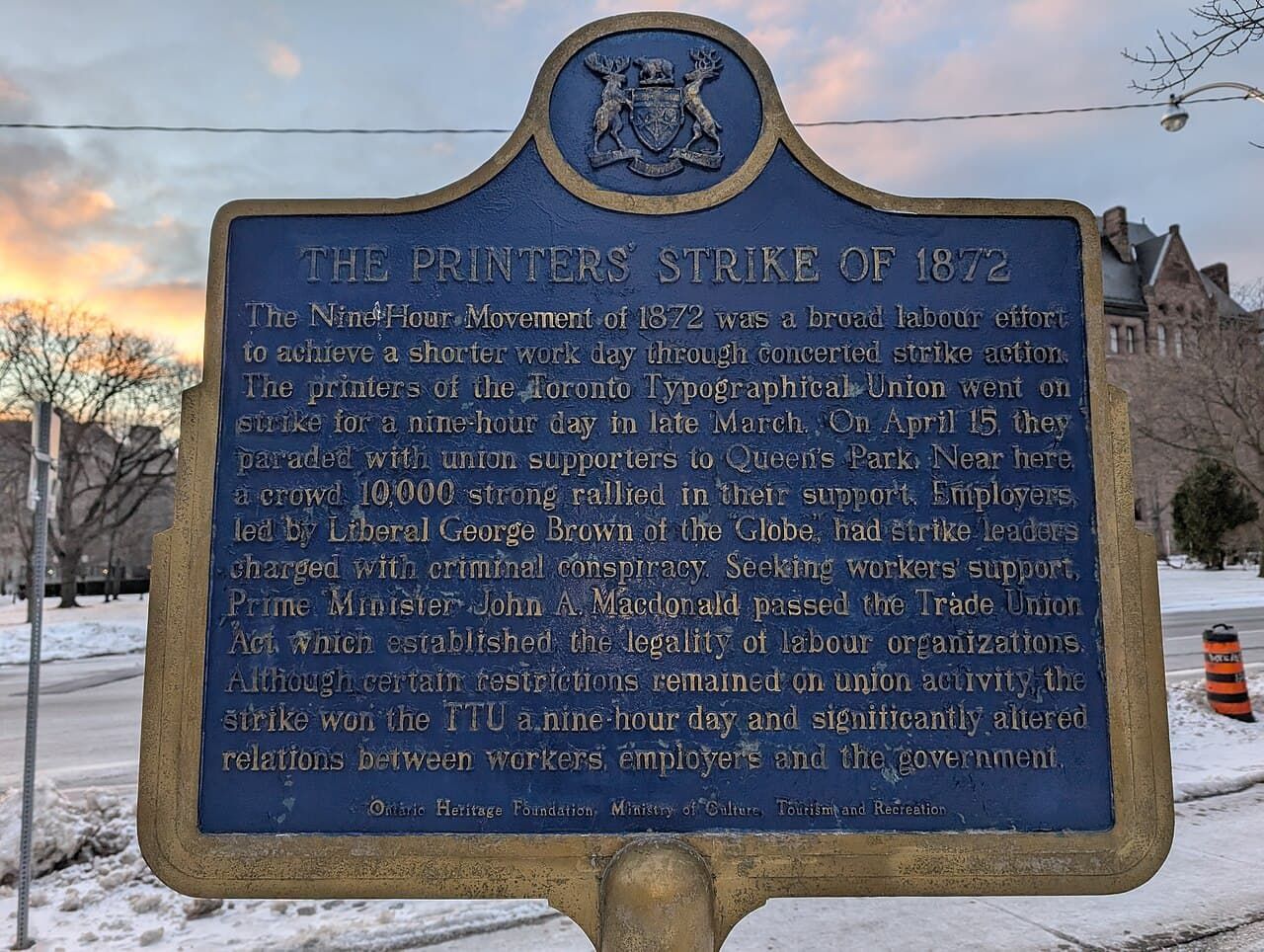
In 1872, members of the Toronto Typographical Union struck for the nine-hour workday. At the time, workers commonly laboured 10 or more hours per day, while trade union activity itself could still be prosecuted as criminal conspiracy. When Toronto publishers rejected the printers’ demands, workers walked off the job. Roughly 10,000 workers and supporters marched to Queen’s Park in solidarity with the strike.
Employers responded by hiring scabs and having strike leaders arrested. But the repression backfired. Days later, then prime minister John A. Macdonald introduced legislation that became the Trade Union Act, providing the first legal protection for union organization. The strike simultaneously helped propel the broader Nine Hour Movement, making shorter working time a defining demand of the emerging Canadian labour movement.
Annual workers’ parades subsequently spread across the country. They provided workers with opportunities to celebrate the dignity of their trades, but also to demonstrate organized labour’s growing social and political strength. In 1894, after sustained pressure from the labour movement, the federal government officially recognized Labour Day as a national holiday.
There is, of course, another side to this history.
By the late 19th century, May Day had emerged internationally as a more militant working-class holiday, associated with the campaign for the eight-hour day and increasingly with socialist and revolutionary politics. Establishing an officially sanctioned September Labour Day provided governments and more conservative sections of the labour movement with a respectable alternative.
Labour historians Craig Heron and Steve Penfold have documented how Labour Day developed as a complicated mixture of working-class solidarity, public respectability, and organized leisure. In this sense, institutionalizing Labour Day could help domesticate working-class politics, providing an officially acceptable celebration of labour in contrast with the more confrontational politics associated with May Day.
But recognizing this history doesn’t mean workers should surrender Labour Day.
Dismissing the September holiday as simply an establishment invention misses its deeper origins in working-class struggle. The appropriate response is not to reject Labour Day, but to reclaim its political meaning.
There remains plenty to fight for.
Most immediately, the right to strike remains under threat. The federal government’s increasingly interventionist approach to major labour disputes has generated serious concern among unions. Repeated government intervention threatens to transform the right to strike into something workers possess only until exercising it becomes economically or politically inconvenient.
Meanwhile, employers continue to find ways to circumvent conventional employment protections altogether. Statistics Canada estimates that 927,000 Canadians performed some form of work through a digital platform in 2023, while 468,000 were paid directly through a platform or app. Gig work raises fundamental questions about who qualifies as an employee and therefore who enjoys minimum employment standards, workers’ compensation protections, Employment Insurance, and meaningful access to collective bargaining. The fight to rein in this exploitative model is only beginning.
Immigrant and migrant workers also face an acute set of vulnerabilities. Canada continues to operate employer-specific work permits that tie many migrant workers’ authorization to work to a particular employer and thus systemically exposes them to abuse. As the use of temporary foreign work permits grows and spreads to other sectors, more migrant workers face exploitation.
But defending existing rights is not enough. Labour Day should also be a time for workers and unions to articulate demands capable of improving life across the entire working class.
Wages are a good place to start. The Organisation for Economic Co-operation and Development (OECD) defines low-paid workers as those earning less than two-thirds of median wages. Its comparative data have consistently placed Canada among countries with substantial levels of low-wage employment, with 19.5 per cent of full-time workers classified as low paid. An economy in which such a significant portion of the workforce can work full time without reliably attaining a decent living is an economy oriented around keeping labour cheap.
Unionization is another obvious place to start. StatCan reports that 30.6 per cent of Canadian employees were covered by collective agreements in 2025. The enormous public-private divide continues. As of last year, 77.5 per cent of public-sector workers had collective bargaining coverage, compared with just 15.1 per cent in the private sector.
Compare this with the Nordic countries. OECD data put union density at about 60 per cent in Denmark and 66 per cent in Sweden in 2024, with collective bargaining agreements covering 88 per cent of workers in the latter country. While some jurisdictions in Canada have returned to card-check certification to help more workers access collective bargaining, if Canada is ever going to fix its low private union density, it will need to adopt a form of sectoral bargaining to allow workers to negotiate standards across industries rather than workplace by workplace.
Labour could also re-centre the demand that gave Canadian Labour Day its origins: shorter working time.
More than 150 years ago, Toronto printers struck because they believed workers deserved more of their lives outside work. There is no reason that demand should be relegated to history.
Canada remains comparatively stingy when it comes to statutory vacation. In most provinces, workers receive just two weeks after one year of continuous employment, rising to three after some further specified number of years on the job. European Union rules, by comparison, guarantee workers at least four weeks of paid annual leave. Sweden mandates 25 days of annual leave, with many industry-wide collective agreements stipulating more. Similar comparative shortfalls exist between Canada and other advanced capitalist countries when it comes to sick leave, parental and caregiving leaves, and other forms of paid time off.
There’s no good reason that workers in Canada should accept spending so much more of their lives at work.
It’s time to demand shorter workweeks and workdays, substantially more paid vacation, stronger paid sick leave, and expanded family and other forms of paid leave. The four-day week, for example, could move from isolated experiments to a central labour movement demand.
These are also precisely the kinds of demands around which a renewed Labour Day politics could be built. Unions necessarily bargain for their own members, but labour movements are strongest when they fight for improvements that extend beyond individual bargaining units. This has been true throughout the history of the labour movement. Labour was instrumental in winning universal health care, public pensions, minimum employment standards, workers’ compensation, minimum wages and other reforms that raised the floor for the entire working class.
Shorter working time has the same potential. A legislated shorter standard workweek without reductions in pay would benefit union and non-union workers alike. More statutory vacation would do the same. So would universal paid sick days, higher minimum wages, easier access to unionization and employment protections covering workers regardless of whether an employer labels them employees, contractors, or gig workers.
There is something especially appropriate about placing working-time reduction at the centre of Labour Day. The Canadian holiday traces its history to workers who organized around precisely that demand. The printers of 1872 understood that workers should not have to surrender nearly all of their waking lives in exchange for a wage. They understood that technological and economic progress should mean more than greater output and higher profits for the bosses.
More than 150 years later, that principle remains unfinished business.
Labour Day should therefore be reclaimed as a moment for the labour movement to think beyond the boundaries of individual unions and collective agreements and formulate demands for the working class as a whole. Higher wages, broader collective bargaining, full rights for migrant and gig workers, a stronger right to strike, and more paid time off — these are class-wide demands from which all workers stand to benefit.
On Labour Day, we shouldn’t simply celebrate past victories or seek to protect them. We should organize to win the next ones.
Recent Class Struggle Issues
- August 31 | Trump And Carney Are Enemies Of Canadian Workers
- August 24 | SEIU Is Fighting For Justice For Toronto Janitors
- August 17 | WestJet Flight Attendants Have Won A Major Settlement