
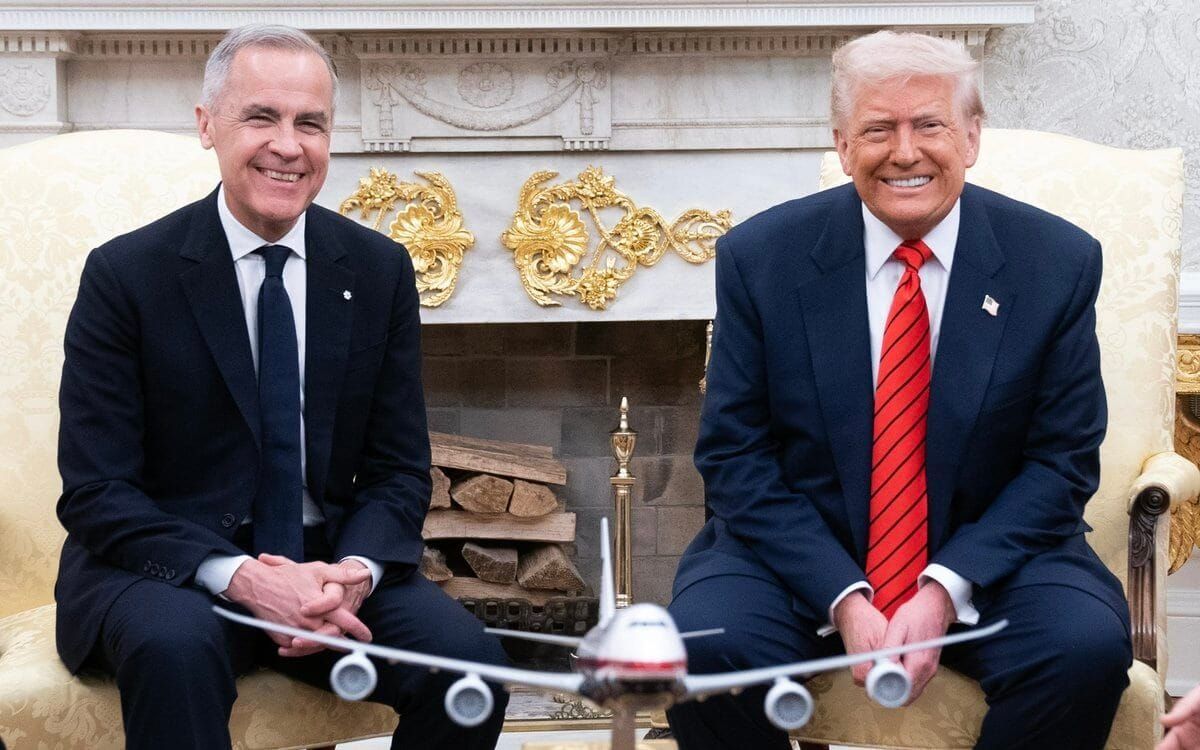

United States President Donald Trump’s trade war against Canada has entered yet another, more destructive phase.
After weeks of negotiations that at times appeared close to producing an agreement, the Trump administration imposed new 50 per cent tariffs on about $27.6 billion worth of Canadian goods on August 22.
The tariffs, imposed under a rarely used provision of the U.S. Tariff Act of 1930, cover a wide range of products and apply even to goods that would otherwise qualify for tariff-free treatment under the Canada-United States-Mexico Agreement. They come on top of existing U.S. tariffs targeting Canadian steel, aluminum, autos, lumber and other products.
The latest escalation followed the collapse of Canada-U.S. negotiations on August 21. Just days earlier, Prime Minister Mark Carney had said the two countries had made “substantial progress,” prompting Washington to postpone the tariffs for several days. But Carney ultimately pulled Canadian negotiators out of the talks, saying last-minute U.S. demands were “unfair” and “uneconomic.”
Trump has since threatened to double tariffs on Canadian cars, trucks and auto parts from 25 to 50 per cent beginning January 1. His administration’s message has been characteristically belligerent. On Wednesday, Trump said it was time to “teach Canada” a lesson.
Ottawa has responded in kind. Beginning September 8, Canada will impose dollar-for-dollar tariffs of 15, 25 and 50 per cent on $27.6 billion worth of U.S. imports, including steel, aluminum, dairy products, appliances, agricultural equipment, electronics, clothing, and furniture. The government has also announced another $7.5 billion in support for impacted workers and businesses.
There is little question about who stands to suffer most from this escalating conflict.
Workers on both sides of the border have already been paying heavily for Trump’s trade policies.
The Bank of Canada reported this spring that Canadian steel exports to the U.S. had fallen by half following the imposition of 50 per cent tariffs, while aluminum exports initially dropped 50 per cent below their 2024 level. Ontario government data show manufacturing employment down by more than 20,000 jobs amid the broader industrial downturn.
The casualties are also visible on factory floors. In December, Algoma Steel announced roughly 1,000 layoffs connected to its accelerated transition away from blast-furnace steel-making, citing the fundamentally altered market created by U.S. tariffs. GM’s elimination of the third shift at its Oshawa, Ont., assembly plant cut roughly 500 jobs, with Unifor estimating as many as 1,200 workers could ultimately be affected throughout the supply chain. The Stellantis plant in Brampton, Ont., meanwhile, remains in limbo after production of the Jeep Compass was shifted to Illinois and the company considers the permanent closure of the facility, which would impact more than 2,200 workers.
The latest round of tit-for-tat tariffs threatens considerably more damage. The Financial Accountability Office of Ontario previously estimated that U.S. tariffs could leave the province with 119,200 fewer jobs in 2026 than under a no-tariff scenario, including 57,700 fewer manufacturing jobs.
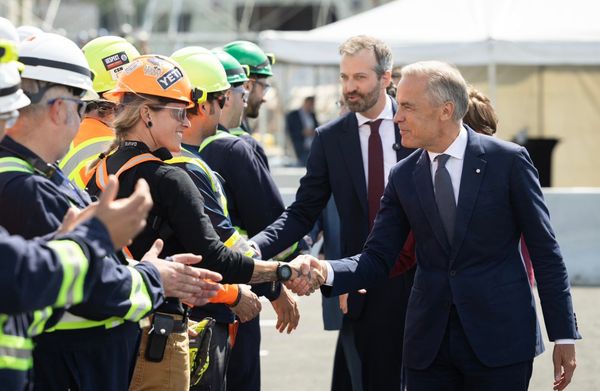
Unsurprisingly, Canadian unions have strongly condemned Trump’s escalation.
Canadian Labour Congress president Bea Bruske backed Carney’s decision to abandon the negotiations, arguing that Canada could not “bargain away our jobs, industries or economic sovereignty.” The CLC has nevertheless demanded stronger protections for workers as the economic damage mounts.
Unifor president Lana Payne similarly applauded Ottawa for refusing a bad agreement. Following the announcement of Canada’s counter-tariffs, the union called for expanded Canadian procurement, industrial strategies and substantially stronger income security. Unifor also pointed out that Ottawa’s latest Employment Insurance (EI) changes remain temporary and fail to fix major holes in the system, including inadequate benefit rates and access barriers facing part-time, seasonal, and precarious workers.
The United Steelworkers likewise supported walking away, with Canadian director Marty Warren insisting that “no deal is better than a bad deal” while calling for stronger measures to defend Canadian industrial capacity and employment.
The response from the Canadian Union of Public Employees (CUPE) to the broader trade war has gone further in questioning the politics of national unity. The union has warned explicitly against relying on “corporate goodwill,” arguing instead for expanded public investment, stronger income supports and the protection of public services. CUPE has correctly located Trump’s tariffs within a broader political project dominated by corporations and the wealthy rather than treating the conflict simply as one nation attacking another.
This is a crucial point that bears repeating.
Trump’s trade war is plainly an attack on Canadian workers. But it does not follow that workers should sign up uncritically for Carney’s revived “Team Canada.”
Indeed, Carney has explicitly described co-operation between Ottawa, the premiers and business as the “Team Canada approach” necessary to confront Trump. But workers should ask what exactly this team stands for and whose interests its captains represent.
While calling for solidarity against attacks from Washington, the Carney government is simultaneously eliminating tens of thousands of federal public service positions. Ottawa intends to shrink the federal workforce to roughly 330,000 people, approximately 38,000 positions below its 2023-24 peak, while extracting $13 billion in annual spending reductions.
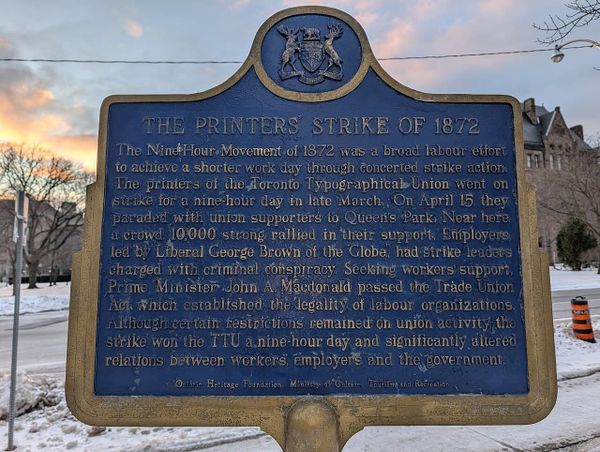
At the same time, the Liberals have been entertaining employer demands to weaken workers’ collective bargaining power. The federal government’s review of the Canada Labour Code has included proposals concerning restrictions on work stoppages and expanded intervention in bargaining. CUPE warned this spring that the process could see the Carney government “Americanize” Canadian labour law for the benefit of corporations, while Unifor argued that restricting strikes in the name of the “national interest” would violate workers’ constitutional rights.
Workers are being asked to rally around a government defending Canadian “sovereignty” against Trump while that same government contemplates restricting one of the most important means through which workers exercise power themselves.
Nor does Carney’s economic nationalism offer a progressive answer to the climate crisis. His government is advancing a proposed new west coast pipeline capable of transporting one million barrels of oil per day while simultaneously supporting expanded oil sands production. The Union of British Columbia Indian Chiefs has demanded that Ottawa and Alberta halt the project, warning that expanded fossil fuel production will intensify climate change and the disasters accompanying it.
And despite the supposedly existential threat posed by Trump’s tariffs, Ottawa still refuses to permanently overhaul Employment Insurance so that workers displaced by trade, technological change or ordinary corporate restructuring have dependable income protection. Unions have been sounding the alarm about the inadequacies of EI since the pandemic to no avail.
So while Carney’s “Team Canada” may present minor sops to labour, it’s clear whose interests are privileged.
Businesses may presently share labour’s desire to remove Trump’s tariffs, but the coincidence of interests ends there. There is every reason to expect business to use the trade crisis to intensify these demands.
Economic crises invariably produce arguments that workers must sacrifice to preserve investment and competitiveness. Wage restraint becomes necessary to save jobs. Environmental protections become “red tape” to be removed to get resources to market. Public spending becomes an unaffordable luxury. Strikes become irresponsible disruptions to fragile supply chains. Wasteful corporate subsidies become investments in our national survival.
The labour movement needs its own response to Trump, one based not on nationalism, but rather on working class independence and solidarity.
That means defending jobs and demanding active industrial policy, domestic procurement, and trade diversification. It means permanently strengthening EI, expanding public services and ensuring corporations receiving public support maintain employment and investment. It means refusing attacks on collective bargaining and the right to strike. Crucially, it also means building economic security without handing corporations a blank cheque.
Trump’s administration is an enemy of Canadian workers, but recognizing that fact should sharpen rather than obscure labour’s understanding of who its allies are at home.
Signing up to a corporate-led “Team Canada” in an effort to resist Trump’s erratic trade war can only produce short-term and likely minuscule reprieve. The deepening crisis will eventually be harnessed by corporate Canada and its political representatives to forcibly extract deep concessions from workers and the general public.
Yes, Trump and his administration are enemies that must be confronted. But Canadian workers also have plenty of class enemies right here in Canada.
These forces too must be resisted.
Recent Class Struggle Issues
- August 24 | SEIU Is Fighting For Justice For Toronto Janitors
- August 17 | WestJet Flight Attendants Have Won A Major Settlement
- August 10 | B.C. Workers Just Defeated Amazon In Court Again