

For decades, Walmart has been one of the most formidable anti-union employers in North America. The retail giant built its reputation on low prices, sophisticated logistics and an aggressive opposition to worker organizing. Union drives at Walmart stores repeatedly ran aground when they met fierce employer resistance, legal battles and, in some cases, outright closures.
That is what makes the recent contract victory by workers at Walmart’s distribution centre in Mississauga, Ont., so significant.
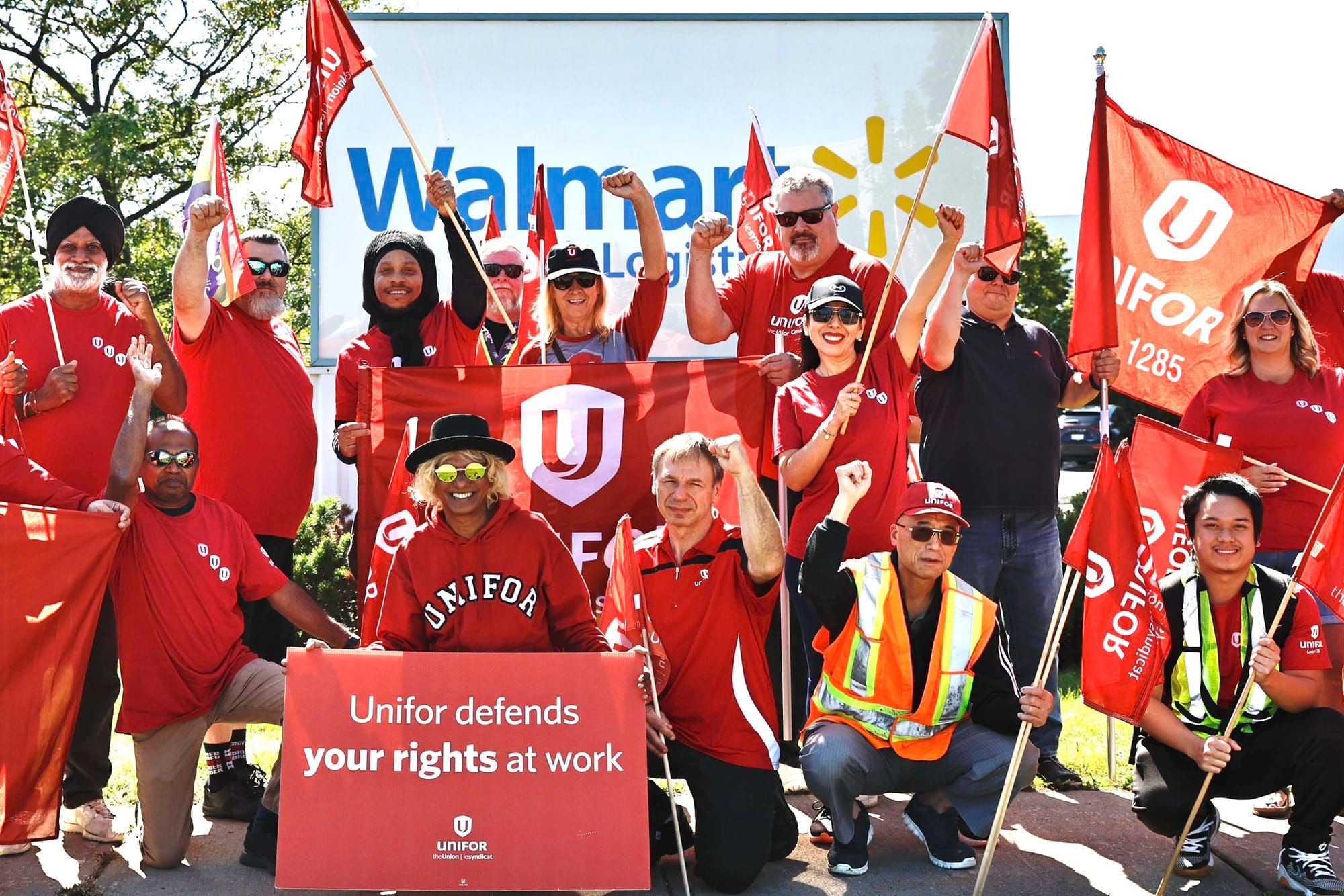
In May, more than 800 workers represented by Unifor Local 252 ratified the first collective agreement ever negotiated with Walmart anywhere in North America. The contract was approved by 93 per cent of members following an organizing and bargaining campaign that began with workers’ successful union certification in 2024.
But this victory is much more than a local bargaining success. It marks a breakthrough in one of the most strategically important sectors of the modern economy: warehousing, distribution and logistics. At a time when corporations like Walmart and Amazon increasingly depend on vast networks of warehouses and other logistics hubs to move goods, workers in Mississauga have demonstrated that even the most powerful multinational corporations can be organized and compelled to negotiate.
A Contract That Raises Standards
The new two-year agreement is more than just a foot in the door at Walmart: it delivers substantial economic gains for workers.
Unifor Local 252 members secured wage increases of up to $5 per hour in the first year of the deal, followed by an additional 3 per cent increase in the second year.
The contract also includes a “me too” provision, ensuring that unionized workers cannot fall behind if Walmart attempts to increase the wages of workers elsewhere as a union avoidance tactic. As Justin Gniposky, Unifor’s national director of organizing, explained to Class Struggle, “The ‘me too’ clause has really put us in a position where we can organize and bargain from a position of strength going forward.”
Relatedly, the agreement resolves an unfair labour practice dispute stemming from company-wide wage increases that Walmart provided to other warehouse workers while bargaining in Mississauga was underway. Under the settlement, union members will receive lump-sum payments ranging from $4,250 to $8,750.
Equally important are provisions aimed at limiting Walmart’s ability to divide the workforce and undercut standards through precarious forms of employment. The agreement imposes a cap on the employer’s use of short-term agency workers, a long-standing practice that reduces full-time jobs and overtime opportunities for regular staff.
The contract thus amounts to far more than a pay bump and some limited protections. It marks an effort to establish greater worker control over workplace standards, scheduling and job security inside a facility that serves one of Walmart Canada’s most important markets.
As Unifor national president Lana Payne put it, workers succeeded in “radically re-shaping fairness in the workplace.”
Taking On Walmart
The full significance of Unifor’s win in Mississauga can’t be appreciated without recognizing Walmart’s anti-union history in Canada, and North America more broadly.
For years, the retail giant cultivated a well-deserved reputation as one of the most union-resistant employers on the continent. Workers have attempted to organize dozens of Walmart locations across Canada and the United States, frequently encountering boss fights as sophisticated as they were brutal.
In Canada, Walmart’s most notorious confrontation with organized labour occurred in Jonquière, Que. In 2004, after retail workers successfully unionized with the United Food and Commercial Workers (UFCW), the company responded by closing the store and eliminating hundreds of jobs. Years of litigation followed, culminating in a Supreme Court ruling that found Walmart had violated workers’ collective bargaining rights.
Another unionized store in Gatineau, Que., also eventually decertified after an arbitrated contract was imposed. This episode reinforced the perception that Walmart would go to extraordinary lengths to resist bargaining a contract and would work tirelessly to be rid of any arbitrated deal.
This history loomed over the Mississauga campaign. As Gniposky said, “I’d be lying if I said I know with certainty that we’d end up here with a really meaningful first collective agreement, given Walmart’s past fights against union stores.”
Gniposky further chalked this victory up to the efforts of workers themselves, who initially contacted Unifor about organizing. “It’s 100 per cent a testament to these workers. From the beginning, they were committed and that’s why we were able to focus in on this facility. The card signing campaign was about nine months long. We won the vote, and then we moved through bargaining. We knew that warehousing logistics is where we wanted to be.”
He also underlined the importance of Mississauga Walmart workers winning a contract at the bargaining table. “We had a strong bargaining committee and a really sound bargaining strategy. It took longer than we would have liked, but we got there, and we put Walmart in a corner where they knew they might end up with an imposed contract. So we think it’s important to bargain that without binding arbitration, that workers were able to win it. Now we’re going to try and build from this.”
Unlike a single retail store, a high-volume warehouse is much more difficult to replace or relocate without significant disruption to operations, particularly when it serves an enormous market like the Greater Toronto Area. That strategic position gave workers and the union leverage that previous retail organizing drives often lacked.
As many labour analysts have argued, workers possess the greatest economic power where they occupy critical chokepoints. Increasingly, those strategic points of leverage are recognized to be in the logistics hubs that undergird the modern digital economy.
Gniposky put it this way: “There’s a few things that aren’t going to go anywhere and warehousing and logistics is one of them. Unions, including my own, are recognizing that.”
Warehouse Workers Unite
The Mississauga Walmart victory didn’t emerge in isolation. Rather, it forms a part of Unifor’s broader effort to organize warehousing and logistics workers through its Warehouse Workers Unite campaign.
Launched in 2021, the initiative is designed to respond to the pressing needs in the sector — relentless productivity demands, health and safety issues, low wages, precarious employment, and the increasingly invasive surveillance experienced by workers — and to build organized worker power.
The campaign further reflects the union’s analysis that warehousing has become one of the most important battlegrounds in the Canadian economy.
According to Unifor’s research, employment in the warehousing industry has grown dramatically over the past decades as e-commerce, online retail and increasingly complex supply chains have transformed how goods move from production to consumption. Major warehouse clusters have been concentrated in populous centres such as the Greater Toronto Area, Metro Vancouver and Montreal. Mississauga and Brampton, Ont., with concentrated workforces of racialized and often immigrant workers, have become particularly important logistics hubs. According to Gniposky, the union has evolved its organizing strategies to meet these changes, providing union information in multiple languages and drawing on workers’ personal networks to build trust and support.
Yet despite the warehouse sector’s growth, union density remains relatively low at 14.2 per cent, in large part due to fierce employer resistance. Firms frequently rely on subcontracting, temporary staffing agencies and contract-flipping, strategies that undermine employment quality and fragment the workforce, while also making union organizing more difficult.
For Unifor, increasing union density and worker power in warehousing is not simply about improving individual workplaces: it’s about reforming the sector and establishing industry-wide standards capable of transforming what are often precarious jobs into stable, well-compensated unionized employment.
As Gniposky described it to Class Struggle, “I think this should send a message to warehouse and logistics workers particularly, but also workers across North America in general, that regardless of who your employer is, you can achieve a meaningful collective agreement.”
The Walmart contract provides a concrete example of what a strategy built on worker organizing can achieve.
Expanding The Fight To Amazon And Beyond
The critical challenge remains replicating the Walmart win elsewhere. The obvious target is Amazon, where Unifor now has a foothold in British Columbia.
Like Walmart, Amazon has built its business model around highly integrated logistics networks and sophisticated warehousing operations. Workers the world over have complained about and fought back against Amazon’s ruthless production quotas, omnipresent surveillance regime, and combative anti-unionism.
While Unifor’s certified bargaining unit at Amazon in B.C. is an important first step, its contract victory at Walmart in Mississauga takes things a step further. Workers now have a living contract as an example to demonstrate what bargaining can achieve. The Walmart contract shows that it’s not only possible to organize a major logistics facility operated by a notoriously anti-union employer but also to win a collective agreement.
As Gniposky said, “We really need to take on these companies like Walmart and Amazon. Twenty years ago, it would be like, ‘Oh that could never happen.’ Well, here we are in 2026 and we’ve not only won a first collective agreement, but it’s a meaningful first collective agreement.”
Of course, no single contract transforms an industry overnight. Walmart remains a massive corporation with enormous resources and is sure to learn its own anti-union lessons from Unifor’s win. Moreover, the warehousing sector remains fragmented and under-organized. Employers like Walmart and Amazon will also continue to invest in labour-displacing technology designed to weaken worker bargaining power and threaten the jobs of those brave enough to fight back.
But as Gniposky put it, “This one collective agreement at Walmart — and when we get one at Amazon — is not enough. We need to keep building to ensure that density amongst these employers increases and we get to a majority of workers. That’s our goal and we welcome partners in the labour movement to join with us because it’s not just a Unifor fight, it’s a labour movement-wide fight.”
As Unifor recognizes, labour victories like those at Walmart and Amazon can have consequences far beyond the workplaces where they occur.
The first auto and steel contracts built industrial unionism, and the first contracts in telecommunications and airlines helped establish standards that spread across those industries. The significance of the Walmart agreement lies not only in what it delivers to 800 workers in Mississauga, but also in what it signals is possible to tens of thousands of warehouse workers across Canada.
Recent Class Struggle Issues
- June 9 | Ottawa Is Plotting New Ways To Contain Worker Power
- June 1 | Ontario’s Social Service Workers Have Had Enough Of Doug Ford
- May 23 | Montreal Sex Workers Are On Strike This F1 Grand Prix
- May 18 | The Left Has Failed To Confront Canada’s Resurgent Right